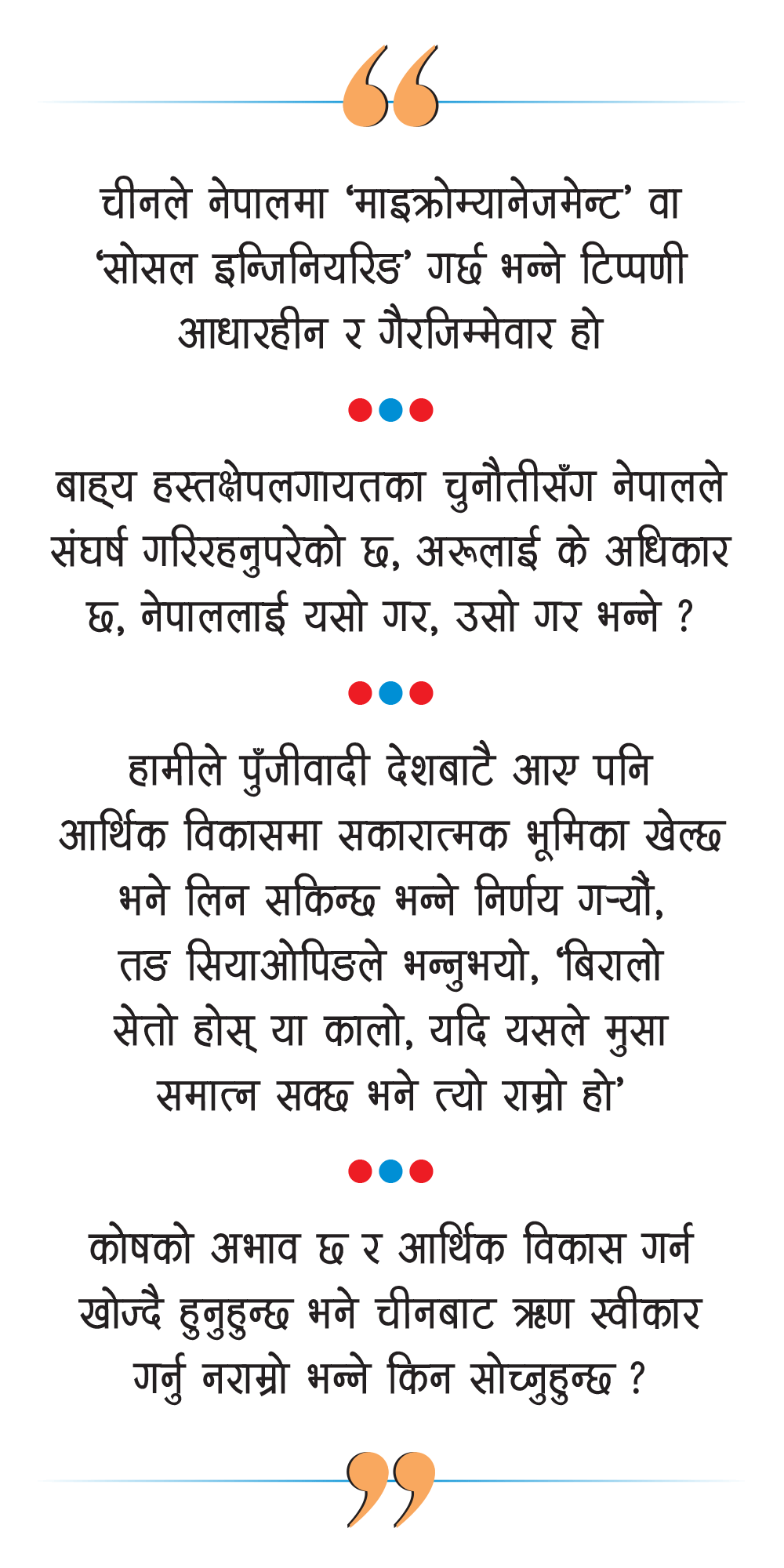
The comment that China is 'micromanaging' or 'social engineering' in Nepal is baseless and irresponsible.
We use Google Cloud Translation Services. Google requires we provide the following disclaimer relating to use of this service:
This service may contain translations powered by Google. Google disclaims all warranties related to the translations, expressed or implied, including any warranties of accuracy, reliability, and any implied warranties of merchantability, fitness for a particular purpose, and noninfringement.
During Prime Minister KP Sharma Oli's visit to China last month, Nepal reached an agreement on the 'BRI Framework'. This has now laid the groundwork for the BRI project to proceed. However, there is still a debate going on whether Nepal will take a loan or not.
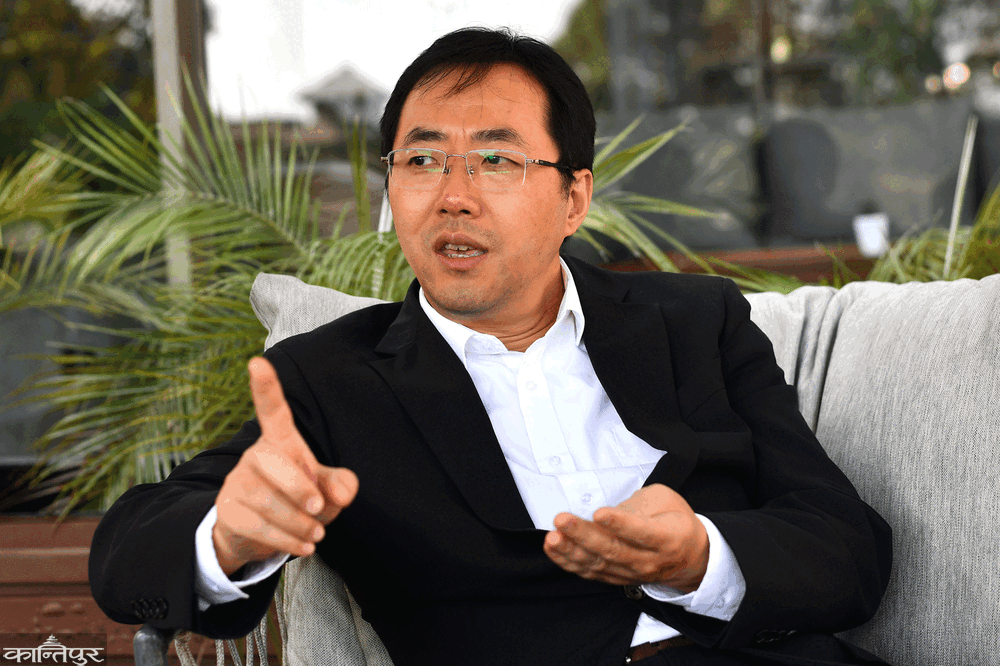
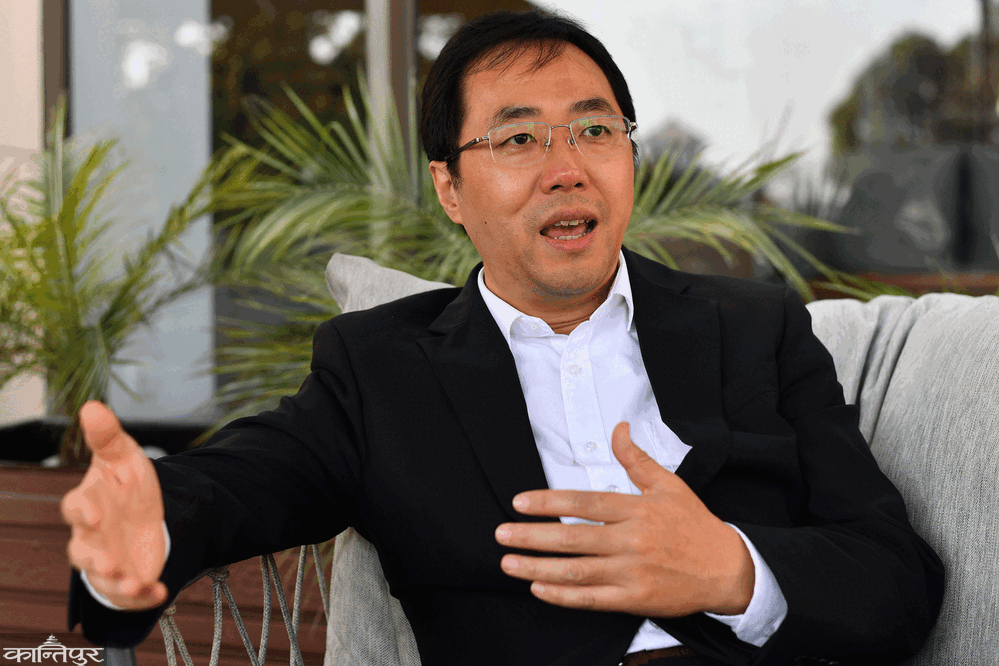
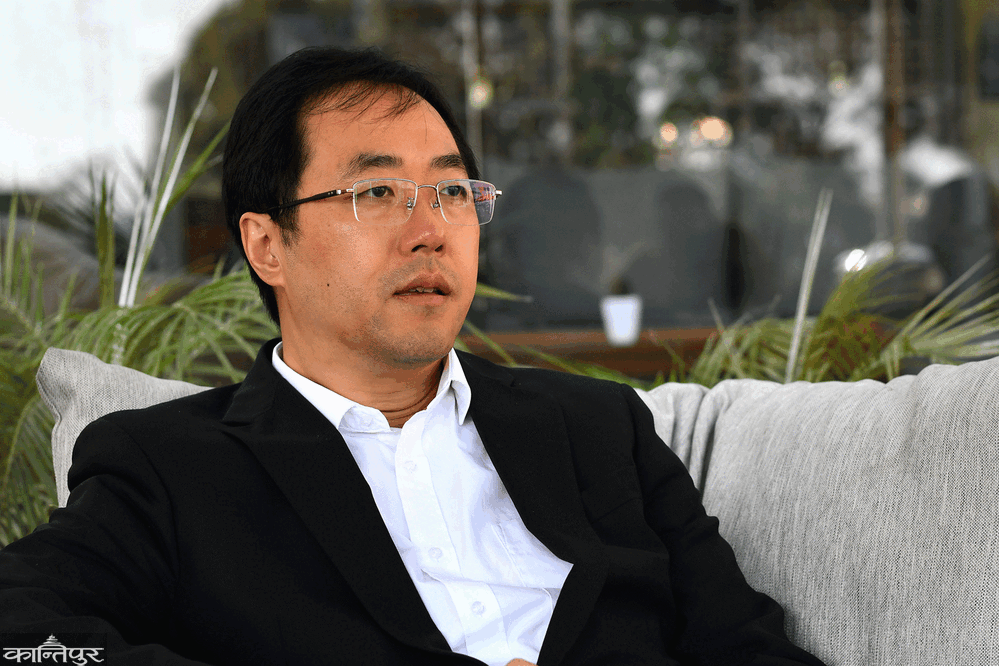
In this context, Professor Eunsong Hwang who is also assistant dean of China's Sichuan University International Studies Center and co-director of the Institute of South Asian Studies, who visited Nepal two weeks ago Durga Khanal of Kantipur and Upendraraj Pandey Talk by break :
How do you remember the historical relationship between Nepal and China?
I think this is a diplomatic kind of question. When we reflect on the history of bilateral relations, there are many positives. I believe, Nepal and China have always been good neighbors for 99.99% of our bilateral relations. We are aware of this beautiful mountain country. Nepal has also contributed to China's cultural prosperity. Many engineers who went to China from Nepal have helped to build beautiful and magnificent buildings. And, the princess of Nepal also went to Tibet and Xi Chang in China. So this relationship has always been good in my memory. Perhaps only one/two incidents have gone down in history as unfortunate.
Especially since the establishment of diplomatic relations, China and Nepal have become good partners. In this context, Nepal's national interest, national security, sovereignty and economic development have always been in our focus. As beautiful a country as Nepal is, Nepal should get an opportunity for rapid development. Unfortunately, Nepal has to struggle with various problems, external interference and other challenges. China has 14 neighboring countries. Among them, Nepal is one of our best neighbors.
You said that Nepal should have an opportunity for economic development. Now China is expanding the Belt and Road Initiative (BRI) globally. Nepal is also included in it. What exactly is BRI? Is it just a focus on economic infrastructure development or is it also China's strategic effort to expand its global influence?
The BRI was launched in 2013 by President Xi Jinping. We have had detailed discussions and conversations with various parties about this. Let me be clear, this is an economic initiative. The focus is on infrastructure development, connectivity, industrial promotion and social harmony. We often hear that BRI is a 'strategic initiative'. My argument is that we are building roads, bridges, airports, tunnels and industrial parks. Tell me, how can China use those infrastructure projects for military purposes? We are building these infrastructures for local economic development. Furthermore, when these developments reach a certain level, there can be strategic implications.
Our main objective is to connect the world. Which provides an opportunity to develop the economy of the countries involved in it, increase exports and expand the capacity of industrial production. Our goal is to help make a country like Nepal more powerful and independent. Nepal will also have the power to stand up against unequal needs, wrongdoing by third parties and undue external pressure on the country. There will definitely be strategic implications but in a positive sense.
s need to be independent. You will have to make your own decisions. What right do others have to tell Nepal to do this or that? If Nepal can become truly sovereign, independent, prosperous and harmonious, then in this sense it is also of strategic importance for Nepal.
During Prime Minister KP Sharma Oli's recent visit to China, Nepal has accepted the 'BRI Framework'. How do you see this agreement and how will it be implemented in the future?
This agreement on BRI is a historic achievement. But it is not without difficulties. Since Nepal signed the BRI in 2017, the progress so far has been very minimal. Don't think otherwise, we are very disappointed to see this. China is a liberal country. As we develop, we want our neighbors to develop as well. We want to exchange good and beautiful things with each other and make people's lives better.
Nepal is in a very good condition. It has a beautiful natural landscape. We don't have these things in China. Nepal can send organic agricultural products to China. But due to limited capacity, we are ready to help. On the one hand, this will make Nepal very strong economically. On the other hand, Chinese consumers can also benefit from Nepalese products. Both parties will benefit from this collaboration. It is 100% good initiative. This will not only help Nepal but also benefit the Chinese people.
I don't think that under any pretext, Nepal will hesitate to move forward and get involved in arguments and disputes within itself. We have tabled very good offers. But if they hesitate to accept this proposal, it will be unfortunate for Nepal.
There is a big debate that Nepal cannot afford the loans coming through BRI. But Nepal has accepted the 'ad financing' model under the BRI agreement. What is the 'ad financing model'? How is this different from conventional loans?
When talking about loans, credit lines or grants, I tell a story from China's experience. China decided to adopt an open policy since 1978. China was very poor at that time. Our industrial base had been established since the 1950s but there was not enough money. At that time, we accepted loans, credit lines and grants from Western countries. Because they were rich. They had additional funds available to develop us.
There was a wide discussion about whether to accept money from the West or not. Finally, we decided that even if it comes from a capitalist country, it can be accepted if it plays a positive role in economic development. Our leadership, especially Tang Xiaoping, said, "Whether a cat is white or black, if it can catch a mouse, it is good." The same situation has happened in Nepal. Why do you think accepting a loan from China is bad when you are short of funds and trying to grow your economy? Not only loans, grants can also play a positive role. In China, we accepted much more loans than grants and built them with funds. We have become prosperous by taking the right path of economic development.
We worked in a planned, efficient and scientific manner, thereby generating more revenue and returning interest to Western financial institutions. This is a positive cycle of long-term growth. Grants play a very minimal role in this regard. This is the story of China. Now think for yourselves and decide, is grant or loan better? We have put our packages on the table, decide which one you want to take.
If you say 'We only take grants, not loans, loans are not good for us', it is your decision. But note one thing, when it comes to subsidy, it comes only in small amounts. What can be done with that little fund? In the case of China, we accepted the loan. Some may have been concessional loans, but most were commercial. If these loans can be used in a good way, one can become rich. Debt is not bad. But why resist something that makes your life better? I cannot understand why such arguments are made.
If a loan is accepted in Nepal, it is said that it will fall into the 'debt trap' and the situation will be similar to that of Sri Lanka. What is Sri Lanka's model and what is the guarantee that such a situation will not happen in Nepal?
You may have mentioned Hambantota port. Western and Indian media have portrayed it as a 'debt trap'. Hambantota port project has some problems due to external interference.
Consistency is the principle of Chinese business. If a project is delayed, it causes financial loss. Let me give a good comparative example between Hambantota Port and Colombo International Container Terminal (CICT) in Colombo. Both projects had Chinese investment. CICT was conducted without intervention. Today, CICT is considered one of the best ports in the world. More than 95 percent of employees here are local. They are financially prosperous. This port has contributed a lot to the Government of Sri Lanka in terms of revenue and taxes. This is why CICT is a good example. But there was external interference in the Hambantota project, due to which the project could not be completed effectively. An example of failure. This shows how important stability and lack of external interference is to the success of any project.
Chinese companies adopted the same commercial strategy as CICT in Hambantota. If successful, it would have contributed greatly to the country's financial capacity. Who turned Hambantota port into a 'debt trap'? Not China. In fact, less than 10 percent of loans come from China, with most of the rest coming from Western countries, the US, Europe and Japan. If the debt from China is called a 'debt trap', the debt from Western countries, India, America and Japan can be called a 'black hole'. Remember, they are 'black holes'. Chinese entrepreneurs want to operate efficiently in a way that makes the business profitable in a short period of time.
The Chinese project is being delayed in Nepal. What is your opinion on this? We have also heard complaints about delays in
projects. I don't want to blame any party. The Chinese have also earned a reputation in the world for working quickly. Look at the example within China, we have never been late. This is proof of our great ability. If an environment can be created in Nepal where there is no external political interference, arguments or disagreements, is there any possibility of delay?
The political systems of Nepal and China are different. But a favorable environment can be created to make such large projects successful, and there is no doubt about the ability of the Chinese to work quickly. We had only government support, favorable environment and no external interference. I don't want to explain too much about the technical side of the delay in work. But do you know why you are late at work? If you want to complete the project quickly, help China.
Pokhara International Airport was built with Chinese loans. Now the government of Nepal intends to convert this loan into a subsidy. But the Chinese government has not been positive so far, why? How likely is it to convert a loan into a grant and what are the implications?
China wants any deal to be settled. The Pokhara Airport agreement was made many years ago. From the Chinese side, it seems difficult to convert loans into grants. Because it can challenge the commercial and diplomatic credibility between Nepal and China. The habit of making compromises and frequent changes can cause a serious blow to Nepal's credibility. This can have a negative impact on trade and investment with other countries. Foreign investors may doubt Nepal's financial and political credibility if the loan-to-grant process is repeated.
China takes a long-term view of trade and deals. China may hesitate to do business or invest in projects with Nepal in the future if Nepal starts changing the agreement frequently. Instead, the terms of the loan can be renegotiated. You can talk about extending the loan repayment period or reducing the interest rate. Nepal should understand that changes made for short-term gains can lead to long-term losses. Something as valuable as credibility could be lost, which would also weaken trade relations with other countries in the future. The Chinese point of view is clear, compliance with previously agreed terms is the right way for a long-term partnership.
Recently, it is heard that China has shown more interest in Nepal politically and has even started to 'micro-manage' in some issues?
China has been involved in activities such as exchange of ideas, training programs and experience sharing with Nepal's political parties. Calling these activities 'micromanagement' is a misnomer. Indian and American embassies also have many employees from those countries. Their activities are also more than China. China has not provided any unethical cooperation, pressure or political interference in Nepal. Chinese ambassadors, entrepreneurs and non-governmental organizations have focused on development projects in collaboration with Nepal's political leaders and people.
China is cooperating with Nepal to share its development experience. Therefore, comments that China does 'micromanagement' or 'social engineering' are baseless and irresponsible. China's activities are transparent and progressive. China's relationship with Nepal is based on coordination and development. We do not blackmail. We do not cheat. We don't even pressure. Whether you want a republic, a democratic system or a monarchy, that is up to you. Whether Congress should be brought to power or UML, that is the decision of the people here. The Chinese people, government and entrepreneurs have no role to play in it. We only observe, not intervene.
But China supports the Communist Party of Nepal a little more ideologically and has good faith. What is China's opinion about the communist parties of Nepal?
Our Communist Party has an international department. Its responsibility is to communicate with political parties around the world. We have similar ideological beliefs. In that sense, we are willing to share our experiences with them. The relationship between the Communist Party of China and the UML and the relationship with other left-wing parties is close. But we also value our relationship with Congress very much. If the Congress wants to cooperate with the Chinese Communist Party, we are ready to offer cooperation. We proposed with UML. What's wrong with that? It is up to the leader of the respective party to decide what kind of relationship to have with whom. We are open to all kinds of options for those who wish to further and fruitfully cooperate with the Chinese Communist Party.
If you consider the cooperation between the UML and the Chinese Communist Party to be some kind of 'micromanagement', please advise the Congress Party to go to Beijing and cooperate with the CPC.
Now there is a coalition government of UML and Congress in Nepal. What is your opinion about this alliance of two parties?
At first, I was surprised that Congress and UML cooperated. However, there is a reason and rationale for cooperation between Congress and UML. For the last several years, Nepal has been facing many problems due to political instability. I think the leaders of Nepal have also thought of a good way to get out of this instability. There have been attempts at collaboration between left-wing parties in the past. Which obviously didn't work out. China has a long-standing tradition of not opposing anyone in its internal affairs. So we do not interfere in your decisions, we are in favor and support of political stability in this country. If the collaboration between UML and Congress is for political stability, we support it.
If one day the leftists unite and try for political stability in Nepal, we will support that too, we will not interfere. In that sense, China does not favor any particular party. It is your decision.
Nepal and China have their own kind of relationship with India. There is a problem with India regarding Nepal's border. But why does China remain silent on this matter?
You must have talked about Kalapani, Lipulek. I think, unfortunately, this is a legacy of colonialism. The colonial legacy has not yet been resolved between the three countries. We have a territorial dispute with India. India also has a territorial dispute with Nepal. I know that India has territorial disputes with many neighboring countries.
Disputes with 12 of China's 14 neighboring countries have been resolved. Before the 1990s, we solved all those complex problems. But India and Bhutan still have problems. Because India considers itself as the natural legal successor of the British Raj. But what is the British Raj? It is an expansionist colonial power. Both Nepal and China are victims of this expansionist history. We are in favor of Nepal. We believe that Nepal is a victim in this situation.
China has a non-interference policy. The border dispute between Nepal and India is a bilateral issue. It is a bilateral issue between the two countries. China has not played any role in this issue so far. If both India and Nepal want to, China can play a positive role, perhaps as a mediator. But we do not want third party interference in territorial dispute between India and China. So we do not want third party intervention in this issue and we do not want to play such a role in similar situation between Nepal and India. But we support political consultation and dialogue. If you want to solve this problem, talk to the southern neighbor and move towards a solution. Tell India – 'You are a big country, powerful and economically prosperous, so return Kalapani as a good neighbour.' There is also a suspicion that this agreement is from Lipulek of Nepal?
China and India have reached an agreement to resume the halted pilgrimage for Indians. But that agreement does not expressly mention anything with the Lipulek Pass. The issue of Lipulek Pass is actually related to the territorial dispute between the two countries. So far we have not taken sides on this issue whether Lipulekh belongs to Nepal or India. I think a detailed investigation should be done on this. It should be found out how the then British government used the Mahakali river to make those areas disputed.
By discovering historical facts you can show everyone the truth. If that happens you will get a positive response from the world community. The world will be on your side. Please do not wait for help from others in this matter. I don't think the issue of using Lipulek pass or Nathula pass is related to territorial dispute. The border dispute is a matter for you to resolve. Our use of Lipulek Pass as a pilgrimage route does not mean it is Indian land.
Has there been any significant improvement in China-India relations lately?
I am very positive about the future of India-China relations. Especially in the last 5 years we have definitely had some problems. We are very ready to solve. The bilateral relationship between India and China is one of the most complex in the world. We are patient enough. If India and China move hand in hand with each other, Nepal will also reach a better position.
Since his return, Donald Trump has proposed, among other things, higher tariffs on Chinese products. The American company is trying to shift from China. How will China's relationship with America progress?
First, there could be a so-called 'trade war' during the Trump administration. We don't know what Trump 2.0 will do, but we're expecting some tough moments. The Chinese people will always be prepared to face the coming problems. As you know, those taxes will not only be for China, but also for India and possibly for Nepal as well. In that case we have to work together. The US administration, should try to convince Trump 2.0 that the world has benefited greatly from 'globalisation'.
I think countries like Nepal, China and India should join hands to understand Donald Trump. We need to show Trump that you are hurting your own people with a trade war. It must be explained that they will face higher inflation rates and people will suffer more. We need to sit together, have honest and good conversations.
You are also an expert on South Asian affairs. What is China's aim to achieve in this area?
We have no other purpose than to make more integrated stable, secure, prosperous. This is also mentioned in BRI. We do not want to take any territory from India or Nepal. We want a better world, so that we can live together happily. What is the integration of the sector? No doubt, you, our life is to be better .