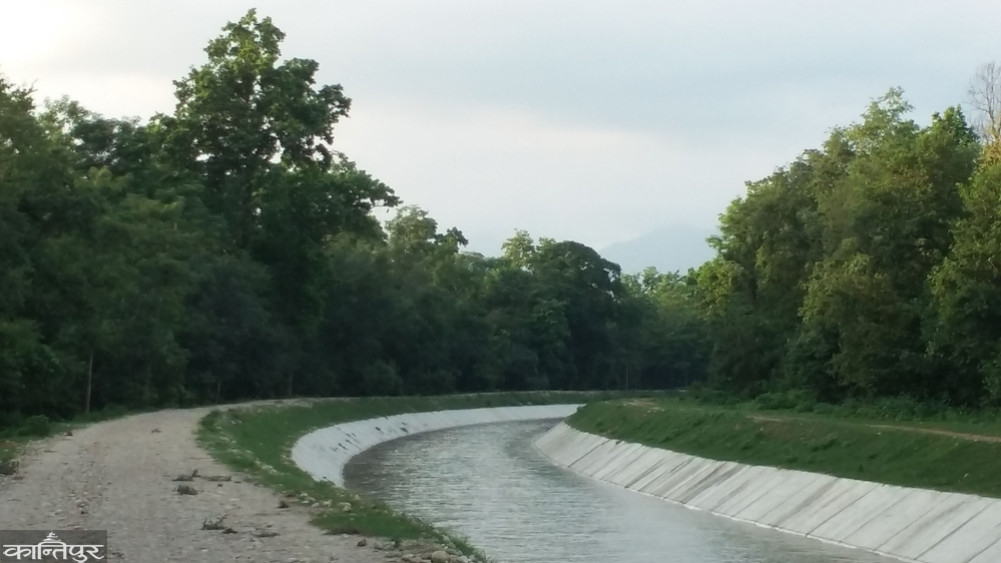
The third phase of the project, which was targeted for completion in 2085/86, has not been able to move forward in Ghodaghodi–2 due to land disputes and local dissatisfaction over the change in the canal route.
We use Google Cloud Translation Services. Google requires we provide the following disclaimer relating to use of this service:
This service may contain translations powered by Google. Google disclaims all warranties related to the translations, expressed or implied, including any warranties of accuracy, reliability, and any implied warranties of merchantability, fitness for a particular purpose, and noninfringement.
The third phase of the national pride Rani Jamara Kulariya Irrigation Project, which farmers in Sudurpaschim have been waiting for years, has been stalled due to land disputes and problems with securing resources. Although most of the structures for the first and second phases have been completed, work on the final phase has not been able to move forward.
Although the project was targeted for completion within the fiscal year 2085/86, construction of the third phase has become uncertain due to the inability to reach an agreement with locals in Ghodaghodi Municipality–2 of Kailali.
Under the third phase, there is a plan to expand irrigation facilities to an additional 17,500 hectares through the Patharaiya–Kandra extension. It is expected that thousands of farmers in Kailali will gain year-round access to irrigation as a result. However, the land acquisition dispute has created an obstacle to achieving this goal.
The compensation determination process has been completed in wards 1, 2, and 4 of Bardagoriya Rural Municipality. However, in Ghodaghodi–2, locals have refused to provide land, claiming that the canal route was changed without informing them and that it would affect arable land. According to the project’s Information Officer and Senior Divisional Engineer Ramkrishna Ghorasaini, although half of the locals are willing to provide land, the compensation determination process has not been completed because the rest have expressed disagreement.
According to Kumarraj Shahi, chairperson of the project’s main consumer committee, it was expected that the third phase would begin immediately after the completion of the second phase last year. However, the project has been halted at the final stage due to the inability to resolve local dissatisfaction. “There have been many discussions with the administration, forest, and land revenue offices. But we have not been able to satisfy the locals,” he said. According to him, if this situation continues, the basis for completing the project within the stipulated time is weakening.
According to Prem Mall, a local affected by the project in Ghodaghodi–2, the dispute is not only about compensation but also about the change in the canal route. “We are not against development. In 2075, there was an agreement to take the canal from the upper part of the Chure conservation area. But we only found out that the canal was being routed through the middle of the village after our land was frozen last Poush,” he said. According to him, the main disagreement among locals is over the change in the canal route. “We have nothing to do with compensation. If it is taken from above, many farmers will benefit; if it is taken from below, the village will be divided into three,” he said.
The project office, however, claims that the route has not been changed. According to project engineer Ankur Subedi, although various options were studied while preparing the DPR, the currently approved route is the final one. “During the survey, various locations are considered. In the end, the shortest and least expensive route is chosen. It is not as the locals claim, that it started on one side and then was moved to another,” he said.
Admitting that there was no direct discussion with locals while preparing the DPR, he said the route was determined in coordination with elected representatives. “There may have been some shortcomings in not consulting directly with locals,” he said.
Time extended, costs rising
The project, which has been under implementation since fiscal year 2066/67, had an initial estimated cost of Rs 12.37 billion. With project expansion, additional phases, and extended construction periods, the total cost will exceed Rs 51 billion, according to project engineer Ankur Subedi. It is estimated that Rs 29.59 billion will be spent on just the first and second phases. An additional Rs 21.74 billion will be required for the Patharaiya–Kandra extension (third phase). Thus, the estimated total cost for all three phases is about Rs 51.33 billion.
Initially, the goal was to provide irrigation facilities to 14,300 hectares and complete the project by 2074/75. Later, the deadline was extended to 2080/81 and then to 2085/86. Subedi said the construction period was extended after an additional 6,000 hectares were included. So far, the project’s physical progress has reached 76 percent and financial progress 74 percent.
Under the first phase, the intake from the Karnali River, an eight-kilometer main canal, and hydropower structures have been constructed. In the second phase, the main and branch canals of Rani, Jamara, and Kulariya were built, expanding irrigation facilities to 14,300 hectares. However, construction of branch and sub-branch canals under the Lamki extension, the Patharaiya–Kandra extension, expansion of irrigation to an additional 17,500 hectares, and management of hydropower operations remain. The project ultimately aims to provide irrigation facilities to 38,000 hectares.
Weak budget implementation
Last fiscal year, the revised budget for the project was Rs 1.43 billion. Of this, only Rs 730 million, or 51.34 percent of the total budget, was spent. According to engineer Subedi, the low expenditure was due to the inability to manage contracts because of a lack of resource assurance. According to him, more than Rs 879.6 million has already been spent on land acquisition and compensation alone.
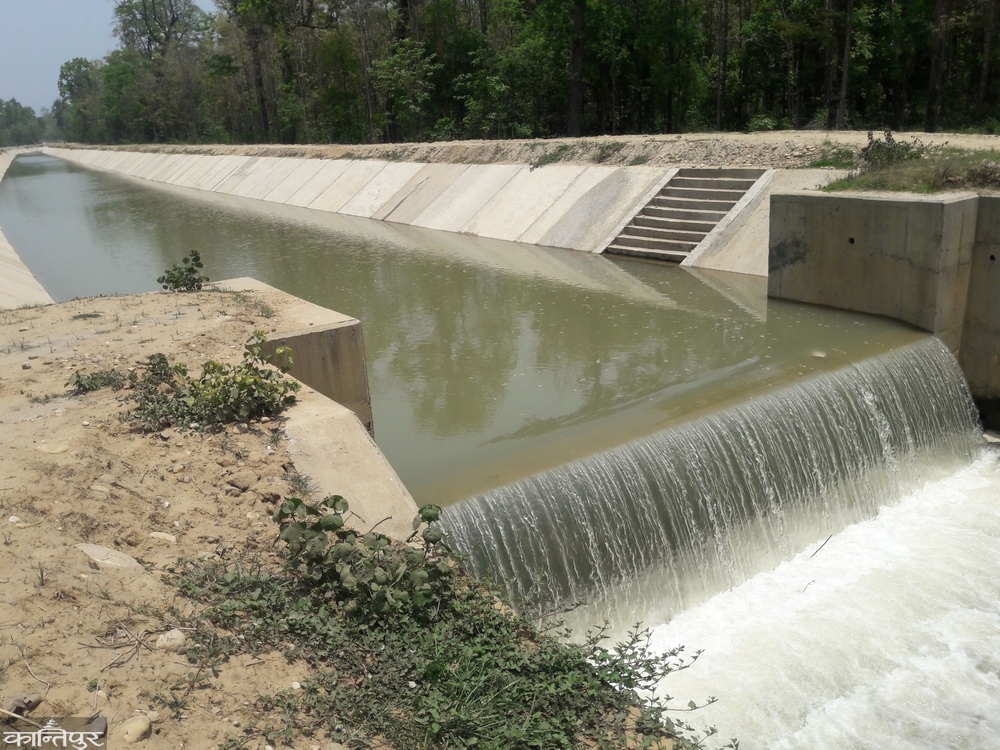
Compensation for the third phase is in process in Bardagoriya, but in Ghodaghodi, it has not been able to move forward due to disputes. The largest amount has been spent on land acquisition for the Nambari land under the Lamki branch. According to project data, even after settling the arrears from the previous year and last fiscal year, about Rs 700.5 million in arrears remains. According to Subedi, there are various reasons for the increase in arrears. “There are also some theoretical reasons. The arrears have increased due to many factors,” he said.
Nevertheless, the project claims to have achieved some successes. The project claims that sustainable and reliable year-round irrigation facilities have now reached 14,300 hectares. The construction of a 4.71-megawatt hydropower plant has been completed, and the operational modality is in its final stage. The project aims to use water from the Karnali River to provide reliable year-round irrigation to a total of 38,000 hectares.
Construction of the main structures currently in operation has been more than 85 percent completed. However, the delays in construction have directly affected thousands of farmers in the 38,000-hectare command area. This has also impacted the goals of local agricultural production and food security. Mitra Baral, Director General of the Department of Water Resources and Irrigation under the Ministry of Energy, Water Resources and Irrigation, said that the increase in time and cost for the project should be understood differently. “It’s not just that the time has increased; the scope of work has also expanded. As the scope has expanded, both time and cost have increased,” he said.