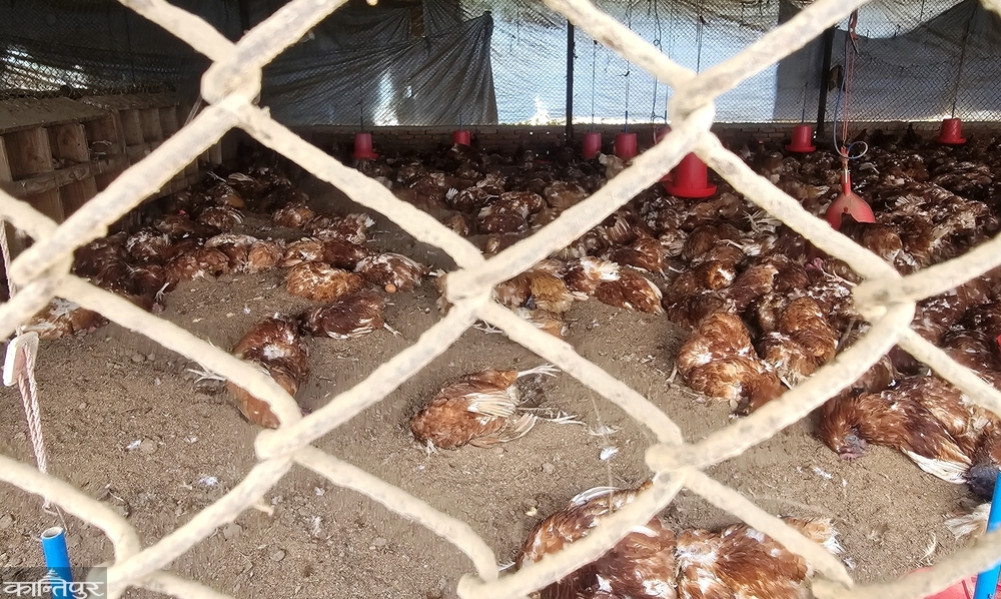
Bird flu, which began in Chaitra, has been brought under control in Jhapa, Morang, Sunsari, Mahottari, Bara, Chitwan and Nawalparasi. However, it has not been brought under control in Kathmandu, Lalitpur, Bhaktapur and Kavre.
We use Google Cloud Translation Services. Google requires we provide the following disclaimer relating to use of this service:
This service may contain translations powered by Google. Google disclaims all warranties related to the translations, expressed or implied, including any warranties of accuracy, reliability, and any implied warranties of merchantability, fitness for a particular purpose, and noninfringement.
Seeing the potential in the poultry farming business, Pradeep Karki of Panauti Municipality-6 started raising chickens eight years ago after saving Rs 150,000. With the idea of becoming self-reliant in this profession, he expanded the business and increased the number of layers to 5,000 in the cage. The business was flourishing. After earning about Rs 150,000 per month, he planned to expand further by adding 5,000 chicks. Three days ago, a piece of news ruined all his eight years of hard work and plans.
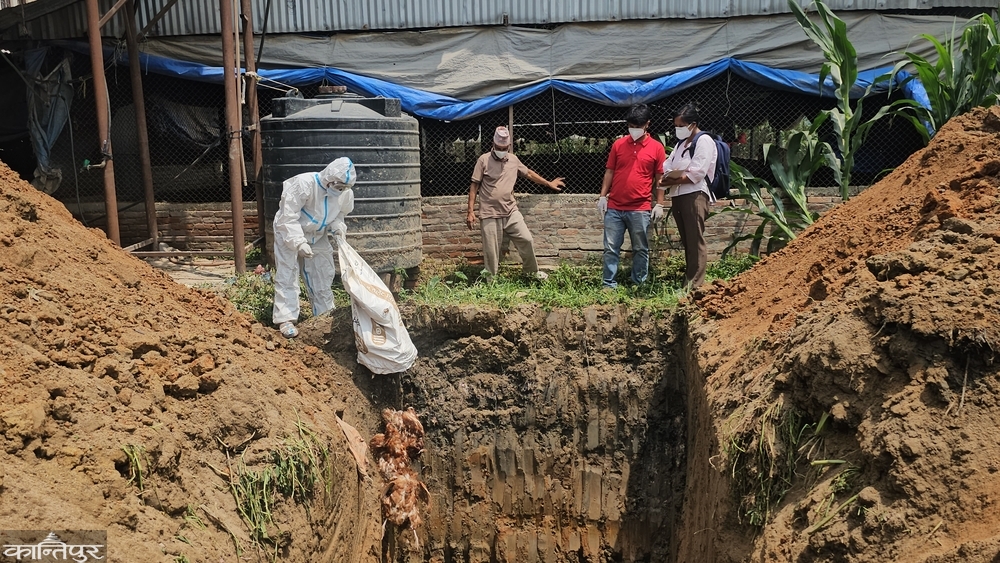
Bird flu was confirmed in the Fresh Agriculture Farm that Karki, 43, had been operating on rent in Malpi, Panauti-8. After bird flu was confirmed in the layer chickens, the Animal Services Department team destroyed the chickens, eggs, feed and all the materials that came into contact with the chickens on the farm. Not only the chickens, but also his years of hard work, investment and faith in the future were destroyed.
‘Years of hard work, millions of rupees of investment have sunk,’ he said, ‘Only recently was the business doing well . I had planned to expand it, bird flu shattered everything, and I was back to zero .’ According to Karki, it costs about 1,300 rupees to bring a layer chicken to the stage of egg production . In this way, more than 6.5 million rupees were invested in 5,000 chickens alone . Other expenses of farm operation are separate .
According to him, he had expanded the business with eight years of continuous hard work . He said that when the market conditions were good, he used to earn an average of 1.5 lakh rupees per month from 5,000 layer chickens . His plan to double the business by adding 5,000 chicks has become a memory only . This has not only sunk his investment, but also the livelihood of two employees .
He has taken a loan of about 7 million rupees from the bank to expand his business. But now that the business has closed, he is worried about how to pay the loan installments and interest. Apart from poultry farming, he has no other source of income. ‘The time has come to pay the loan.’ He said, ‘Since the business is no more, where will he pay the bank installment?’ The government has made arrangements to prevent any poultry from being raised on the farm for 3 months to control bird flu.
He is worried that his income will be cut off for at least the next three months. He said, ‘The main source of income has been lost, now he will have to make a living by chatting with friends, what will he do next? How will he start the business again?’ According to him, the entire family’s expenses were being met from this business. Two employees were also dependent on the same farm. Now that the business has closed, the employees have to be given leave. ‘We cannot always pay our employees,’ he said. ‘We have also given leave to those who are currently in financial crisis. We will call them when the business can be operated properly again.’
Although the government said that there is a system to provide relief to farmers affected by bird flu based on evaluation, Karki said that he did not receive any information about when, how much and how he would receive compensation. He said that he does not have the capacity to restart the business if the relief money is not received quickly. He said that the government should properly assess the damage done to businesses like his. ‘If compensation is not received, there is no way to start from scratch again,’ he said. ‘Right now, the future is uncertain. There is a big concern not only about how the three months will pass, but also about how life will move forward after that.’
According to Karki, this problem is not limited to his farm, the entire poultry sector is in serious crisis. Although the bird flu infection has so far been confirmed only in egg-producing chickens, the panic and rumors spread in the market about it have also affected farmers raising broiler (meat-producing) chickens. 'The infection has only been seen in layer chickens,' he said, 'but the message has spread in the market that all chickens are unsafe, due to which the sale of broiler chicken meat and eggs has also decreased significantly.'
According to him, the demand for chicken meat and eggs in the market has decreased significantly due to the fear spread among consumers. This has put even farmers from farms where bird flu has not been seen under financial pressure. He suggests that the government should take the initiative to control the infection and also dispel unnecessary fear by disseminating correct information to consumers.
Reasons why Kavre has become a 'hotspot': Transportation, poor quarantine and neglect of biosecurity
While bird flu infections are being seen in various districts of the country, Kavre is among the most affected. According to District Animal Service Office Chief Dr. Bajrakishor Thakur, the main reason for the rapid spread of the infection in Kavre is the high movement of chickens, poor quarantine arrangements, disorganized management of dead chickens and non-compliance with biosecurity standards.
According to Dr. Thakur, since Kavre is directly connected to the Kathmandu Valley (Kathmandu, Bhaktapur and Lalitpur), a large amount of chickens and poultry products are transported here daily. Similarly, since the route connecting with Madhesh Province also passes through this region, he said that transportation from various regions has created an easy environment for the spread of the infection.
According to him, although the bird flu infection was initially seen in Koshi Province, it was difficult to stop the transportation of infected chickens as quarantine could not be effectively implemented. This is why the infection has spread to various districts and reached Kavre, he says.
This bird-borne disease had recently spread to 11 districts. According to the Department of Animal Services, bird flu has not been controlled in Kathmandu, Lalitpur, Bhaktapur and Kavre. Bird flu, which started in Chaita, has been controlled in Jhapa, Morang, Sunsari, Mahottari, Bara, Chitwan and Nawalparasi.
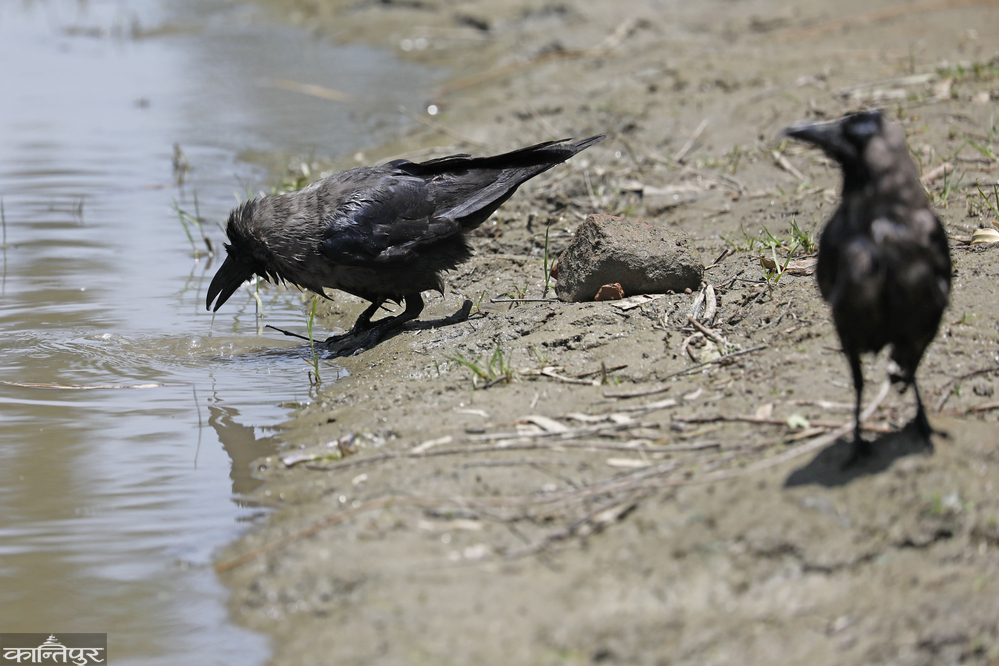
The first infection in the district was confirmed in Sanga, Banepa Municipality-13. Since there is a lot of movement of vehicles carrying chickens in that area, Dr. Thakur estimates that the infection spread through transportation. He also said that since H-9 infection was confirmed in a crow in Namobuddha district before that, the infection may have spread through wild birds.
According to him, some farms used to throw dead chickens in bushes and open places without destroying them safely. Birds including crows live in such places and there is a possibility that those birds can carry the virus to another place. ‘The biosecurity measures that should have been adopted after the infection was detected in one farm were not implemented effectively,’ he said, ‘that is why the infection gradually spread to other farms.’
So far, the District Animal Service Office has confirmed that the infection has been confirmed in 17 places in the district.
Dr. Thakur informed that the infection has been seen in areas including Banepa Municipality-7 and 13 and Panauti Municipality-5, 8, 9 and 10. Regarding the relatively high infection rate in Panauti, he said that the main reason is the lack of proper management of dead chickens. According to him, Panauti has been more affected due to the tendency to throw dead chickens in the open, the regular movement of transport vehicles and the potential infection route.
The office has stated that 62,519 chickens and ducks, 36,01 kg of feed and 9,800 eggs have been destroyed in Kavre so far to control the infection of bird flu. According to the office, chickens, feed and eggs have been destroyed in 17 affected farms in Banepa and Panauti as per biosecurity standards. This is estimated to have caused crores of rupees in damage to the poultry sector in the district.
After the infection started spreading, the District Animal Service Office has increased surveillance in Banepa, Nala, Dhulikhel, Panchkhal and Roshi rural municipalities. In addition, a public awareness program has been conducted in coordination with farmers, public representatives, stakeholders and the media, said Dr. Thakur.
Farmers who have destroyed a large number of layer chickens after the bird flu infection are waiting for relief from the government. The affected farmers have demanded that the amount due from the government be provided quickly. There is a provision to get relief up to 75 percent of the value of the chickens destroyed by the government during the control of bird flu.
The Animal Services Office has stated that relief will be distributed to farmers after the decision is made by the Compensation Evaluation Committee to be formed under the coordination of the Chief District Officer in the district. According to Kavre Chief District Officer Gopal Kumar Adhikari, the district has recommended a rate for compensation and sent it to the concerned body. He said that relief will be distributed to the affected farmers after the budget is available from the center. He said that the timing of relief distribution will depend on the budget release. 'Relief will be distributed immediately after the budget is received. We are requesting that the amount not be frozen,' he said. He clarified that the compensation amount will vary not only according to the number of chickens but also according to their age, production status and the rate determined by the government. 'Not everyone gets the same amount based on the number, 75 percent of the rate determined according to the type and age of the chicken is provided,' he said.
Director General of the Animal Services Department Dr. Umesh Dahal said that relief money has been started to be sent to the accounts of farmers affected by bird flu. He claimed that they will receive the amount based on the evaluation of the district-based committee in a few days.