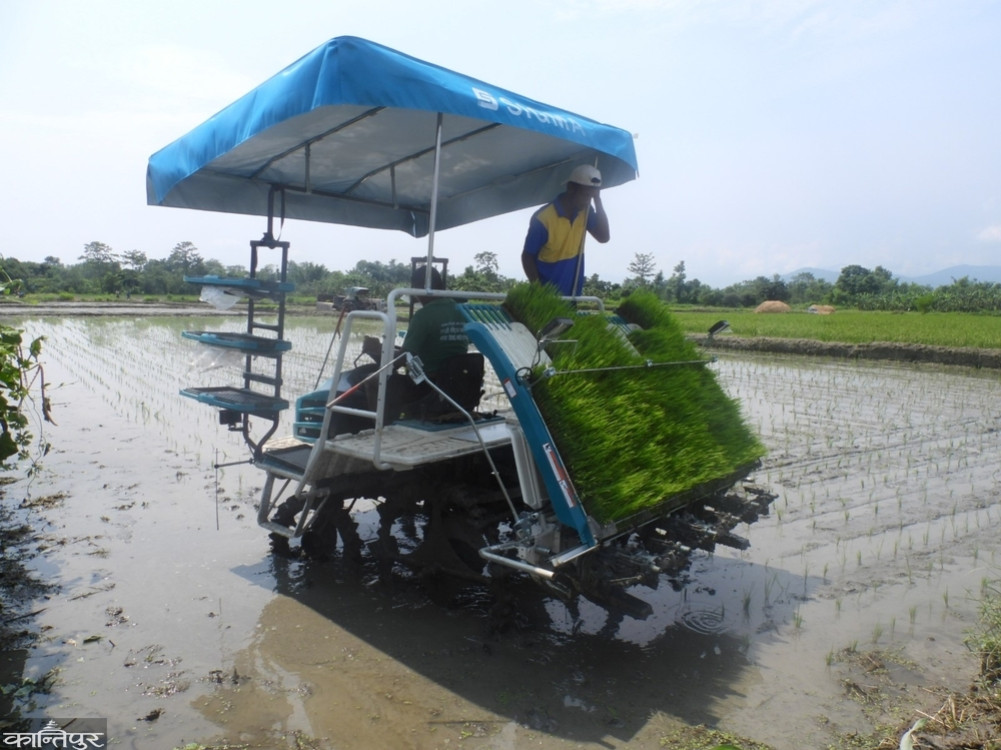
Although rice planting machines reduce costs and time, their use has not yet become widespread among farmers in Chitwan.
We use Google Cloud Translation Services. Google requires we provide the following disclaimer relating to use of this service:
This service may contain translations powered by Google. Google disclaims all warranties related to the translations, expressed or implied, including any warranties of accuracy, reliability, and any implied warranties of merchantability, fitness for a particular purpose, and noninfringement.
On Sunday afternoon, the day before the National Rice Day, officials from organizations and farmers were busy in Kathar, Khairhani, in the eastern part of Chitwan. A local cooperative was busy preparing for a formal program for Rice Day. Farmers were engaged in the regular work of weeding, weeding the fields, and sowing seeds. Not only people but also machines were seen rushing to sow.
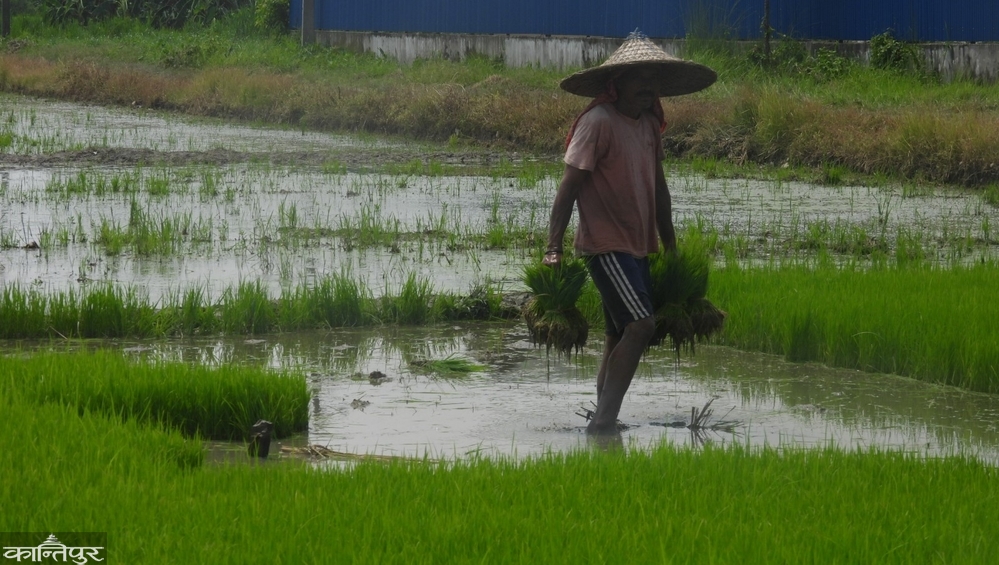
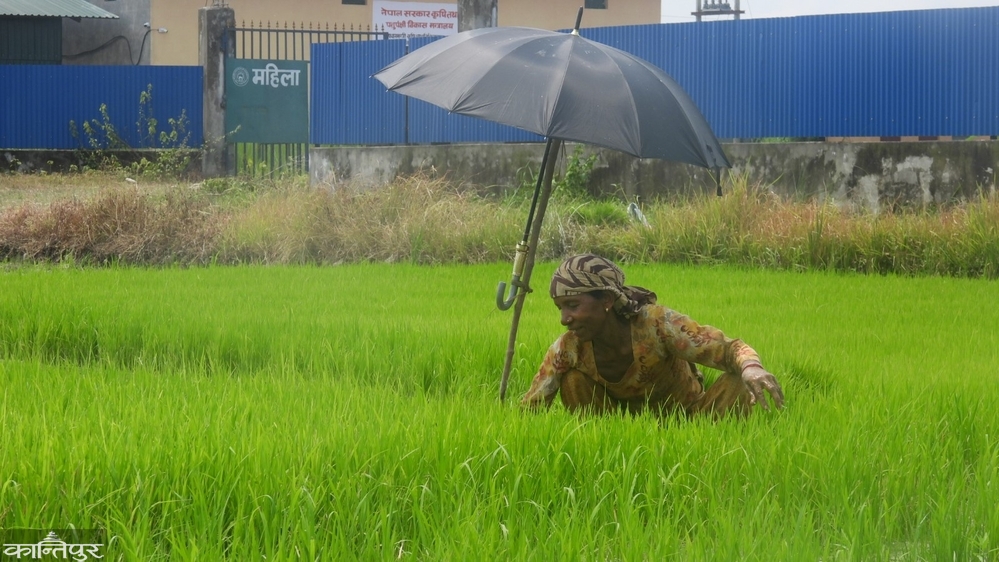
Sitaram Chaudhary was sowing seeds in the field wearing an umbrella (like a large hat) made of choya (a bamboo cane) to protect himself from the scorching sun. Sitaram of Kathar, Khairhani Municipality-10, in the eastern part of Chitwan, has five kattas of land. His sister-in-law Pahuniya Kumari was also sowing seeds with Sitaram, tying an umbrella to a stick. 'Sometimes it's early, sometimes it's a little late.' We always sow paddy from 7/8 to 15/20 of Asad,' Sitaram said. He said that he always sows in mid-Asad because he experienced that if planted too early, diseases and pests will attack him and if planted too late, the pests will cause trouble. In this region, Chaite paddy is also a favorite. Farmers here are in a hurry to sow rain-fed paddy after taking care of Chaite paddy. In the rush of sowing, not only people but also machines can be seen in some places. About three hundred meters west of the field where Sitaram and Pahuniyakumari were sowing seeds is the field of Jaleshwar Chaudhary of Kathar. Jaleshwar had used machines to sow in his nine-acre field instead of people. The machine was running fast, sowing paddy in the field that had been shaken and leveled. 'Ploughing the field with a machine is beneficial. It saves a lot of wages.' "It would be better to pay a quarter of the wages to the machine than to pay to the person," said Jaleshwor.
The Kathar Women's Small Farmers Agricultural Cooperative Society is located almost between Jaleshwor and Sitaram's fields. Jaleshwor has been planting rice by renting a machine from the same organization. The cooperative is organizing a program to plant rice by machine on Monday morning, Paddy Day.
Drought pain for farmers, planting festival for stakeholders
'But the use of machines has not been able to flourish that much,' said Geeta KC, president of the organization. When planting rice by machine, seeds should be placed in special trays, not in beds. To encourage planting rice by machine, the cooperative has been selling seeds in such trays to farmers at the time of planting. However, president KC said that machines are used less in spring paddy planting than in Chaite paddy.
The National Agricultural Modernization Program is an active government agency for mechanization in agriculture. According to Mahesh Regmi, head of the program implementation unit, Bharatpur, the area planted by machines is very low compared to the area planted with rice. He said that rain-fed rice is planted on more than 27,000 hectares in Chitwan. There are only 13/14 rice planting machines in Chitwan.
The National Agricultural Modernization Program has been operating the Rice Zone Program in the eastern part of Chitwan covering 20 wards of Rapti, Khairhani and Ratnanagar municipalities. He said that 11 rice planting machines have been available under subsidy for the rice zone.
Similarly, two machines are also in operation in the western part of Chitwan. Apart from the government, he said that people have been operating one or two machines themselves. ‘The 13/14 machines available under government subsidy and those purchased by people themselves have been planting in two to three hundred hectares.’ The remaining land has been planted by people by hand,’ said Regmi.
According to Geeta KC, the president of Kathar Women’s Agricultural Cooperative, there is a shortage of people to plant fields in the village. Mostly, people from Madhesh and other places are forced to rely on those who come from India for planting. At such times, the practice of sowing by machine should be promoted. But she said that many people have not been able to fulfill their desire to sow by machine even though not everyone knows the method of placing seeds in trays. It is not possible for a cooperative to prepare seeds in trays for everyone. ‘There are more than two thousand members. Even the cooperative cannot afford to place seeds in trays for everyone. If everyone placed seeds in trays, the practice of sowing by machine could have increased,’ said Chairperson KC. Mahesh Regmi, head of the National Agricultural Modernization Program, Program Implementation Unit, Bharatpur, said that the use has not increased because the locals are not used to using machines.
A rice planting machine is also a bit expensive to buy by an individual. Regmi said that the machine initially cost up to 20/21 lakh rupees in the market, but in recent years it has cost up to 15/16 lakh rupees. Government agencies have been providing subsidies of 50 to 75 percent to farmer groups and cooperatives. Therefore, even if the group cooperative buys machines, the practice of buying them individually has not been able to flourish. 'Those who have been planting with machines for four/five years are still planting with machines. Planting with machines costs less. The time for sowing and sowing seeds will be reduced. Since they are planted less and planted in straight lines, they grow weeds and produce more,' said Regmi. It has been more than 6 years since the rice zone was declared in Chitwan. It is a decade since the use of machines began. However, the use of machines has not been widespread.