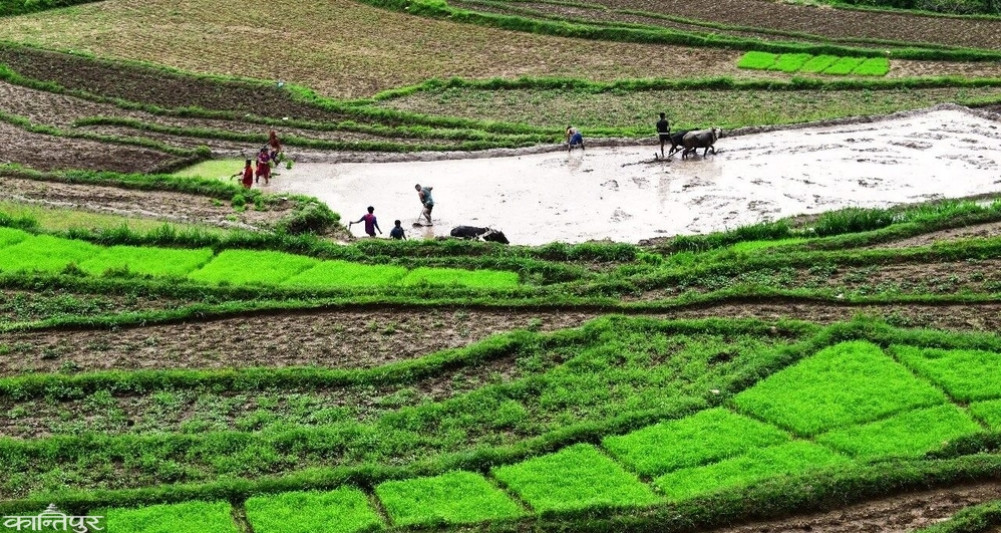
More than 7 billion rupees have been spent on rice seeds in 6 years, but the expected success in promoting and conserving indigenous rice varieties has not been achieved.
We use Google Cloud Translation Services. Google requires we provide the following disclaimer relating to use of this service:
This service may contain translations powered by Google. Google disclaims all warranties related to the translations, expressed or implied, including any warranties of accuracy, reliability, and any implied warranties of merchantability, fitness for a particular purpose, and noninfringement.
Multi Agrovet in Bidur-4, Nuwakot, sells Indian seeds. The owner of Multi Agrovet said that most of the Indian seeds are sold from his shop. ‘Farmers also keep Nepali seeds at home.’ The owner said that since Indian seeds come in one-kilogram packets, Nepali seeds also need to be packaged and promoted in the same way.’
***
Rajkishore Jha, owner of Chaudhary Agrovet in Rajahar, east of Nawalparasi, says that farmers prefer both imported and indigenous seeds. He also said that farmers also use their own seeds. ‘Farmers also buy Indian seeds from us. They also buy Hardinath and Sanwa Mansuli seeds in Nepal,’ he said.
***
Hanuman Pandey, a farmer from Yashodhara-4, Kapilvastu, plants rice in a 6-bigha field. This time, he is planting Indian hybrid and Nepali improved variety Ramdhan. He is also planting Kala Namak, known as the native rice. ‘Earlier, we used to keep Kala Namak rice seeds at home. But in recent years, why is it that the home-grown seeds do not grow well? That is why we use Kala from India,’ said Pandey. He says that the government should take the initiative to protect the native rice.
In fact, municipalities have been providing up to 50 percent subsidy to farmers on improved rice seeds. Devchuli Municipality has provided subsidy on seeds including Savitri, Ramdhan and Hardinath.
Paiyumpata of Balewa, Baglung Municipality-13 has been providing subsidy to farmers who protect the native rice. The ward has been providing a subsidy of Rs 1,000 per muri to farmers who grow indigenous varieties of rice, such as Anadi, Jhinuwa, Ramani, Jarneli and Anga. Despite initiatives taken by the local government to the federal government to protect and promote indigenous rice varieties that are disappearing from the agricultural system, the use of imported seeds has not decreased.
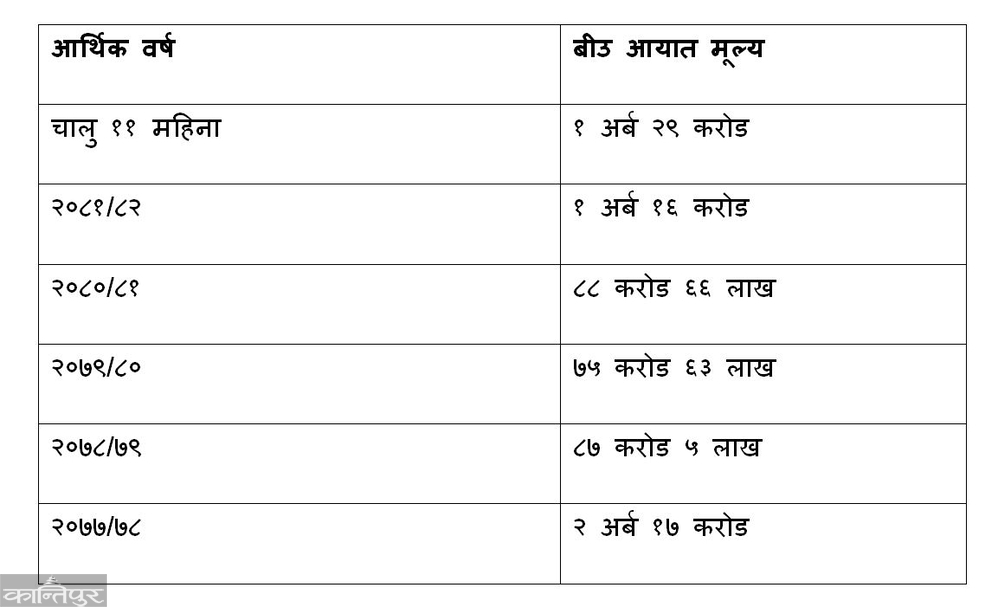
The Customs Department has data that about 3,000 tons of rice seeds were imported in the 11 months of the current fiscal year. About Rs 1.29 billion has been spent on these rice seeds. Last year, rice seeds worth Rs 1.16 billion were imported.
The department has stated that rice seeds worth Rs 886.6 million were imported in the fiscal year 2080/81. In 2079/80, seeds worth Rs 756.3 million and in 2078/79, seeds worth Rs 875.5 million were imported. In 2077/78, the department says that 2.17 billion 3.8 billion rupees were imported. In 6 years, about 7.13 billion rupees worth of rice seeds have been imported.
Rice seeds in Nepal mainly come from India. In the 11 months of the current fiscal year, 2.69 million kilos of seeds worth 1.14 billion 2.5 million rupees have been imported from India. 324 metric tons of rice seeds have been imported from China. Through this, 156.7 million rupees have been exported.
Nepal also imports a large amount of rice. During the same period, 460 million kilos of rice have been imported from India alone. About 17.23 billion rupees have been exported from this. Nepal sends more money to India to buy rice than it receives from selling cardamom. In the 11 months of the current fiscal year, cardamom worth about 12 billion rupees has been exported.
Recently, hybrid rice has become the choice of many, so seed imports have increased, says Sudha Sapkota, an agricultural economist who is also the information officer of the Nepal Agricultural Research Council (NARC). 'We are emphasizing on using indigenous rice seeds.' 'Dukkha 1 to Dukkha 6, Hardinath and multi-purpose rice developed in Nepal also produce well,' she said.
She emphasizes that Nepali seeds should also be packaged in small packets and sent to the market. 'Indian and Chinese seeds are available in 1/2 kg packets.' And they reach every agrovet. If our seeds are also branded and made available in the same way, farmers will definitely be attracted.'
She also said that after farmers started planting hybrid rice, they were forced to buy seeds. 'Hybrid rice is not as fertile as indigenous seeds, so they had to buy seeds,' she said.
The Seed and Quality Control Center has stated that hybrid rice seeds are the most imported. Of the imported hybrid rice seeds, 53 have been registered. 'A total of 161 rice seeds have been registered, both imported and released in Nepal. 99 have been released and registered domestically,' said Prakash Acharya, Senior Crop Development Officer of the Center. 'Of the imported seeds, 53 are hybrids and 9 are open irrigated varieties.'
Nepal has released only two hybrid varieties (Hardinath 1 and Hardinath 3), said Acharya, Information Officer. He says that the production of Nepali hybrid and improved varieties of seeds is also not less than that of imported ones. ‘There is not much difference in productivity.’ The production of our locally developed Hardinath-1 and Hardinath 3 is also good.’ Therefore, all three levels of government should work to promote Nepali seeds,’ said Acharya. He said that the government should also provide subsidies to Nepali seed producers.
Among the imported seeds, 53 are hybrids and 9 are open irrigated varieties. Among them, HIG 5, Super China 601 and HQ 002 are Chinese varieties of rice, while the others are Indian. Sushilraj Subedi, a scientist at NARC who is also a rice expert, also says that there is not much difference in the production of imported seeds and local seeds. ‘The varieties that produce coarse grains weigh more. It seems that they are more when you weigh them.’ It doesn't matter much if it's rice,' he said. Subedi also said that cooperatives producing rice and seeds should make 1, 2, 3 and 5 kg packets like international seed companies. 'Consumption of indigenous seeds will not increase unless attractive packets are made and placed in every seed shop. Hardinath-6 is very good. It tastes good,' he said. Subedi also emphasizes the need to make seed availability easy. 'Nowadays, if seeds reach every household, where will farmers go to look for indigenous seeds? Agrovets also keep Chinese and Indian seeds in a decorative manner,' he said. 'If you ask them if they don't have our seeds, they say they have them.' Subedi said that everyone should pay attention to the promotion and use of indigenous seeds. 'If we want to save the country and the seeds, intervention on agrovets is necessary. They should be able to sell indigenous seeds,' he said.
The center has stated that about 71,000 tons of rice seeds are required for the approximately 1.4 million hectares of area to be sown. According to the Economic Survey-2083, 1,165 metric tons of rice seeds were produced from government farms in the fiscal year 2081/82. One hundred tons of rice source seeds were produced by Falgun of the current fiscal year. The center's data shows that the replacement rate of rice seeds is 28.78 percent.