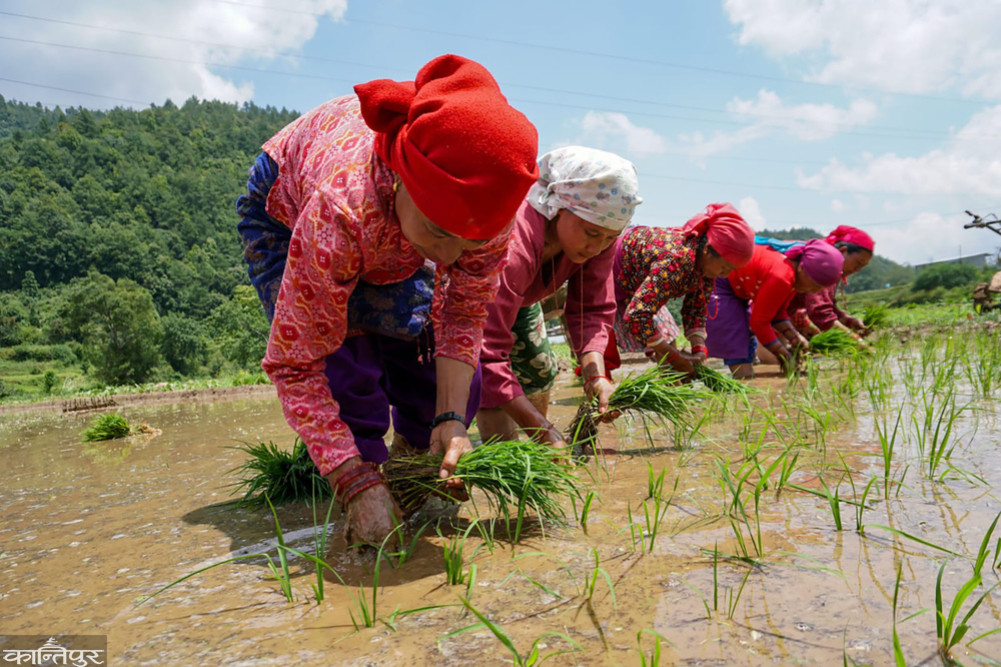
The Nepal Agricultural Research Council has advised farmers to choose rice varieties that can produce good yields even with less water, citing the possibility of low rainfall this year.
We use Google Cloud Translation Services. Google requires we provide the following disclaimer relating to use of this service:
This service may contain translations powered by Google. Google disclaims all warranties related to the translations, expressed or implied, including any warranties of accuracy, reliability, and any implied warranties of merchantability, fitness for a particular purpose, and noninfringement.
A few days later, on Asad 15, the government is celebrating the 23rd National Paddy Day and Planting Festival. The Ministry of Agriculture, Department of Agriculture's Crop Development and Agricultural Biodiversity Conservation Center has sent a letter to all local levels urging them to celebrate the day and festival with grandeur.
Due to the lack of rain, planting has not started in most parts of the country, and in some places, beds have even been set up. This time, keeping in mind the change in the seasonal system, the slogan of the Paddy Day and Planting Festival has been 'Climate-friendly technology, self-reliance and prosperity in paddy.'
Although the monsoon became active a week ago, planting has not been done to any significant extent. According to the center, till Asad 28, planting has been done in 9.97 percent of the country. During the rainy season, planting is done on 1.381 million 488 hectares across the country.
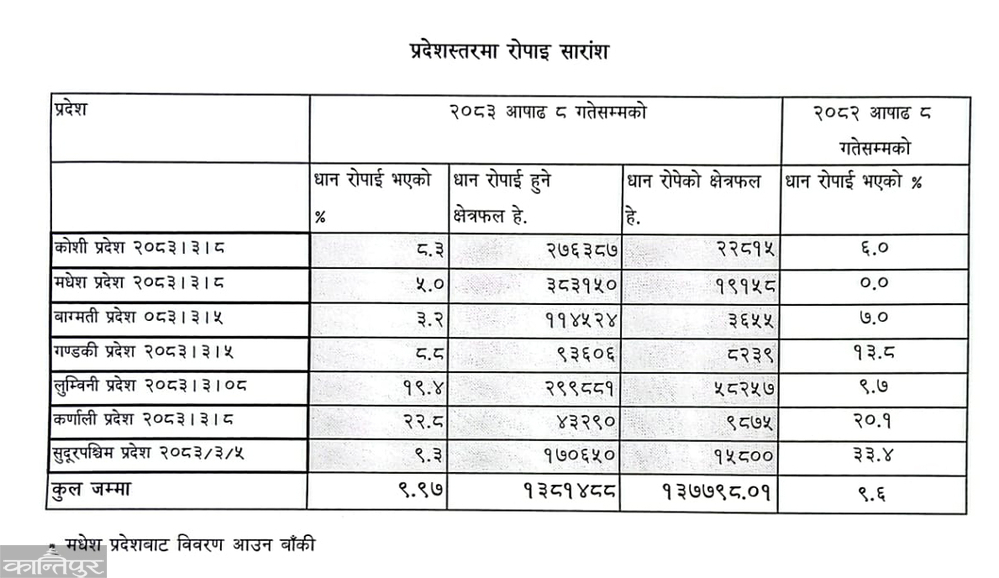
Till Asad 28, 137,798 hectares have been sown. Provincially, more sown than last year has been done in Koshi, Lumbini and Karnali provinces. Sowing has been done in 8.3 percent of the sown area in Koshi, 19.4 percent in Lumbini and 22.8 percent in Karnali. Similarly, sowing has been done in 5 percent in Madhesh and 8 percent in Gandaki. As of Asad 28 last year, 33.4 percent of the sown area in Sudurpaschim has been sown, but this year only 9.3 percent of the sown area has been sown.
Last year, there was no rain in the monsoon and a drought followed, so paddy production was not good. On top of that, farmers were hit by a double whammy when it rained when the paddy crop was ripe and ready to be imported. According to the Economic Survey 2083, 5.75 million metric tons of paddy are projected to be produced in the current fiscal year 2082/83. If paddy production is as projected, it will be less than last year.
In the last fiscal year 2081/82, 5.955 million metric tons of paddy were produced. Although this quantity is 2.31 million 242 tons more than in the fiscal year 2080/81, 500,000 tons of paddy (including seeds) worth Rs 20.35 billion were imported in the last fiscal year. 241,000 tons of rice (including kanika) worth Rs 18.66 billion were imported.
Keshav Devkota, head of the Crop Development and Agricultural Biodiversity Conservation Center, said that sowing has not started because the monsoon is not fully active. 'The Meteorological Department has predicted that it will be dry this time.' He said that even though paddy sowing has started, it has not been done significantly everywhere.
What is the probability of a drought?
The monsoon, which entered Nepal almost a week late on Ashad 20, will take a few more days to spread across the country. According to the Department of Hydrology and Meteorology, Weather Forecasting Division, monsoon has entered the entire territory of Koshi Province, Madhesh Province, Bagmati Province, some areas of Gandaki Province and a few places in the eastern territory of Lumbini Province.
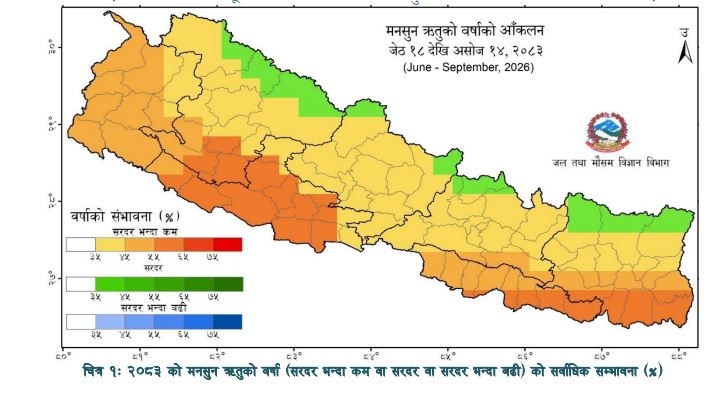
According to the department, this monsoon season (from Jestha 18 to Ashoja 14) is likely to see less than average rainfall in most parts of the country. The department also estimates that the maximum and minimum temperatures are likely to be higher than average across the country.
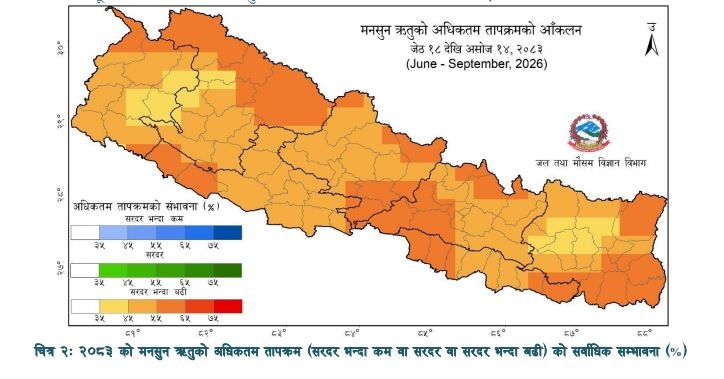
According to the department, the southern part of Karnali Province, most of Lumbini Province, eastern part of Madhesh Province and southern part of Koshi Province have a 55% to 65% chance of below-average rainfall, while most of Sudurpaschim Province, western part of Madhesh Province and central part of Koshi Province have a 45% to 55% chance of below-average rainfall. Similarly, the northern part of Karnali Province and northern part of Koshi Province have a 35% to 45% chance of below-average rainfall, while the rest of the country has a 35% to 45% chance of below-average rainfall. According to the department, the maximum temperature is likely to be above-average across the country. The probability of maximum temperatures exceeding the average is 55% to 65% in the north-eastern part of Sudurpaschim Province, the northern part of Karnali Province, the western part of Lumbini Province, the north-eastern and southern parts of Gandaki Province, the western part of Bagmati Province, the eastern and western parts of Madhesh Province, and the eastern and southern parts of Koshi Province.
The probability of maximum temperatures exceeding the average is 35% to 45% in the central part of Koshi Province and the eastern part of Sudurpaschim Province, while the probability of temperatures exceeding the average is 45% to 55% in the rest of the country.
What to use as an alternative to rice?
The Nepal Agricultural Research Council (NARC) has released a weather advisory bulletin based on rice cultivation, keeping in mind the seasonal forecast.
This time, the projections released by the World Meteorological Organization and the South Asian Climate Forecasting Forum (SASCOF) have also estimated that South Asia will receive below-average rainfall this year.
The department has stated that the El Niño developing in the eastern Pacific Ocean and the Indian Ocean conditions (IOD) will affect the climate of Nepal's monsoon season.
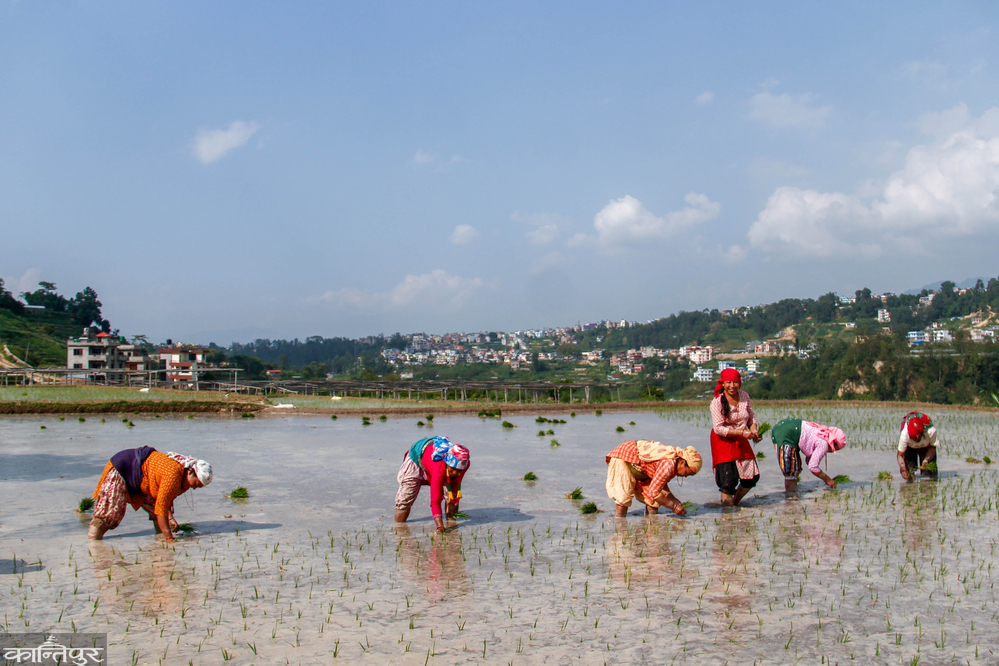
NARC had advised farmers to choose rice varieties that can give good yields even in low water, saying that there is a possibility of less rainfall this year. NARC has urged farmers to choose Radha-4, Radha-12, Hardinath-1, Ghaiya-3 and dry rice-1, dry rice-2, dry rice-3, dry rice-4, dry rice-5, dry rice-6, Bahuguni rice-1 and Bahuguni rice-2, which can give good yields even in drought.
Nark has also urged people to collect rainwater and store water in ponds, saying that rainfall may be erratic. Nark has also urged people to choose crops such as maize, bodi, mas, rahar, millet, and phapar as alternatives to rice.
Weak pace of monsoon