According to the association, more than 30 tea factories, both large and small, and about two dozen tea gardens in Jhapa will be closed from Ashar 40.
We use Google Cloud Translation Services. Google requires we provide the following disclaimer relating to use of this service:
This service may contain translations powered by Google. Google disclaims all warranties related to the translations, expressed or implied, including any warranties of accuracy, reliability, and any implied warranties of merchantability, fitness for a particular purpose, and noninfringement.
Tea factories and plantations in Jhapa will also be closed from Ashad 4 in protest against the Indian Tea Board's restrictions on Nepali tea exports. Earlier, more than 53 orthodox tea factories in Ilam have been closed since Ashad 1.
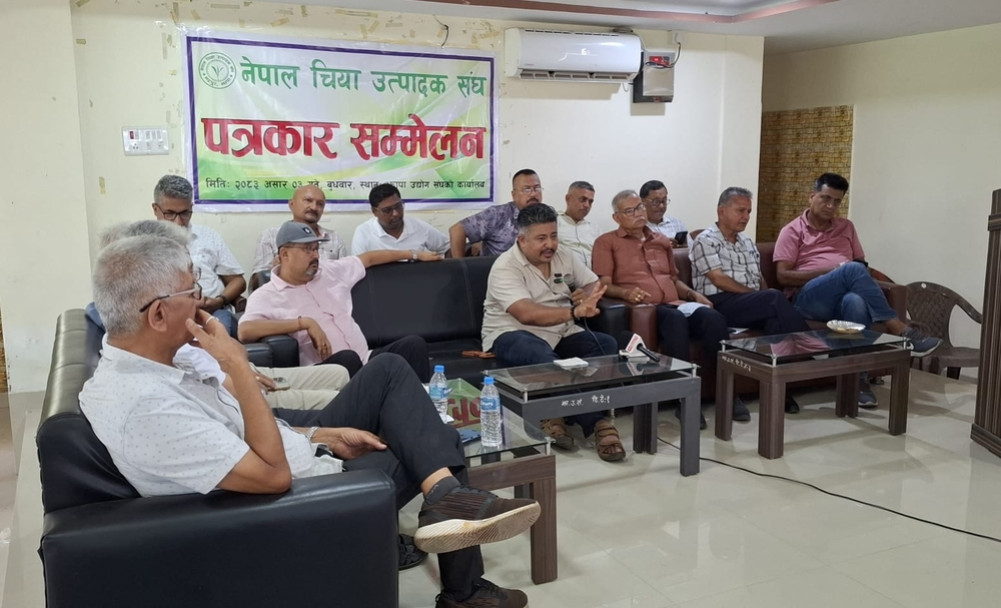
The Nepal Tea Producers Association, holding a press conference in Jhapa on Wednesday, said that it was forced to take the decision to close the factories and plantations after there was no concrete initiative from both the government and India to resolve the problem.
Association President Aditya Parajuli complained that despite drawing the government's attention for 45 days, no response has been received. 'We submitted a memorandum to all bodies including the Prime Minister, the Ministry of Foreign Affairs, the Ministry of Agriculture. But the government did not show serious interest,' he said, 'We have now raised our hands. Since it could not, we saw no option but to close the factories and plantations.'
According to him, in the past, when such problems were noticed, a solution was sought after drawing the government's attention, but now it is difficult to even convey our point to the relevant bodies.
'Earlier, the government would have taken the initiative to solve the problem after informing it,' Parajuli said, 'It has become difficult to even meet the current government, let alone discuss it.'
Businessmen have interpreted the new quality testing process implemented by the Tea Board of India as a non-trade barrier. Parajuli accused India of repeatedly trying to create obstacles to Nepali tea under the pretext of quality.
'They are the ones who mix our tea and sell it under the Darjeeling brand, and then doubt our tea itself?' He expressed his anger, 'This seems like a well-planned attempt to weaken the Nepali tea market.'
According to the association, more than 30 tea factories, both large and small, and about two dozen tea gardens in Jhapa will be closed from Asad 40. It is said that the shutdown program will continue until the obstacles imposed by India are removed. Jhapa is the largest tea producing region in Nepal. Here, the annual tea trade, including orthodox and CTC, is worth 12 to 14 billion rupees. There are data on entrepreneurs exporting tea worth more than 5 billion rupees out of the total production to India.
About 60,000 workers, employees and farmers are directly dependent on the tea sector. The industries also pay about one billion rupees in revenue to the government annually.
According to industrialists, the halt in exports due to Indian restrictions has resulted in a shortage of tea produced in the industry, cash flow has been affected, and it has become difficult to pay farmers for green tea leaves.
After Ilam, the industries and plantations of Jhapa have also started closing, indicating that the crisis in the Nepali tea sector is set to deepen further. The entrepreneurs have stated that they will continue the strike if Indian restrictions are not removed through immediate high-level diplomatic initiatives.