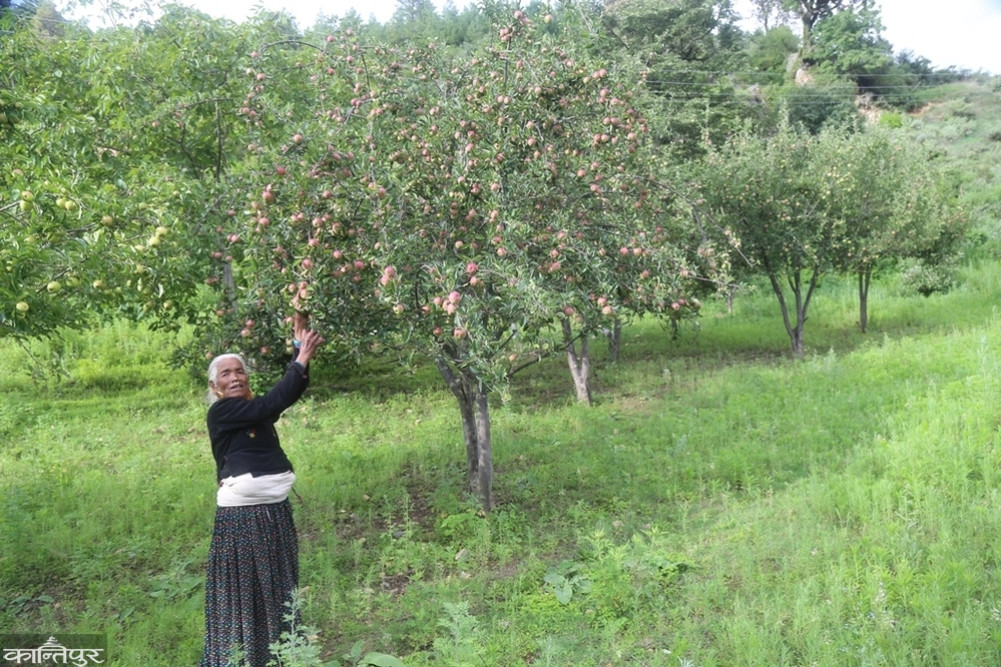
Although Karnali Province produces more than 31,000 tons of apples annually, farmers have not been able to get a fair price due to storage, packaging, and market shortages.
We use Google Cloud Translation Services. Google requires we provide the following disclaimer relating to use of this service:
This service may contain translations powered by Google. Google disclaims all warranties related to the translations, expressed or implied, including any warranties of accuracy, reliability, and any implied warranties of merchantability, fitness for a particular purpose, and noninfringement.
Apples are in full swing in the apple orchard of Banche Mahatara of Chayanathrara Municipality-4, Mugu. He has planted about 1,000 apple trees on about 10 ropanis of land. Of which, about 600 trees are producing. ‘This year, the fruit has grown well, the trees are covered with apple seeds,’ he said. ‘They start ripening from Bhadra, but the worries about the price and market have already started.’
Last year, he had grown about 8 metric tons of apples and sent 5 metric tons of apples to Nepalgunj. ‘At that time, the Karnali Highway was closed due to a landslide. When the road was closed for 5 days, some apples rotted on the road,’ he said. ‘The highway was closed during the apple season, which caused a big loss.’ He had sold apples to a local trader for Rs 45 per kilo last year. While in Nepalgunj and Surkhet, the price of a kilo of apples was sold for 150 to 200 rupees.
Every farmer in Talch, Maitulek, Ghattlekh, Bam, Foipata, Dakhryalbada, Jhapagard, Mathitum, Pina, Jhayari and Kotila of Chhayanathrara has an apple garden at his home. About 300 farmers in the village cultivate apples on up to 10 ropanis, said Anklal Mahatara, a farmer from Talch. ‘When picking apples, there is a lack of cartons to store them, then the price and the market, the traders who come here never give more than 40-45 rupees,’ he said, ‘If you could send the apples to the city yourself, you would get a better price. If there was a cold store, you could store the apples at least until Dashain, you would get a better price at that time.’
He complains that due to the lack of market certainty, he is forced to send raw apples to the market. According to him, most of Mugu's apples will be sold before Dashain. According to the District Agricultural Development Office, 3,800 metric tons of apples were produced in the district last year.
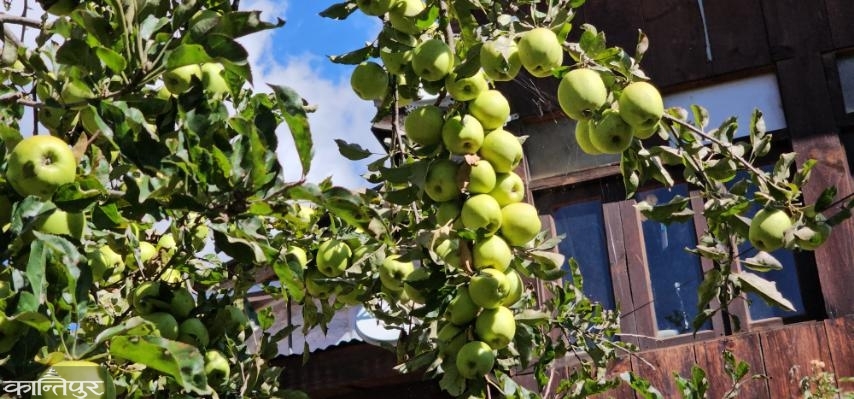
Similarly, 3,640 metric tons of apples were produced in the fiscal year 2080/81. District Agricultural Development Chief Ganesh Bahadur Adhikari said that there are problems in taking apples to the market and getting good prices due to storage problems, lack of grading, road inconvenience, packaging problems, etc.
Last year, farmers sent raw apples to the market in Shrawan. Although juicy and sweet apples are produced after Bhadra 15, some apples were sent to the market raw for fear that they would not be sold in the cities, said Karna Bahadur Mahatara, a farmer from Talcha. ‘We have not been able to make the expected profit from farming,’ he said, ‘If wholesalers had come directly and bought from us, we would have gotten some concessions.’ According to him, there is a compulsion to feed unsold and rotting apples to cattle in troughs.
The data of the Ministry of Land Management, Agriculture and Cooperatives of Karnali Province shows that apple production is increasing. Apples are cultivated in an area of 9,377 hectares in all districts of Karnali except Surkhet. Out of which, 3,419 hectares of land is considered productive area. An average of 9.10 metric tons of apples are produced per hectare in productive areas.
Last year, 31,102 metric tons of apples were produced. Of which, Jumla produced the highest amount of apples at 12,500 metric tons, followed by Humla at 4,224, Mugu at 3,891, and Dolpa at 3,600 metric tons. Similarly, the ministry's data shows that Kalikot produced 5,800, Jajarkot at 330, Dailekh at 260, Salyan at 172, and Rukum West at 75 metric tons.
The ministry's data shows that 30,440 metric tons of apples were produced in the fiscal year 2080/81 and 28,265 metric tons in 2079/80. Tek Bahadur Shahi, a farmer from Raskot-2 in Kalikot, said that the biggest problem for Karnali is storage and transportation. ‘If we could keep them in cold storage without spoiling, we would also get a good price, and the market demand could also be met for at least 7/8 months,’ he said. ‘During the apple season, landslides block the Karnali Highway, and half of the apples rot on the way.’ According to the data of the Karnali Provincial Police Office, the Karnali Highway was blocked for 18 days in Bhadra alone last year, and landslides occurred in 43 places.
Shahi said that he was forced to carry the apples from the village to the Karnali Highway for about 3 hours. ‘The transportation cost of carrying the apples to the porter is 20/30 rupees per kilogram, and there is also a fear of spoiling the apples,’ he said. ‘Only after they are taken to the highway, traders buy the apples and take them out, that too at a very low price.’ He said that he has planted nearly 900 apple trees in 10 ropanis and sold about 7 metric tons of apples produced last year at 40 rupees per kilogram. Nearly 700 trees produce in his orchard.
Despite the increase in the price of apples in Karnali every year through quality seedlings, organic fertilizer management and maximum use of organic pesticides, farmers have not yet been able to benefit, said agricultural expert Naveen Sharma. ‘Traders from Nepalgunj and Surkhet reach the places where the road reaches, but the price is as they say,’ he said, ‘There is no alternative to selling apples cheaply to farmers due to the inconvenience of storage and roads.’
The biggest problem in marketing apples is in Humla. Last year, apples were cultivated in an area of about 518 hectares in all 7 rural municipalities, including the Humla district headquarters Simkot, which is connected to the national road network. According to the District Agricultural Development Office, 4,200 metric tons of apples were produced last year. ‘On the newly opened track, one-third of the apples spoil on the way,’ said Bhim Bahadur Rokaya of Simkot Rural Municipality-7 in Humla. ‘Due to the lack of cold storage, we are forced to finish all the apples within a month. There is no alternative but to feed the unsold apples to the livestock.’
According to him, until 5 years ago, the apples produced were forced to be sent to relatives by Koseli and fed to the cattle. He has planted about 800 apple trees in about 9 ropanis, and about 500 trees produce in his garden. Last year, he sent about 3 metric tons of apples to Nepalgunj at Rs 50 per kilogram.
Min Bahadur Bhandari of Guthichaur Rural Municipality-5 in Jumla said that the highest number of apples are produced in Karnali, namely Fuji, Gala, Kinrad and Golden varieties. He has been establishing an apple orchard for four years with an investment of about Rs 220 million. His orchard, which has planted about 48,000 trees, produced 80 metric tons of apples last year. He said that traders visit the orchard to buy apples. The farm aims to produce 200 tons of apples this year. ‘There is no problem in marketing when producing on a large scale, wholesale traders come to the orchard in vehicles,’ he said, ‘but it is difficult to keep apples even for 10/15 days due to the lack of storage facilities.’
Jumla was declared an organic district by the 14th District Council of the former District Development Committee in 2057 BS. The concept of ‘one house, one apple orchard’ was also put forward in the same year. According to the District Agricultural Development Office, about 16,000 households out of 19,000 in Jumla are cultivating apples. If the government sets a minimum price for apples, farmers will not suffer losses, said Jumla trader Manoj Bohora.
According to him, apples that cost 40 to 50 rupees in Jumla are sold for up to 250 rupees per kilo in Kathmandu. 'There is a difference of 200 rupees per kilo between consumers and farmers, and a maximum of 50 to 70 rupees are spent on transportation, packaging and grading,' he said, 'The traders and middlemen in Kathmandu are reaping the most benefits.' He complained that the lack of cold stores, packaging and grading problems have forced them to pick apples raw.
Despite the increase in apple production in Karnali, due to the lack of transportation, storage and reasonable prices, farmers are forced to sell raw apples and feed them to livestock. Sanjiv Kumar Karna, Secretary of the Ministry of Land Management, Agriculture and Cooperatives, said that 31 to 33 thousand metric tons of apples are expected to be produced in Karnali this year, around the same as last year. According to him, there are problems in the marketing and price of Karnali apples due to shortage of cartons, storage problems, grading problems, road inconvenience, packaging problems, etc. ‘Due to the lack of organized marketing, farmers are facing low prices and consumers are facing high prices,’ he said. ‘To solve this problem, we have introduced the concept of forming an apple board. If the board is formed, it will help in both production and marketing.’
He said that apples produced in Karnali are covering an average of 47 percent of the Nepali market from Bhadra to Kartik. According to him, Karnali apples are organic because chemical fertilizers, chemical pesticides and any other chemicals are not used. He said that if attention is paid to quality production, grading, leveling and packaging, demand will also increase in the international market. He informed that there have been some problems in apple production due to the infection of lycaera, scab and fungal diseases in apples in recent times.
Formation of ‘Apple Board’ stalled
The Karnali provincial government has put forward an ambitious plan to form an Apple Board in the current fiscal year for the cultivation, production and marketing of apples. For which, Rs 140 million has been allocated. But the work of forming the board has been stalled for 10 months since the start of the fiscal year.
The government included it in the policy and program and budget to form a board to market apples produced in Karnali. Nearly Rs 100 million is also being spent on apples through the National Agricultural Modernization Program Implementation Unit. Similarly, the ministry has so far spent Rs 130 million on apple production.
Ministry spokesperson Sunil Limbu said that technical support has been provided to farmers since they started cultivating apples. "Technicians are being deployed directly for fertilizer management, tillage and pruning, and we are providing subsidies to farmers for purchasing seedlings, various organic pesticides, cartons, etc.," he said. "We are also providing training to farmers and purchasing various equipment." He complained that there was a problem in the construction of cold stores due to lack of budget.
But due to the lack of formation of the board, apple cultivation, production and marketing work has been stalled, said agricultural expert Ghanashyam Rijal. "The government brings plans, but is always negligent in implementation," he said. "Farmers are being harmed by bringing programs haphazardly without prior preparation." Minister for Land Management, Agriculture and Cooperatives Binod Kumar Shah said that work is underway to draft a bill related to the formation of the board. "We are preparing to form a board by completing the draft work as soon as possible," he said. "After that, all the work being done for Karnali's apple production will be done through a single-door system."