Equity tax on education and health, value added tax on electricity and ride sharing.
We use Google Cloud Translation Services. Google requires we provide the following disclaimer relating to use of this service:
This service may contain translations powered by Google. Google disclaims all warranties related to the translations, expressed or implied, including any warranties of accuracy, reliability, and any implied warranties of merchantability, fitness for a particular purpose, and noninfringement.
The budget for the upcoming fiscal year, which the government has introduced by increasing the salaries of employees and providing relief to the working class in income tax, has had an indirect impact on the pockets of the common man. After the changes in income tax and salary increases increased purchasing power, taxes have been increased or imposed in sectors such as education, health, electricity, and ride-sharing. The maximum income tax rate has been fixed at 29 percent, and the limit for levying only one percent tax has been almost doubled to Rs 1 million.
A three percent parity fee has been imposed on all types of fees charged by private sector educational institutions from students. The government claims that this fee will be spent on access to quality education and the construction of educational infrastructure. Similarly, there is a provision in the budget to charge a three percent parity fee in health services in the coming days. This will also make private sector health services more expensive.
The government is trying to radically change the tax system by reducing the income tax rate and imposing multiple rates on VAT, said Arun Raut, former president of the Nepal Chartered Accountants Association (ACAN). ‘The government has increased the tax on passive income by giving tax exemptions to citizens’ active income,’ he said. ‘It has increased the limit for which income tax is not levied. It seems that it is trying to expand the scope by increasing the revenue that will be reduced by reducing the high rate of income tax by increasing taxes on share trading, real estate, and imposing equality in education and health.’
Finance Minister Swarnim Wagle, who mentioned in the budget statement that a study will be conducted on the multiple rates of value-added tax, has imposed a five percent tax on electricity and ride-sharing. Currently, the value-added tax is 13 percent and zero percent. This will increase the expenses of those who consume more than 50 units of electricity and use ride-sharing services.
According to Chartered Accountant Raut, the government has increased the tax rate on capital gains tax on share and real estate transactions by considering it as the final tax. According to which, now citizens will have to pay 7.5 percent capital gains tax on selling shares for more than a year and 10 percent capital gains tax on selling shares for less than a year. Earlier, the limit was only 7.5 percent for less than a year and 5 percent for more than a year.
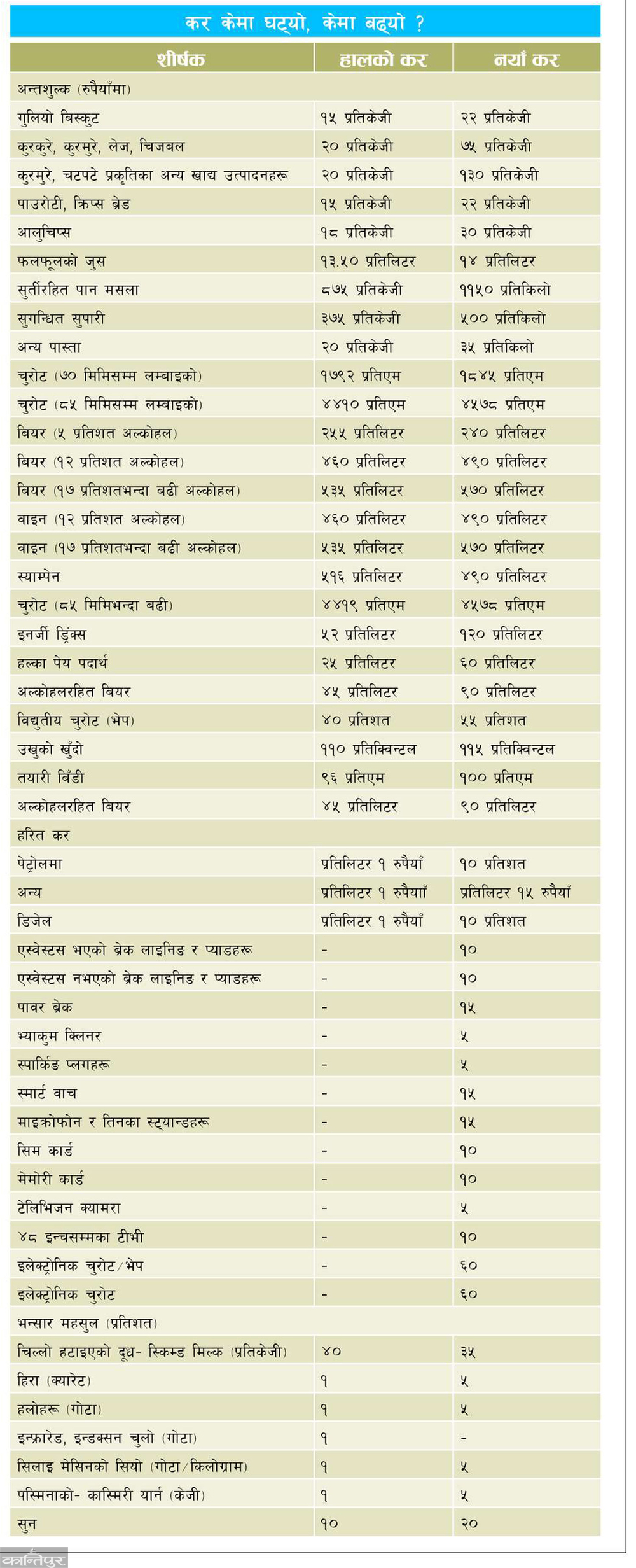
The government has made important amendments to the green tax provisions through the upcoming Economic Bill 2083. The government has abolished the excise duty levied on 360 items through the budget and integrated scattered taxes such as infrastructure development tax, road maintenance and improvement fees collected at customs points into the green tax.
Similarly, only 2.5 percent clean infrastructure investment fee will be levied on vehicles with a transaction value of 2 million rupees. Only 15 percent clean infrastructure investment fee will be levied on vehicles with a transaction value of 3 million to 4 million rupees. An additional 70 percent clean infrastructure investment fee will be levied on vehicles with a transaction value of Rs 40 lakh to Rs 50 lakh. An additional 110 percent clean infrastructure investment fee will be levied on vehicles with a transaction value of more than Rs 50 lakh.
According to the economic bill, the green tax on petrol has been increased by 10 percent. It includes taxes such as road maintenance fees and infrastructure development taxes. Similarly, a 5 percent green tax has been levied on vacuum cleaners and their parts. A green tax has also been levied on smart watches, SIM cards, memory cards, smart cards, etc. Excise duty on bread, crisps, gingerbread, sweet biscuits, cakes, cookies, pastries, waffles and waffles has been increased from Rs 15 per kg to Rs 22 per kg. The excise duty on items such as crispy kurmure, lays, and cheese balls, which was previously Rs 20 per kg, has been increased to Rs 75. Earlier, the excise duty on potato chips was Rs 18 per kg, but it has been increased to Rs 30 per kg. These items will now become more expensive.
The excise duty on various fruit juices (orange, grapefruit, mango, apple, tomato, and mango) has been increased from Rs 13.50 per liter to Rs 14.
The excise duty on pan masala has also been increased. The excise duty on non-alcoholic beer has been increased by 100 percent to Rs 90 per liter, from Rs 45 per liter. The excise duty on energy drinks has been increased from Rs 52 per liter to Rs 120. The excise duty on soft drinks has been increased from Rs 25 per liter to Rs 60.
The government has made special arrangements for the restoration of damage to buildings, furniture, machinery and equipment caused by arson or vandalism in industries, businesses or commercial establishments during the Gen-G movement. Up to 50 percent exemption has been given on customs duty and excise duty when importing such goods for the purpose of restoration and operation based on the details of the goods confirmed by the insurance surveyor's report.
If damage is found to have occurred in a star hotel during the Gen-G movement, the budget states that customs duty exemption will be provided on the customs duty when importing such goods once again for the purpose of restoration and operation based on the details of the goods confirmed by the insurance surveyor's report.
Similarly, the government has removed the 2 percent luxury tax that has been imposed on gold. However, a skill promotion fee of 0.5 percent has been imposed. This fee will be levied on the price of gold, silver and their jewelry or similar items sold to consumers. The government has increased the customs duty on diamond imports from 1 percent to 5 percent per carat. Similarly, the royalty for games played through modern machines or equipment in casinos has been increased from 15 million to 30 million rupees annually.