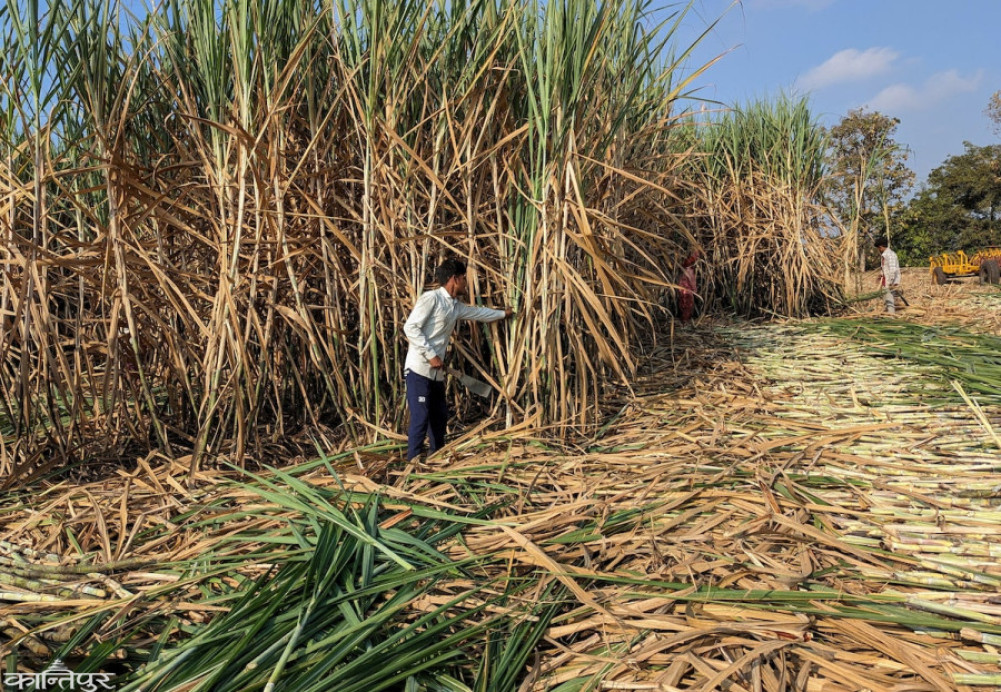
Indian media writes – ‘The ban on domestic price controls has been imposed amid fears that the effects of El Nino could cause drought, reduce agricultural production and reduce the yield of the coming season.’
We use Google Cloud Translation Services. Google requires we provide the following disclaimer relating to use of this service:
This service may contain translations powered by Google. Google disclaims all warranties related to the translations, expressed or implied, including any warranties of accuracy, reliability, and any implied warranties of merchantability, fitness for a particular purpose, and noninfringement.
India has again banned sugar exports to Nepal and other countries, effective from Wednesday. With this, India's protectionist policy has once again raised concerns about supply disruptions and a threat to food security in the Nepali market. The ban imposed by India in 2023 was partially lifted a year and a half ago.
According to Indian media, the ban was imposed to control domestic prices amid fears that the effects of 'El Niño' could cause drought, reduce agricultural production and reduce the yield of the coming season. The Directorate General of Foreign Trade under the Ministry of Commerce and Industry of India has revised the export policy for raw, white and refined sugar from 'restricted' to 'prohibited'. However, the ban will not apply to sugar exports to the European Union and the United States under certain quotas. According to the information, the ban will remain in place until September 30, 2026 or until further notice.
India, one of the world's largest sugar exporters after Brazil, has already allowed mills to export 1.59 million tonnes of sugar. Indian traders have already signed agreements to export 800,000 tonnes of sugar out of that. Of that, 600,000 tonnes have already been shipped. Nepali officials say the decision has reminded them of Nepal's sensitivity to India's trade restrictions.
Netra Prasad Subedi, Joint Secretary at the Ministry of Industry, Commerce and Supplies, said the news of the sugar ban came as India was discussing new rules on tea exports. "We will discuss the sugar ban with stakeholders and clarify Nepal's needs," he said. The official says that sugar can be imported from alternative sources if needed compared to rice. When India banned sugar exports in 2023, Nepal had planned to import sugar from Pakistan to meet the demand for festivals. "If there is no alternative source, we can coordinate with India through the government-to-government (G2G) process," Subedi said.
Nepal has already requested to import 80,000 tonnes of chemical fertilizers through the G2G mechanism after the global market was facing shortages due to the ongoing conflict in West Asia. Although Nepal imports only a small portion of India's total exports, traders and experts say that India's protectionist trade policy will directly affect Nepal.
In September 2023, India stopped sugar shipments to Nepal for the first time in seven years, citing reduced sugarcane production due to low rainfall. The ban was extended until October 31. Sugar prices had skyrocketed during Nepal's main festival season.
Sugar prices had increased sharply before Dashain 2023. Until a few weeks ago, sugar, which was available for Rs 88 per kg, had reached Rs 160 on the black market due to shortages. Nepal had sought permission to import 60,000 tonnes of sugar to meet the festive demand, but India had approved only 25,000 tonnes through the ‘National Cooperative Exporters Limited’.
On 20 January 2025, India relaxed the ban and allowed sugar mills to export up to 1 million tonnes. This decision was taken to support domestic prices that were below the cost of production. India’s protectionist policy is not limited to sugar.
On 20 July 2023, India had already banned the export of non-basmati white rice to ensure food security due to ‘El Nino’. Nepal, a major importer of Indian rice, was badly affected by the policy, leading to a price increase in the market. Later, in the same year, India allowed 95,000 tonnes of rice to be sent to Nepal under the quota system to ease the shortage of non-basmati white rice.
After the ban, rice prices in Nepal set a new record in 2024. At that time, the National Consumer Forum's market analysis showed that a 25-kilogram bag had increased by up to Rs 800. The forum considered India's export ban as the main reason for the increase in rice prices.
This was mainly due to the high price of rice and other essential commodities, which had led to continuous food inflation in Nepal. Before the ban, rice varieties like 'Pearl Jeera Masino' were sold for around Rs 1,600 per 25-kilogram bag, but later its price increased to Rs 2,400, according to retailers.
India had tightened the ban again in August by imposing a 20 percent export duty on unhusked rice. Trade expert Ravi Shankar Sainju said that any ban imposed by India on food grains would immediately affect Nepal, which is dependent on its southern neighbor.
'Importing food grains and goods from other countries becomes expensive due to transportation costs, which puts pressure on foreign exchange reserves,' he said, 'so Nepal needs to be vigilant.' There should also be separate talks on issues related to food security.' He also said that the latest sugar ban indicates that other food items may also be banned in the coming months.
Nepal's largest trading partner is India, which accounts for more than 60 percent of Nepal's total trade. In the fiscal year 2023/24, bilateral trade was more than $8 billion.
Meteorologists in South Asia have predicted that Nepal, which has had above-average rainfall for the last three years, may experience below-average rainfall this year. Analysts predict that if the drought situation worsens, India may tighten its export of additional agricultural produce to secure its domestic supply.
Experts warn that Nepal may face food security challenges due to low rainfall, lack of chemical fertilizers and rising fuel prices in the country. 'The combination of low rainfall, lack of chemical fertilizers and high fuel prices can be fatal for the agricultural sector,' said agriculture and food expert Devendra Gauchan. ‘We need a coping mechanism immediately.’ The government should make a plan,’ added Gauchan, who is also a member of the National Planning Commission.
Monsoon rains are very important for Nepal’s Rs 6.6 trillion economy. It supplies about 80 percent of the water needed for agriculture and also recharges reservoirs and groundwater levels.’ said Kumar Rajbhandari, deputy chief executive officer of Salt Trading Corporation, which has about 2,000 tonnes of sugar in stock. According to Salt Trading, the country has a monthly demand of 20,000 to 25,000 tonnes of sugar, which reaches 30,000 tonnes during festivals. The annual demand is about 300,000 tonnes.
Nepal has a deficit of about 100,000 tonnes of sugar annually, which will be met through imports, Rajbhandari said. India has imported 17,185 tonnes of sugar worth Rs 1.13 billion in the first nine months of the current fiscal year after imposing the quota system. Last fiscal year, Nepal imported 25,862 tons of sugar worth Rs 1.83 billion.
Salt Trading Corporation used to import sugar under the preferential customs duty regime. But after the government cut subsidies, the corporation started buying sugar from domestic producers and selling it in the market, Rajbhandari said.
Salt has been buying sugar from private producers for Rs 89 to Rs 95 and selling it in the retail market for Rs 98 per kg. Until a few years ago, Nepal used to produce 155,000 tons of sugar annually. But as sugar mill owners did not pay farmers on time, the attraction towards sugarcane farming has decreased, and sugar production has also decreased to 120,000 tons.