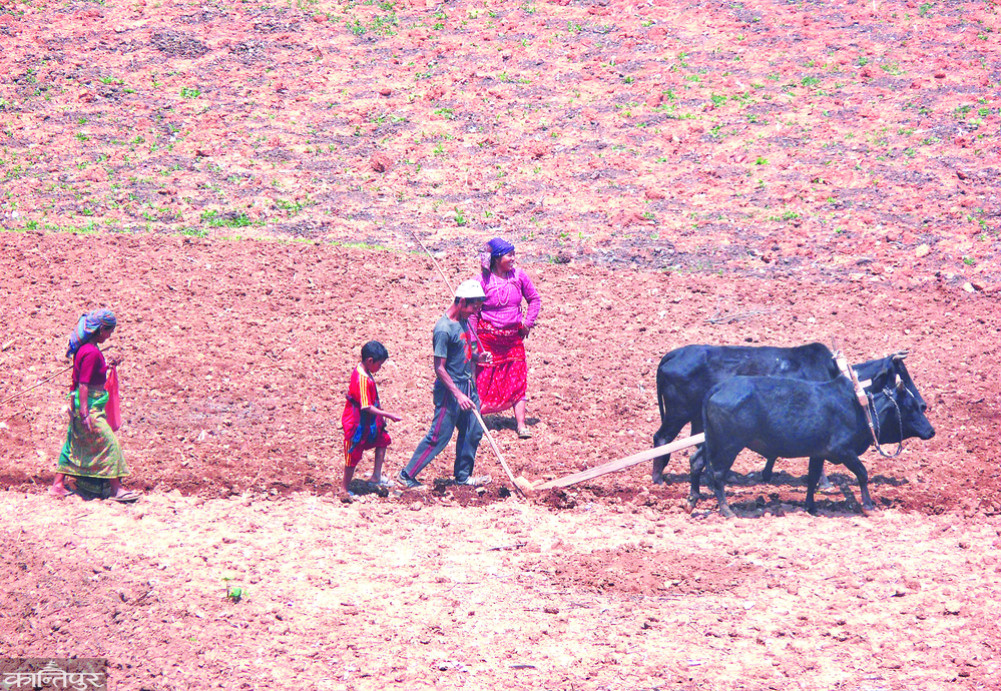
Farmers use pump sets to irrigate in areas where canals and electricity lines do not reach. These farmers are worried about the increase in diesel prices.
We use Google Cloud Translation Services. Google requires we provide the following disclaimer relating to use of this service:
This service may contain translations powered by Google. Google disclaims all warranties related to the translations, expressed or implied, including any warranties of accuracy, reliability, and any implied warranties of merchantability, fitness for a particular purpose, and noninfringement.
The increase in the price of petroleum products due to the West Asian tensions has hit farmers who make a living by farming along with big investors. The use of modern equipment in agriculture has become expensive due to the increase in fuel prices. Now, drought has increased everywhere. At such times, water has to be drawn from underground by using pump sets for irrigation. Farmers say that since diesel is expensive, it is not possible to draw water using pump sets.
This is the time to cultivate wheat. At such times, farmers are struggling to use threshers to cultivate wheat. Farmers in Bardiya were hit when the price of diesel increased in the first week of Baisakh. Farmers say that the financial burden has increased due to the increase in the price at the time of wheat harvest. Currently, the price of diesel is Rs 234.5 per liter. In areas where canals and electricity lines do not reach for irrigation, farmers use pump sets for irrigation. Such farmers are worried about the increase in the price of diesel.
The cost of farmers cultivating maize and vegetables has increased. Farmers complain that this has added to their financial burden. Due to the increase in the price of diesel, they have had to spend more on importing wheat this year, said Meghnath Godiya of Gulariya Municipality-4. ‘The machine owner was paid Rs 8,000 per bigha of wheat harvested,’ he said, ‘The planting season is approaching in a few days. If the price of diesel does not decrease, it seems that farmers will suffer a lot.’
Ratanlal Tharu of Thakurbaba-5, Dungrahawa said that the cost has increased because equipment is used more than manpower in agriculture. ‘Hand tractors were used to harvest wheat and tractors for threshing,’ he said, ‘Due to the increase in the price of diesel, importing more wheat this year cost more than last year. But we farmers are even more distressed because the government has set a very low support price for wheat.’
Ratanlal’s settlement has canal facilities. But he says that since cleaning and construction work is going on, a pump set has to be used when there is no water. He said that diesel is being spent on running pump sets for maize, sugarcane and vegetable farming. Mehboob Khan of Gulariya-7 said that vegetable farming is facing problems due to the increase in fuel prices. He is cultivating vegetables in 50 kattas.
‘The drought increased immediately after the start of the summer season,’ Khan said, ‘Since the soil is sandy, it needs to be irrigated every day with a boring. If not, the vegetable plants start to dry up.’ He said that a lot of money has been spent on irrigation recently. He has taken 50 kattas of land on lease at the rate of Rs 3,000 per katta annually and cultivated gourds, pumpkins, cucumbers, bitter gourds and watermelons. Laxmi Roka of Gulariya-8 says that the maize planted in two kattas has to be irrigated daily.
Ganesh Dhungana, a farmer from Galdha Dhunganabesi, Nisdi-5, Palpa, is now worried about how to grow his crops after the increase in fuel prices. He had been selling his oxen at home and plowing his fields with a mini tiller, but now the price of fuel has increased, and he is worried about how to farm.
It was easy to plow tar, rivers, fields, and fields with a mini tiller. ‘The oxen at home were also sold,’ said Dhungana, ‘now we can’t even buy oxen. We farmers are facing problems.’ Mini tillers have been installed in villages through groups/cooperatives. Local, provincial, and federal government offices have distributed mini tillers through groups and cooperatives on a grant basis.
Dhungana, who is also the president of the Lekbensi Krishi Jagran Farmers’ Group, said that there is a facility to plow for 600 to 800 rupees per hour within the group and 800 to 1,000 rupees outside the group. ‘With the increase in fuel prices, there is confusion about how much money to take now,’ he said, ‘the farmer is affected anyway.’
Narayan Parajuli, a farmer from Rampur-6, Tilakpur, has complained that he has stopped farming due to the high cost of fuel, chemical fertilizers not being available on time, and expensive seeds. He said that the cost of tractors that could plow in Rampur field for 3,000 per hour has reached 3,500 to 4,000. ‘Now what to do with farming,’ he said, ‘how to do farming when the cost of farming is not even recovered.’
Krishna Kumar Aryal, a farmer from Rampur-6, has 45 buffaloes, both small and large. He says that all goods have become expensive due to the high cost of fuel. He now has to pay 85,000 rupees for chaff that used to cost 70,000. Aryal said that the price of silage, which used to cost 14 rupees per kilogram, has now increased to 15.5. He said that the price of feed has increased by 100 rupees.
Farmer Noordev Poudel of Kunsare Madi, Tansen Municipality-7, says that the consumers are the ones who are suffering due to the increase in transportation fares. The price of a sack of rice has now gone up to Rs 100. He said that the price of even plowing the fields has been affected by the increase. In the district, 10 municipalities, the National Agricultural Modernization Project, the Agricultural Knowledge Center, and others have distributed mini-tillers and hand tractors worth more than Rs 10,000. Due to this, the number of people who have given up raising cattle has increased, the farmer said.
Farmers are worried that thresher owners are charging arbitrary fares after the increase in fuel prices. In Madhesh, the use of threshers for threshing wheat and maize seed has increased in recent days. Machines can do the work that used to take months in a few hours. But farmers are having to pay a high price for this convenience.
Farmers who are oriented towards agricultural mechanization are facing difficulties during the time of wheat and maize harvest with the increase in diesel prices. Rural
Farmers in the area are now struggling to harvest wheat and maize with threshers, said Senam Zimba, a farmer from Maira. ‘The price of oil
has increased. On the pretext of this, the rent of threshers has been increased,’ he said, ‘Nowadays, whatever they say, they have to pay.’
Farmers are in trouble after businessmen operating diesel-powered ‘threshers’ (grain crushing machines) and combine harvesters refused to work at the old rent, citing the increase in fuel prices. There is a rush to import wheat and store maize in Madhesh districts. Farmers complain that the rent of threshers this year is more expensive than last
year.
Businessmen submit memorandum
Construction businessmen of Bardiya have submitted a memorandum to the government, stating that they are in trouble due to the unexpected increase in fuel prices. The officials of the Construction Entrepreneurs Association submitted a memorandum to the Office of the Prime Minister and Council of Ministers through the district administration on Tuesday.
The officials including the President of the Construction Entrepreneurs Association, Hemanta Prakash Giri, drew attention by submitting a memorandum through Chief District Officer Gogan Bahadur Hamal.
The memorandum states that the price hike has increased the construction cost and has created a situation where development work cannot be done. ‘The construction industry, which is the backbone of the country’s physical infrastructure development, is currently going through a very difficult situation,’ the memorandum states, ‘The unexpected price hike in fuel and other construction materials has pushed the construction cost out of control, and the increase in the market price of materials such as bitumen, cement and rods in construction and the shortage of materials have brought the entire construction sector to a standstill.
Therefore, the entrepreneurs have also urged to control the price hike and create a working environment.