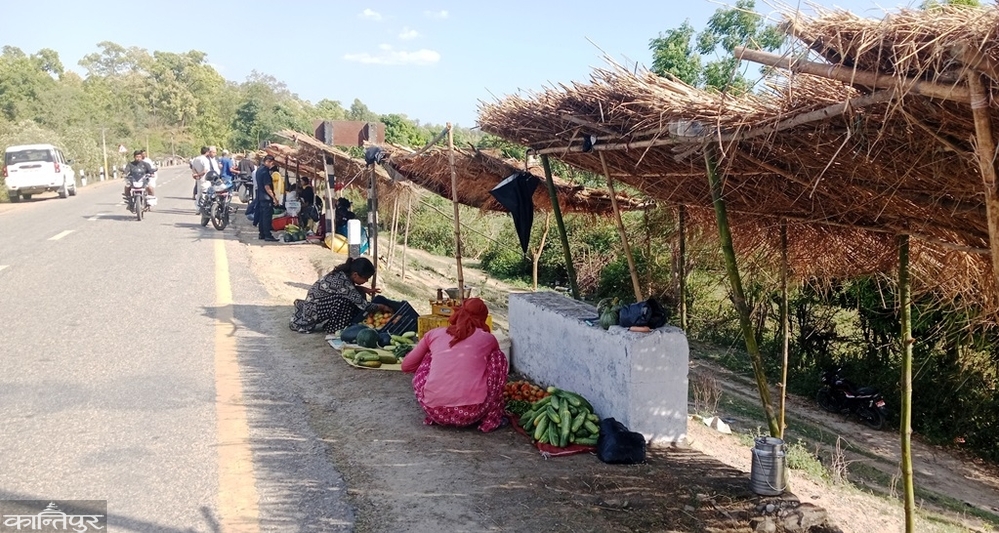
Hundreds of farmers are earning a good income during the season by cultivating vegetables along the banks of the Banhara River in Kanchanpur.
We use Google Cloud Translation Services. Google requires we provide the following disclaimer relating to use of this service:
This service may contain translations powered by Google. Google disclaims all warranties related to the translations, expressed or implied, including any warranties of accuracy, reliability, and any implied warranties of merchantability, fitness for a particular purpose, and noninfringement.
Nandalal Rana of Krishnapur Municipality-2 Bani is currently busy. On the one hand, he has to look after the vegetable garden planted in the Banhara River and on the other hand, he has to pick and sell the vegetables there. He even sleeps in the garden at night. He travels from village to village to sell the products produced in the garden, including cucumbers, gourds, pumpkins and watermelons. He is also selling them from a hut near the Banhara bridge. He has also planted vegetables at home along with the garden. He plans to earn at least Rs 4 lakh by selling vegetables this season. ‘I have been doing this work for 10/12 years, I have also called my sons who are in India to work as watchmen,’ said Rana. ‘I produce vegetables according to the season for 12 months, and that is where I earn my income.’ He is currently selling watermelons, gourds and pumpkins for Rs 50 per kilo. Katra is being sold for Rs 30 and bitter gourd for Rs 100.
Bagar farming begins after winter sets in on the banks of the Banhara River on the border of Krishnapur Municipality and Shuklaphanta Municipality in Kanchanpur. Farmers grow vegetables and fruits such as watermelon, cucumber, pumpkin, and gourd on the sand left by the river during the rainy season. After fertile land was turned into bagar due to river erosion and floods, some have made a living by sweating in the bagar.
In the scorching sun of Baisakh, farmers who cultivate bagar have set up huts on both sides of the Banhara Bridge to sell their produce. Passengers traveling on the highway stop their vehicles in the area and shop. One farmer is selling up to Rs 5,000-7,000 a day. ‘Currently, the production is low, but now it will increase,’ said Rajendra Rana of Krishnapur-3 Bani, ‘After that, we have to go around the villages and sell it.’ He has also been cultivating vegetables on his land along with the bagar for the past four or five years.
More than 200 families from the Mutt Kamaiya settlement in the Bani area of Krishnapur Municipality have also been cultivating vegetables according to the season. More than 100 families have also been cultivating spring vegetables in the bagar of the Banhara River.
Vegetables planted in the bagar in Poush/Magh start producing from the end of Chaitra. That is where farmers are busy in the bagar since Poush. Since the produce is stolen, they have been living in the bagar. Some have even built huts to live in. A family has been earning at least Rs 1.5-2 lakh from spring vegetable farming in that area. Rana says that those who cultivate on a large scale are earning more. The rivers flowing from Chure dry up in winter. Some have been cultivating on their own land that has been cleared, while others have been cultivating in empty fields. Hundreds of farmers have been earning a good income by cultivating fields in the fields of rivers including Macheli and Doda along with Banara. ‘This field was our cultivated field earlier. The Banara River eroded it and washed it away. Later, the river itself brought sand and made it flat. Now we are making a living by growing vegetables in the sand there,’ said Nandalal Rana, who was selling vegetables he had grown himself in a field on the banks of the Mahendra Highway.
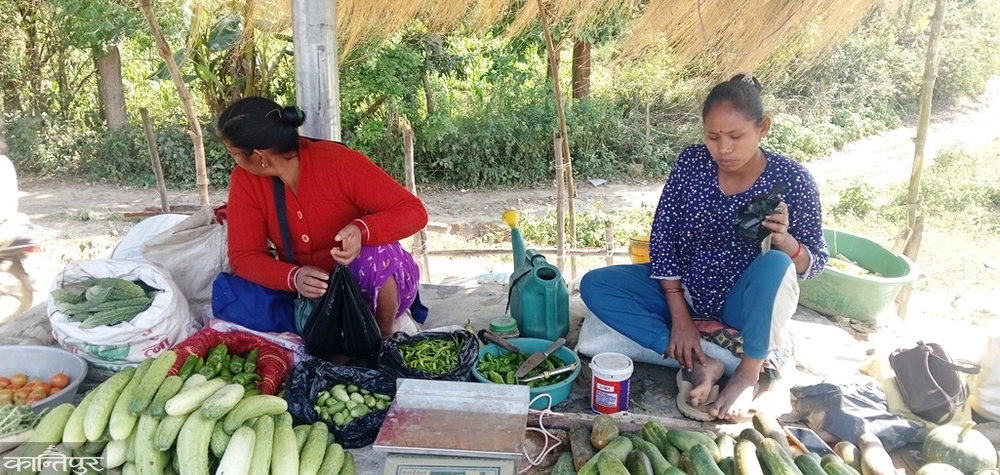
Mandu Chaudhary, who was selling next to him, pointed to the field and said, ‘That place is our land. The river made the field.’ We are looking for a basis for survival by living in the same bagar.' Bimal Rana, who is doing business on the north side of the road next to the bridge, also shared the same pain. 'After the flood, there was nothing to do. In the winter, we are planting cucumbers and watermelons in this bagar. We also rent some other people's land and grow vegetables,' he said. 'The price is lower when we take it to the market. That is why we are selling it right here on the roadside.'
Local Janaki Bista said that the dust and fumes from bagar farming and street trading make it difficult to breathe. 'There is no land to cultivate elsewhere. If you don't sell it on the street, you can barely get 10 rupees for a 50-rupee kilo of cucumber and gourd in the market,' she said.
Since the market does not get a fair price, farmers are forced to take risks and set up a hut near the Mahendra Highway to trade. Local farmer Rabindra Rana said that he is doing business on the banks in a risky manner due to the narrow highway and fast-moving vehicles.
Recently, the local level and the Agricultural Knowledge Center have been providing seeds and technical support to farmers cultivating bagar. Krishnapur Municipality has said that preparations have been made to build a safe and organized market for farmers dependent on bagar farming.
According to Mayor Hemraj Ojha, a plan has been taken forward to build a market by filling the empty land to the north of the area where the huts are located. 'We understand that farmers are doing business at a risk,' Ojha said, 'The budget has been allocated. We will start work soon and provide a safe trading place. Their struggle to bring life back to the land taken away by the river is still ongoing on the roadside.