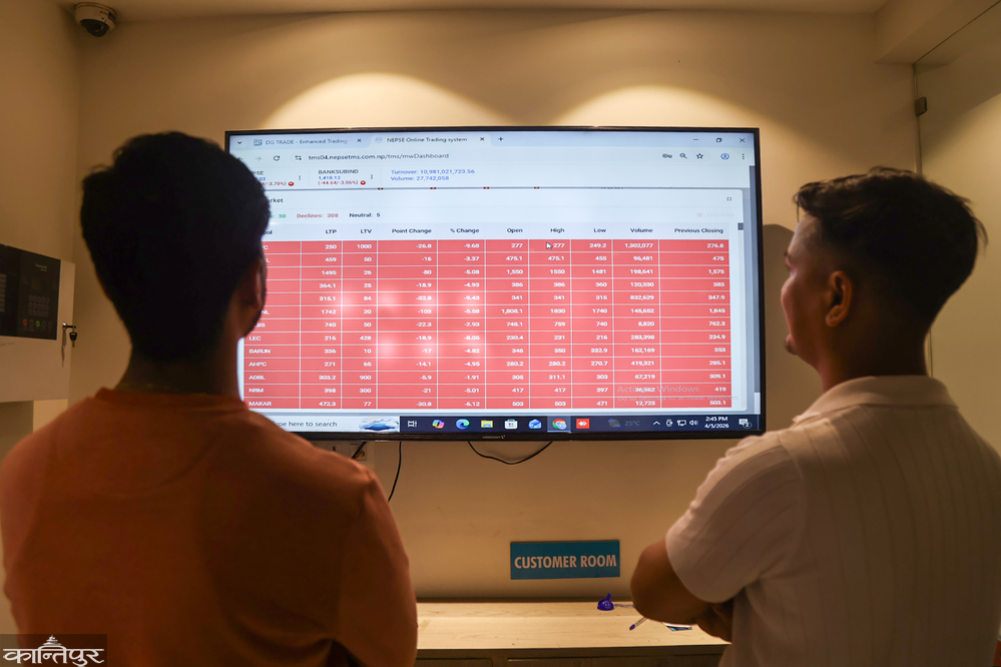
The NEPSE, which was at 2,875 points before the election, fell to 2,676 on Sunday. Investors have lost 3.5 trillion during this period.
We use Google Cloud Translation Services. Google requires we provide the following disclaimer relating to use of this service:
This service may contain translations powered by Google. Google disclaims all warranties related to the translations, expressed or implied, including any warranties of accuracy, reliability, and any implied warranties of merchantability, fitness for a particular purpose, and noninfringement.
Four days after the election, on 25 Falgun, the NEPSE index, which measures stock trading, rose by 162 points, causing three circuit breaks. Since then, the stock market has been trading for 19 days until Sunday, of which 11 days increased and 8 days decreased. During the increase, there was a moderate increase and during the decrease, there was a rapid decrease.
Since last week, the NEPSE has been on a downward journey with high points. Accordingly, in the last one week alone, the NEPSE index has fallen by 300 points and dropped to 2,676 points as of Sunday. During that period, the size of the stock market and the total market capitalization have shrunk by 450 billion. The share prices of most companies have fallen. On Sunday alone, the share prices of 261 companies fell, while only 7 companies increased. According to NEPSE data, the share prices of most companies have fallen sharply while the shares of only a few companies increased in the previous days.
Stock investors, who were tired of the long-term political instability, had become more optimistic in the last two weeks of Falgun. Because the 21 Falgun election had given the country a government with a two-thirds majority. At that time, the stock market also showed signs of hope. But before that ‘increased hope’ could come to fruition, the stock market started its downward journey.
 The government’s action (arresting industrialists) created a negative perception that the capital market would not be able to grow anymore, which is why the NEPSE has seen a continuous high-point decline, said Narendra Raj Sijapati, former president of the Stock Brokers Association. ‘People from established businesses and business families have been arrested, who had good investments in the stock market, and their own companies were also listed,’ he said. ‘The arrest of them by the police has had a psychological impact on the common citizen. And, it has helped the stock market fall.’
Sijapati says that big businessmen are now trying to exit the market due to fear. ‘They seem to be in a state of mind to leave the market at any cost. They are afraid that their assets will be frozen if the police catch them,’ he said. He claims that although it is not certain how many shares each businessman sold, the message has spread among investors that big investors are selling shares.
The amount that can be loaned to banks has been sufficient for the past three years. Interest rates have fallen to a historic low. The NRB has removed the limit on share loans and has made flexible arrangements for banks to buy shares. Investment opportunities are limited due to the lack of expected improvements in other investment sectors including industry, real estate, hotels and tourism. For all these reasons, it was expected that the stock market would rise. After the formation of the new government under the leadership of Prime Minister Balendra Shah, the stock market rose for a few days.
But the market has shown a different situation since last week. Along with the NEPSE index, the trading amount and number of shares have also started to decline. Brokers say that the market has been negatively affected after the government started arresting and detaining top leaders of some business houses. They understand that the market has been pressured to fall after some big investors started selling shares in a hurry, as the stock market is the fastest way to liquidate their assets (convert them into money).
 On Sunday, the first day of weekly trading, the NEPSE index, which measures stock trading, fell sharply. The NEPSE, which has been falling since the market opened on Sunday, finally fell by 105.50 points. The overall NEPSE has fallen by 3.79 percent compared to the previous day, to 2,676.68 points.
Of the companies that traded on Sunday, the price of 7 increased, while the price of 261 companies decreased. On this day, 31,166,162 shares were bought and sold in a total of 141,036 times. Shares worth 12.38 billion rupees were traded in these transactions. The transaction amount increased compared to the previous trading day. Shares worth 8.81 billion rupees were traded in the stock market last Thursday.
Ambika Poudel, former president of the Nepal Investors Forum, said that the stock market has been falling sharply in recent days due to psychological fear among investors. “In recent days, the police have arrested leaders of some business families,” he said. He said that this has sent a message to investors that money in the capital market has been misused. ‘This seems to have spread psychological fear among general investors that the capital market has become a means of laundering wealth,’ said Poudel.
It is expected that politics will stabilize after the Rashtriya Swayamsevak Sangh (RSS) forms the government. ‘Currently, other policies, including interest rates, high liquidity and other indicators, are also stock market-friendly. But investors are afraid,’ said Poudel, ‘In such a situation, the government should clarify its stance on the capital market.’
Poudel understands that the market has not been able to take the path of growth as some investors are still in a wait-and-see mode. ‘Investors who are waiting and watching to see how the new government will work have not yet entered the market,’ he added, ‘because it seems that big and institutional investors want to be reassured by the government’s statements and actions.’
Niranjan Phuyal, CEO of NRN Infrastructures and Development, also claimed that there is psychological fear among investors. ‘Currently, many listed companies in the market are being declared problematic by the relevant regulatory bodies, and rumors are spreading in the market that the company is sinking,’ he said. ‘The investigation into money laundering in the stock market has also increased fear among general investors.’
However, Phuyal argues that there is no black money in the stock market as rumored. However, he said that the general public is afraid that listed companies will be prosecuted, that they will not get returns, and that the market will fall further. Even if the state investigates money laundering, and some individuals and organizations are found guilty, the general public does not need to be afraid.’
 ‘The investigation may cause inconvenience to certain people. But there are many investors in the stock market. Many have acted in accordance with the rules. People who have not made mistakes need not be afraid,' Phuyal said, 'The government is declaring a company problematic and even if it does, only that company will be subject to action. All investors need not be afraid. There will be purification in the market.' Phuyal said that even though the market has fallen in the last few days, this situation will not last for long.
The overall NEPSE fell by 105 points after all the indices of the 13 subgroups that traded on Sunday fell. But even in the declining market, 7 companies have made good profits. Of these, the share prices of four companies have increased by more than 10 percent, causing a circuit break. The share prices of the remaining three companies have also increased. The share prices of Reliance Spinning Mills, Bhujung Hydropower, Ridge Line Energy and Hotel Forest Inn have increased by 10 percent each, causing a circuit break. The share prices of the remaining 3 companies have also increased by high points.
Neeraj Giri, a capital market expert and former executive director of the Securities and Exchange Board of Nepal (SEB), said that the NEPSE has continued to decline due to pressure to sell shares in the market in recent days. “Bank interest rates are at their lowest ever, there is sufficient liquidity, banks are looking for customers to take loans. The limit on share loans has been removed. Overall, the existing policy arrangements are favorable to the stock market,” he said. “Although research is a continuous process, there is a lot of negative publicity about research on social media. That is why small investors are panicking.”
Although the economy has not been that good for a few years, there have been signs of political stability. But Giri said that the market is continuously falling because investors have not been able to be convinced of it. “The situation has never been this good for the capital market,” he said. “But investors are panicking. This is just fear. This has increased the selling pressure in the market.”
Many investors have taken loans from banks to invest in the market. As soon as a certain percentage of shares
occurs, a ‘marginal call’ comes from the bank. Giri's analysis is that as investors sell shares after the market continues to decline, the supply of shares in the market has increased, which has led to the decline in the NEPSE.
But on Sunday, shareholders of 261 companies have suffered losses. After the share prices of those companies have decreased, the value of the shareholders' assets has been analyzed as having decreased. Of these, the share prices of Narayani Development Bank, Himalayan Reinsurance and Bhool Energy have fallen by 10 percent each, triggering a circuit break.
As the stock market continues to decline in this way, the regulatory body Securities and Exchange Board of Nepal (SEBON) is also closely monitoring the situation, the official says. Although fluctuations in the market are a natural process, the regulatory body is making some efforts to increase investor confidence, says Santosh Narayan Shrestha, Chairman of the Nepal Securities Board.