The federal government's ride-sharing arrangements are limited to paper. Drivers complain that even though gasoline is expensive, fares are cheap, the company is profiting from their hard work, and they have been suffering injustice for four years.
We use Google Cloud Translation Services. Google requires we provide the following disclaimer relating to use of this service:
This service may contain translations powered by Google. Google disclaims all warranties related to the translations, expressed or implied, including any warranties of accuracy, reliability, and any implied warranties of merchantability, fitness for a particular purpose, and noninfringement.
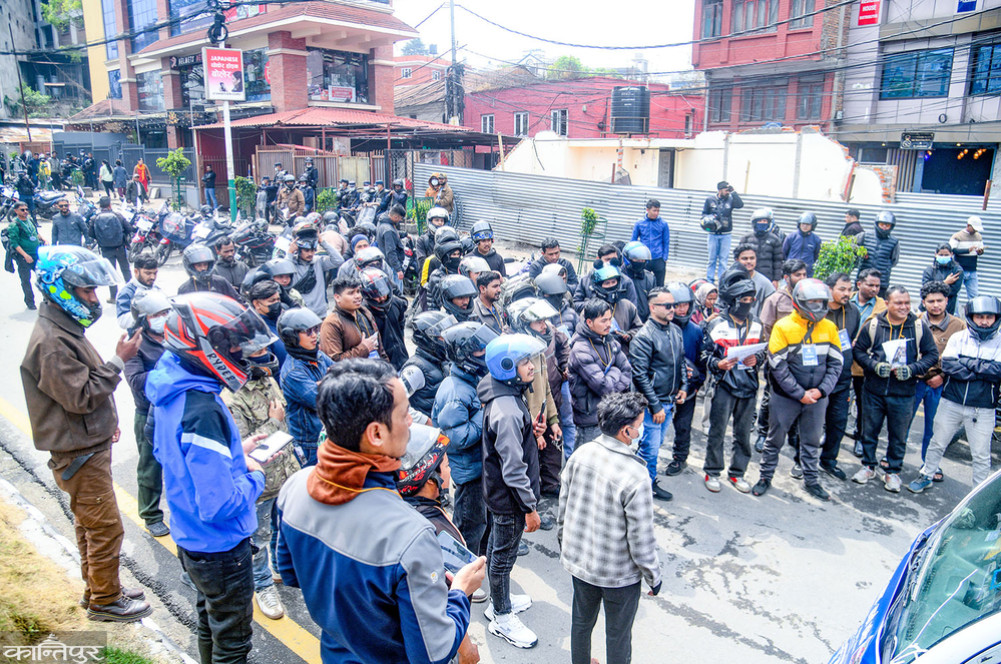
Drivers have staged a protest against ride-sharing companies with demands such as 'Petrol is expensive, fares are cheap', 'Stop exploiting riders', 'Our sweat, your profit'. Riders have taken motorcycles/scooters to Maitighar along with the protest organized by the Independent Drivers Foundation Nepal. They say that despite petrol being expensive, fares are cheap, the company is profiting from their sweat, and they have been suffering injustice for four years. Muktinath Phuyal, the founding chairman of the foundation, says that all companies should have the same fares, commissions, and insurance and other service facilities. He said that drivers of ride-sharing companies operating in the country are participating in the protest and are urging the government to set a fee of Rs 30 per km. Phuyal also urges that a scientific fare be set so that drivers and service recipients do not suffer. He said that ride-sharing companies should work on insurance facilities, 24-hour service, etc. in case of accidents. 'Companies have made rules for the convenience of riders, but not all of them have been implemented,' Phuyal said, 'Pathao's insurance is good, but InDrive and Yango's insurance is only in name.' They also demand that ride-sharing companies remove the system that automatically increases fares when sitting in traffic jams or in other situations. Ride-sharing company Sajilo Sathi has issued a statement drawing attention to the issue of various groups including Pro Rider Team protesting against the ride-sharing app, raising various demands of riders. 'We are positive towards the legitimate demands of all riders.' We are always ready to address those demands,' the statement said, 'We believe that trust, respect and cooperation between riders, passengers and the platform are essential for the success of the ride-sharing service.'
Pathao Nepal spokesperson Suraksha Hamal also said that the company has taken the demand for rides positively. 'We have taken their demands positively, they are demanding Rs 27 per kilometer, we are paying Rs 25 on average,' she said.
Drivers say that such problems will not arise if the federal government has brought a law on 'ride-sharing' and fixed the fare. On 29 Magh 2076, the Patan High Court had ordered the regulation of ride-sharing by making a law. But the order is limited only to the draft of the federal government.
Since the federal government has not made a law, transport entrepreneurs have been questioning the efforts of the provincial government to regulate 'ride-sharing' and bring it under the tax ambit. Sub-section 2 of Section 8 of the Union Vehicle and Transport Management Act, 2049 states that private vehicles cannot be used for transport services. Sub-section 1 of Section 12 of the same act states that a vehicle registered for one purpose cannot be used for another purpose. Transport entrepreneurs have been arguing that the regulations brought by Gandaki Province are in violation of the Union Vehicle and Transport Management Act.
The Gandaki Province government has already brought the Ride Sharing (Regulation and Management) Regulations, 2082. Sub-section 4 of Section 13 of the Gandaki Province Vehicle and Transport Management Act, 2076 states that four-wheeled and two-wheeled vehicles with registration certificates for private purposes can transport passengers like public vehicles. It is said that other provisions related to Sub-section 5 (Section 4) of the same act will be as prescribed.
Rule 8 of the Vehicle and Transport Management Regulations, 2080 mentions the use of private vehicles. It has been said that the ministry can formulate and issue the necessary standards so that four-wheeled and two-wheeled vehicles with registration certificates for private purposes can transport passengers like public vehicles. Accordingly, Gandaki has already published the regulations in the gazette on 1 Jestha 2081. The federal act prevents this, but after the province tried to regulate 'ride sharing' by relying on the same provision, transport entrepreneurs had stopped transport across the country. In 2081 Shrawan, Gandaki Province was about to introduce a procedure to bring the 'ride sharing' service, which was also operating, under the tax ambit.
Transport entrepreneurs had protested saying that the provincial government was about to formulate a procedure to allow vehicles with red number plates to transport passengers. Immediately, Gandaki Province stopped introducing the procedure. Despite that, Gandaki Province is currently working to determine the fare for ride sharing.
Muna Adhikari, spokesperson for the Ministry of Physical Infrastructure Development and Transport Management, said that a committee including the private sector has been formed to determine the fares. She said that after the committee recommends the fares, it will be decided accordingly. She said that all ride-sharing companies across Gandaki Province should adjust the fares accordingly and implement them.
Drivers protest against ride-sharing companies [Photos]
Although ride-sharing services have been provided in the country for almost 8 years, the federal government has not been able to make a systematic law. The federal government's proposed Federal Vehicle and Transport Management Act, 2081 bill has provisions related to ride-sharing. The 60th and 61st reports of the Auditor General also stated that the Patan High Court had also ordered a law to regulate the situation where the bill was not received after using the ride-sharing service. It states that vehicles operating without registration, including the safety of passengers, are not brought under the scope of regulation.
The application does not come under the legal scope, vehicles registered for private purposes are transporting passengers and goods by charging fares against the law, unsafe offline ride sharing is taking place, and there is no provision for issuing bills after the service is taken, the 60th report of the Accountant General states. In the current situation where there is a lack of compliance with the law, the Patan High Court has ordered to make a law and regulate it on 29 Magh 2076 BS, but it has not been implemented, the Accountant General says.
The proposed Federal Vehicle and Transport Management Act, 2081 BS BS mentions information technology-based networked transport services (ride sharing). According to the proposed bill, the Department of Transport Management will be able to determine the basic criteria for operating transport services based on information technology.
While determining the basis and criteria, the department has mentioned that the nature of the vehicle, the maximum fare that can be charged, the area in which transport can be operated, the insurance and service facilities of the driver and passenger, the distance and the maximum number of passengers that can be carried should also be considered. But since Magh 2081, the bill has been limited to a draft.
If the government brings a ride-sharing-friendly law, such problems will be reduced, said Hamal, spokesperson for Pathao Nepal. ‘The federal government has not brought a law yet, the law brought by Gandaki has also been amended and has finally been implemented,’ she said, ‘Raide-sharing-friendly laws should be brought instead of upsetting ride-sharing companies.’

![राइड सेयरिङ कम्पनीविरुद्ध चालकहरू आन्दोलनमा [तस्बिरहरू]](http://assets-cdn.ekantipur.com/uploads/source/news/kantipur/2026/miscellaneous/65785886313866235135091924210340652733145221n-3032026081342-1000x0.jpg)