This year only 71 lakh 91 thousand rupees of dried ginger rice is exported to Germany
We use Google Cloud Translation Services. Google requires we provide the following disclaimer relating to use of this service:
This service may contain translations powered by Google. Google disclaims all warranties related to the translations, expressed or implied, including any warranties of accuracy, reliability, and any implied warranties of merchantability, fitness for a particular purpose, and noninfringement.
In recent years, the routine of farmers in Nisdi rural municipality-5, Galdha has changed. Especially the busyness of women farmers has increased. Before, ginger was cultivated in the village, but there was a problem with the market. Even if the products were delivered to the market, there was an obligation to rely on middlemen. It was difficult to get a price.
Again, the farmers used to burn firewood and make it black and sell it. When Galdha Social Entrepreneurs Women's Cooperative Society was established in 2073, then the promotion of local agricultural products started. Instead of firewood, ginger rice is now made using machines.
The number of commercial ginger growers has increased in the village, which is 65 km away from the capital Tansen. From the year 2008, the cooperative started buying ginger from farmers. There are 541 women share members in the cooperative. Ginger has been worn by 272 people.
The cooperative buys the ginger planted by the share members. Dilmaya Saru, the manager of the cooperative, said that ginger was planted in an area of about 900 plants in Ward No. 5. "Ginger was grown in the village from the beginning, then it was sold in the market in nearby cities," she said, "Ginger was not fetching a price even in the market, now it is exported abroad."
According to her, it has been three years since she started exporting to Europe. "In the first year, we sent 805 kg at the rate of 350 rupees, in the second year we sent 4,460 kg at the rate of 750 rupees," she said.
This year only 71 lakh 91 thousand rupees dried rice ginger has been exported. According to him, 1 lakh 15 thousand kg of fresh ginger was purchased from farmers. Ginger has been purchased from farmers at the rate of Rs 60 per kg. She said that the excess sales amount will be kept in the cooperative and will be distributed to the shareholders as a bonus.
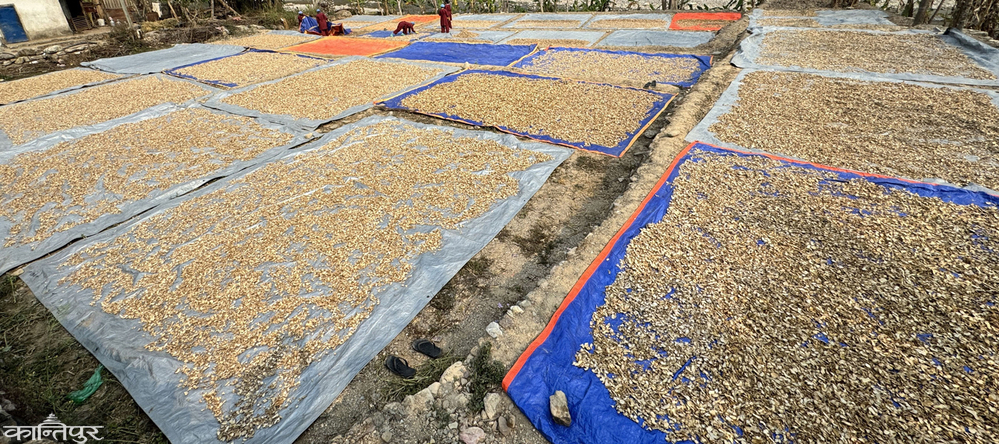
"When 93 thousand 373 kg is processed, 14 thousand kg of rice is made," she said, "again, only 1 kg of ginger is made when processing 6 and a half kg of rice." She said that 8 thousand 690 kg of juice was sent to Germany this year. From which the cooperative earned 8 lakh 19 thousand 467 rupees. Akesta Nepal requested 20,000 kg of dried rice from ginger of the Nese variety with the help of Heifer International Nepal, which was produced in
village. Manager Saru said that it could not be delivered as per the demand . Saru said that Hefer has financial and technical support from applying ginger to processing.
Similarly, with the help of governmental and non-governmental organizations, the cooperative has given employment to women by collecting materials for washing, grinding, drying, grinding, and packaging of ginger. Germany's Ceres company checks the quality of ginger by going to the farmer's house to check whether it is organic or not. Saru, the manager, told her that it would be eligible for export to Germany only after she proved it was organic. Export to Europe is done through Akesta Nepal.
This year, the chairman of the cooperative, Ammaya Mashrangi, said that they were able to export certified organic raw ginger as well. "There was a demand for 20,000 kg of raw ginger," she said, "but we have only exported a small amount as we could not produce as per the demand."
She said that the ginger planted for juicing purposes could not be sent as per the target because it did not grow well. Dried rice is certified organic and less ginger is extracted. Narayani Dhungana of the cooperative organization has been encouraging the cultivation of ginger as a cash crop to make women self-reliant.
Since only the Galdha area is certified organic, the organization said that in the near future, the ginger of nearby Jamire, Mityal, Jhiruwas and Sahalkot will also be certified organic.
The ginger produced in Nisdi was bought by local traders and taken from Butwal, Bhairahawa, Kathmandu to the neighboring country India only. "We are ready to send to other countries as well," manager Saru said, "interest in farming is also increasing."
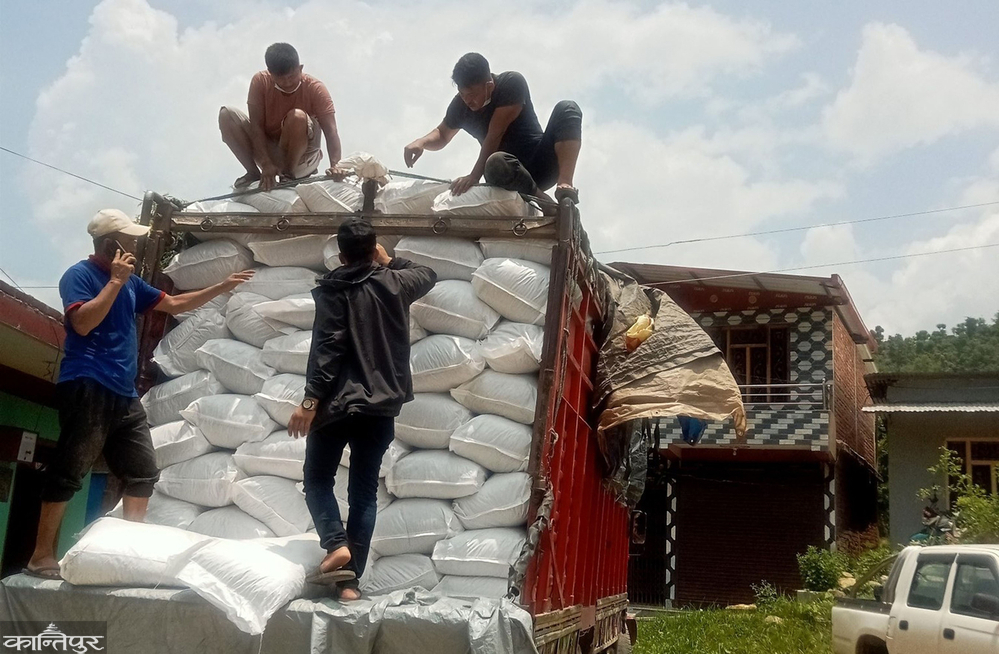
Also, India is the main market for ginger produced in Nepal. In 11 months of the current financial year, 32 lakh 44 thousand 176 kg of ginger worth 543.671 million has been exported to different countries.
in which only 25 lakh 45 thousand kg of fresh ginger worth Rs. India, the largest market of Nepal, has exported 2.536 thousand kg of fresh ginger worth 287.8 million. 299,211 kg worth of sweet ginger worth 48.4 million was exported.
30 kg of fresh ginger worth 13,000 to Japan, 10 kg worth 8,000 rupees to Switzerland. Similarly, 6 thousand 9 kg of dried ginger worth 3.8 million and 8 thousand 690 kg of fresh ginger worth 2 million have been exported to the Netherlands. After India, 2 lakh 10 thousand 460 kg of fresh ginger worth 171.5 million rupees has been exported to Germany.

