It is believed that this worship will protect the village from natural calamities from epidemics and droughts. In every village, they perform Jajar Puja at intervals of five, seven, nine and at most 11 years. But this time Jajar Puja has been held in Khurhuriya only after 19 years.
We use Google Cloud Translation Services. Google requires we provide the following disclaimer relating to use of this service:
This service may contain translations powered by Google. Google disclaims all warranties related to the translations, expressed or implied, including any warranties of accuracy, reliability, and any implied warranties of merchantability, fitness for a particular purpose, and noninfringement.
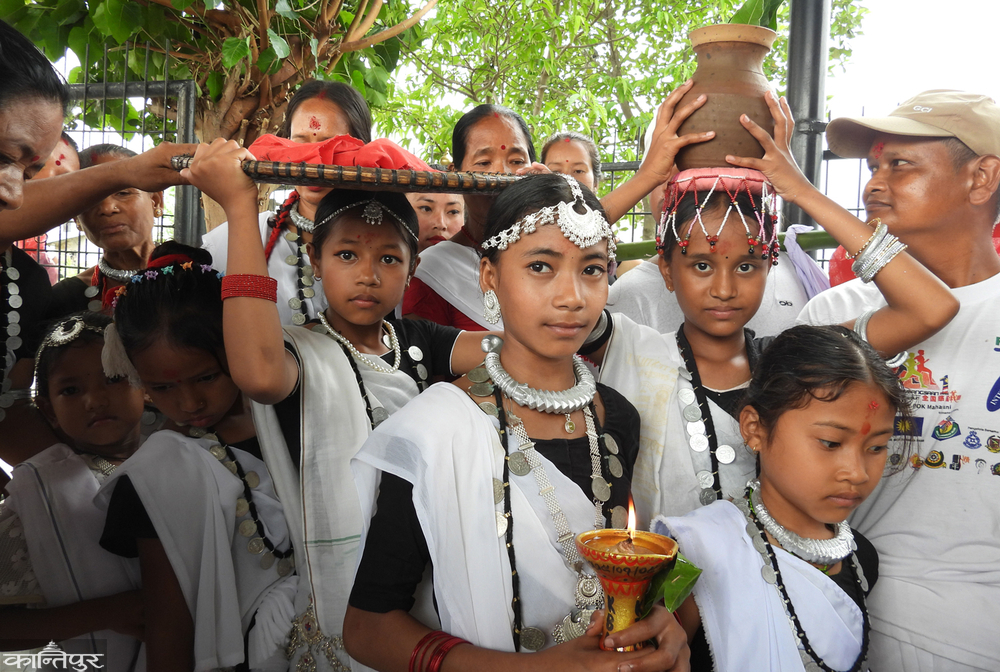
The old Tharu settlement of Chitwan, known as Khurkhure, was bustling since Tuesday morning. Around 8:30, Surendra Choudhary was raking dung in the courtyard. Under the guidance of Guru Babhana, when he started the puja, 6 girls dressed in Tharu costumes came to Tuplukka. Two teenagers also arrived with a dolly.
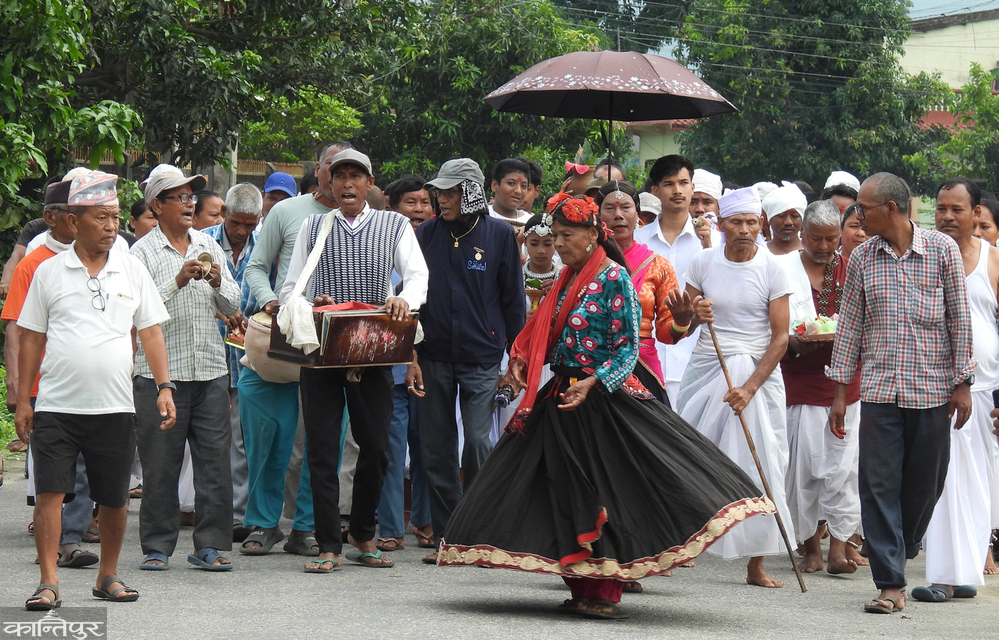
This is how the preparations for the 'Jagir' Puja, which is popular in the Tharu community, began. After a while, a troupe joined in, playing harmonium and tabla. Two men disguised as women started dancing 'Jhumra'. Pooja was done for a while as instructed by Guru . The main worship was held at the Khurhuriya Brahmasthan Temple in Rapti Municipality-7, five hundred meters from Surendra's courtyard. It took a while to reach the temple. Khurkhure is called Khurhuriya by the Tharu community.
After the guru discovered the 'Jakhkhin', which had been hidden by no one the previous evening, and buried it in Brahmasthan, then the main method of Jajar Puja begins. It took some time for Guru Bhavna who came from Kathar to find the hidden 'Jakhkhin'. From Surendra's house, a team carrying a doli went ahead with the girls.
Jhumra Nach was still busy . In the front was Guru Bhavna wearing a white ganji, a white dhoti and a white feta and holding a cane stick. Stopping for a while on the way to look at Jokhna to find Jakhkhin, the Guru went ahead after offering sacrifice of a pair of pigeons. He also entered a cornfield, at one point looking for a path in a nearby bush.
The Guru and the team, who went a little beyond Brahmasthan, came back and came near the police station . There, the guru asked for rice and looked at Jokhana . A couple of pigeons were sacrificed again. And went straight ahead. From the road, take a little south and turn east. In that way, the Guru, who had only gone a little further, found 'Zakhkhin' in the bush on the side of the road at half past nine.
Jakhkhin is the lower part of the plough, where the tiller of the field rests. Surendra's couple performed pooja after the Guru met Zakkhin. A female chicken was slaughtered and sacrificed. And put it on a doli and took it to Brahmasthan. "Before, it was as if he came to take the bride, now it is as if he took the bride away. The song is also according to the same," said Radha Chaudhary, a local.
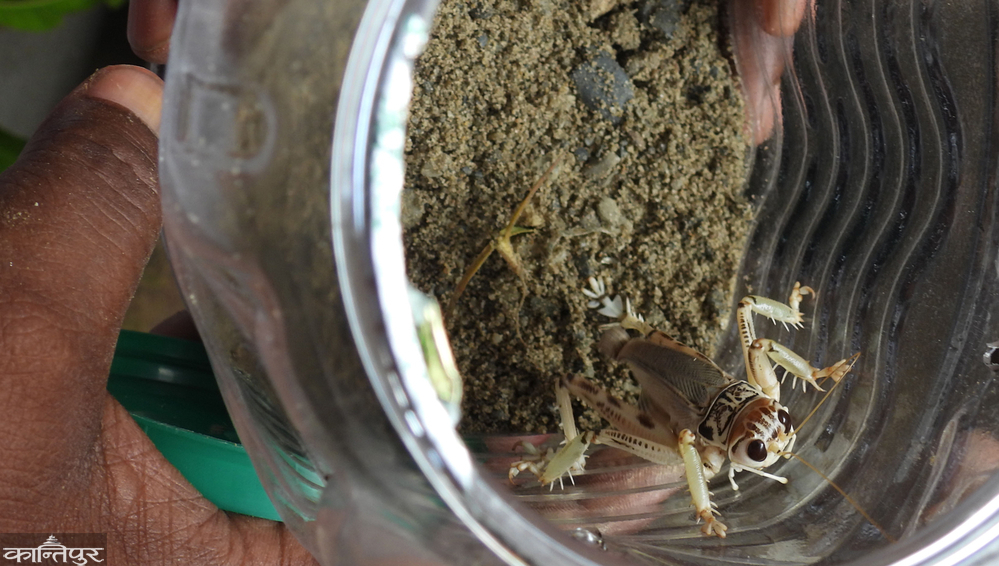
After placing Jakhkhin in Bramhasthan, it started to be filled with soil from seven villages connected to Pur after the name. A small grasshopper-like insect that lives in the sand called 'Kanthi Vedi' by the Tharu community was also offered in it. Shilpat Kakra means a special kind of rat that lives in the water seeping from the rock and the rat found in the forest was also buried in the same hole along with 'Jakhkhin'.
And Guru Bhavna continued the 'Jagir' Puja . During this, seven pairs of pigeons, seven male chickens and three females, a goat, a male sheep (female) and a duck were sacrificed, said Vijay Chaudhary, chairman of the Khurhuria Brahmasthan Temple Committee. Jagir Puja is a bit special. It is not possible to do it every year as the cost is high. This has been going on in every Tharu village since time immemorial," said President Vijay.
Every Tharu village has one or the other Brahmasthan . Vijay says that the worship of Brahma Baba, the creator, is believed to be good for everyone. Jagir Puja is held at intervals of a few years as promised for the special enjoyment of Brahma Baba. It is believed that this puja will protect the village from natural calamities, such as epidemics and droughts, said President Ziya.
In every village there is a job puja at intervals of five, seven, nine and at most 11 years. But this time, after 19 years in Khurhuriya, Vijay said that Jajar Puja took place. This worship was done by the zamindar. It has become difficult to continue after the problem of gathering expenses and support.
'Along with money, time and helpers must also be gathered . Different teams go in search of wild rats, small insects that live in the sand, and Shilpat Kakara. Sacrificial chickens, ducks, pigeons, goats, goats, and sheep also had to be found. There is a separate team to search for the soil of seven villages," said Vijay, "There is not only hiding the Jakhkhin in the evening before the Jagir Puja but also other methods . Two days are busy in worship. That's why it's only possible together.'

