Allocation of around Rs 6 crore this year for various programs related to Digital Karnali
We use Google Cloud Translation Services. Google requires we provide the following disclaimer relating to use of this service:
This service may contain translations powered by Google. Google disclaims all warranties related to the translations, expressed or implied, including any warranties of accuracy, reliability, and any implied warranties of merchantability, fitness for a particular purpose, and noninfringement.
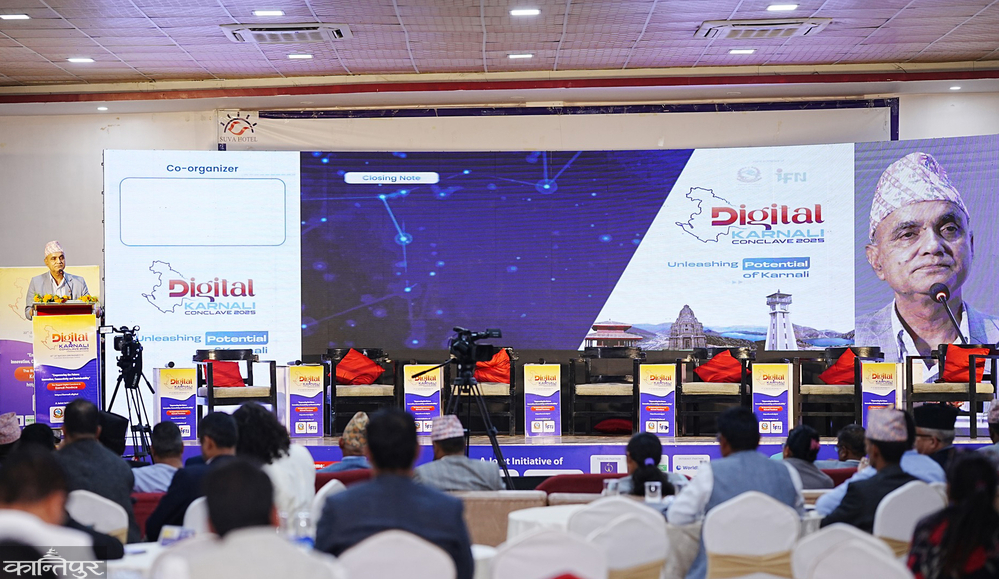
The Ministry of Internal Affairs and Law of Karnali Province organized 'Digital Karnali Conclave' in Birendranagar in collaboration with ICT Foundation in the second week of Baisakh. Most of the participants of the two-day program, which was attended by about 40 speakers, raised questions about the rationale of the program itself. "Digital Karnali conference is held at Tare Hotel in Surkhet with pomp and circumstance," said Junu Shah, information technology officer of Kushe Rural Municipality of Jajarkot, "but there is no light, no telephone and no internet in the center of the municipality."
Last year too, the ministry organized a conclave. The ministry is allocating 10 lakh rupees annually for the program.
The state cabinet meeting on January 6, 2074 decided to digitize Karnali province and formed an 8-member study committee on February 8, 2074 under the coordination of the then deputy secretary of the Ministry of Internal Affairs and Law, Bhakta Bahadur Karki. On 27th Chait 27, 2074, the committee submitted a study report on creating a digital province to the then Minister of Internal Affairs and Law, Naresh Bhandari. Based on that, the state government has been implementing various programs related to digital Karnali. For this year, about 6 crore rupees have been allocated through various ministries.
The Karnali government has been promoting the concept of 'Digital Karnali' in its policies and programs since 2075/76. But still its master plan has not been made . This year, 1.5 million rupees have been allocated for the construction of the master plan. "The work will become more systematic after the master plan," said Uttam Gautam, spokesperson of the Ministry of Internal Affairs and Law, "The draft of the Karnali Mass Communication and Information Technology Bill is also being prepared to manage the digital Karnali campaign."
In the first five-year plan of the state government, "Digital Karnali" was also included among the six priorities to fulfill the slogan of "Prosperous Karnali, Sukhari Karnalibasi". Ashoknath Yogi, a member of the State Planning Commission, said that it has been given priority in the second five-year plan which is being constructed now. "We are trying to make the government and subordinate government offices as technology-friendly as possible, we have put forward various plans so that most of the work of the customers will be done through the online system," he said.
According to the State Treasury Accounts Controller's Office, about 130 million rupees of Digital Karnali have been frozen so far. According to the data of the office, 6 crore rupees have been allocated under Digital Karnali this year.
Civic leader Durga Prasad Sapkota says that the 'Digital Karnali' campaign is not relevant now as most of the residents of Karnali are deprived of electricity, telephone and internet facilities. "The extension of 132 KV transmission line in the provincial capital Birendranagar has been stalled for four years, let's not talk about the inconvenience of internet and telephone, Digital Karnali has only become the slogan of the government," he said, "Most of the telephone towers in the hilly and Himalayan districts rely on solar energy, the phone network comes when the sun shines or else we have to be without contact for weeks." Only 4.78 percent of the population has access to the Internet. According to the census, there are 11 thousand 228 households in Humla. Only 196 houses have landline telephones. In Humla, which has a population of 55,394, only 397 people use the internet regularly. Smart mobiles are owned by 4 thousand 467 people while the number of ordinary mobile users is 9 thousand 275 .
Indra Bhai, a teacher of Bamdev Basic School in Maspur, Tajakot-3, Humla, said that she had to walk for almost a day to come to Chhaprela, the village center, to communicate with her family members through the Internet. "I am also preparing for public service officer and secondary level teacher service commission, I have to find everything on the Internet," she said, "The phone network in the village keeps going, so I come to Chaprela once a week and get the news of the house by video call."
She is a permanent resident of Kaski . She complained that she had to come to Chhaprela to send any document of the school to the Education Development and Coordination Unit. "Now all the data of the school has to be sent through the Internet," she said. Where the tower is powered by solar . He says that he goes to the telephone network for 10/12 hours everyday because there is not enough charge.
There is great difficulty in using the Internet in Simkot, the headquarters of Humla. Nepal Telecom has installed fiber technology in all district headquarters of Karnali except Simkot. Electricity of Hildumkhola small hydropower project has been connected in Simkot. But due to non-supply of water and the problem of bursting of penstock pipe, daily load shedding is 5 to 10 hours . "How can we use the Internet when there is no electricity?," said Vijay Lama, a local businessman, "Mobile data is like the fruit of the sky for us, even a normal browser can be opened in 5 minutes."
Internet is the same problem not only in local but also in government offices. Subba Ratan Nepali, deputy of the Hilsa-Simkot road project, said that although most of the government reports and data have to be updated in the software, it takes a whole day to keep the small details. "It takes 5/10 minutes to open a normal server, some documents have to be updated by telling friends in Nepalgunj and Kathmandu over the phone," he said.
Humla has ADSL of Nepal Telecom and Internet facility of Worldlink. Locals say that they have to rely on ADSL because Worldlink internet is very expensive but it is not reliable. According to him, Telecom's ADSL can be used for Rs 1,000 per month, while Worldlink charges up to Rs 10,000 per month.
Telephone, landline and internet services are interrupted daily due to lack of electricity, said Ringzinammu Lama, Acting Head of Telecom Office in Humla. According to him, 2 solar panels of around 3,000 watts have been connected to the telecom office. But once the sun goes down, solar doesn't work. "The price of fuel is also expensive, so even a telephone tower cannot be operated by running a generator all day long," he said.
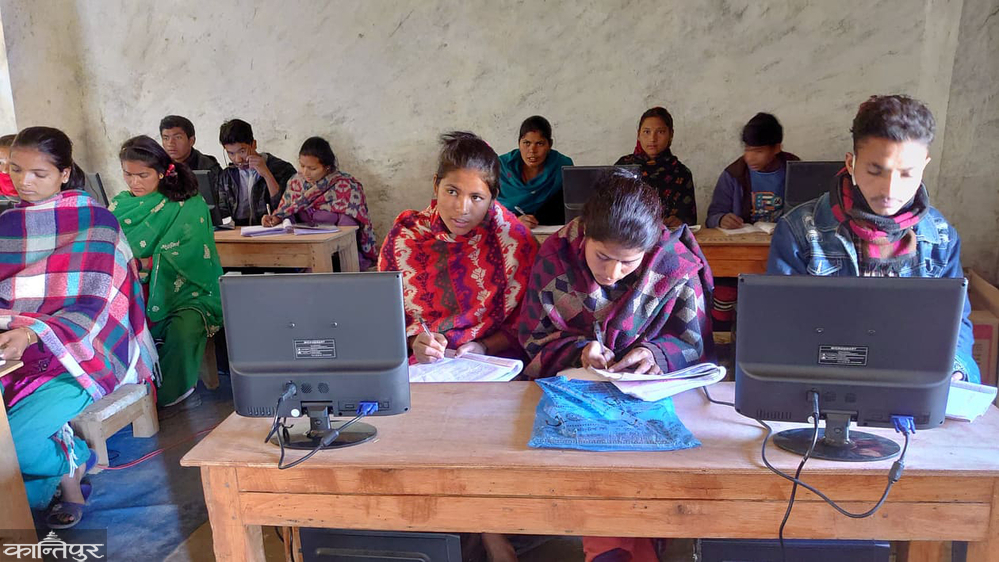
Mainadal Budha, the headmaster of Nepal National Secondary School in Sobhagaon, Chaya Natharara Municipality, Mugu, said that due to lack of electricity, the school's computer class was shut down and he had to walk for 3 hours to reach the headquarters, Gamgarhi, to access the internet. Narrated . "Nowadays, most of the government data must be sent through the Internet," he said, "even if sometimes a small document has to be sent, it is not easy to walk for 3 hours."
Chairman of Mugumkarmarong rural municipality in Mugu, Chhiringcapne Lama said that there is a problem in government service flow due to the internet. "We have connected the Worldlink network, it works fine when the sun is shining, if it is cloudy or raining, we cannot use the Internet for weeks," he said, "even to download a 50 MB file, we have to wait for half an hour."
Nepal Telecom's ADSL along with Worldlink, Subisu and other internet services have been extended in the Himalayan districts of Dolpa, Humla and Mugu. But except for government and non-government organizations, internet is not connected. Agant Rana, chairman of Kaike rural municipality, said that although most of the work should be done through the internet and software, there was a problem in entering even the general data due to the interruption of the internet service for almost a month. "Nowadays, most of the government software is made in a city-centric way," he said, "In most places of the municipality, the phone does not work properly, how to use the Internet?"
Dolpa has a population of 42 thousand 371 in 9 thousand 398 households. In which 643 people use regular internet and 288 landlines are connected. In Dolpa, 3,805 people carry a smart phone while 7,108 people have a normal mobile.
Civic leader Pitambar Dhakal says that the residents of remote areas are still deprived of communication facilities due to geographical difficulties, the needs of the locals and the oppression of those who live in the state system. "The people there are burdened with household work from morning to evening, so they don't have time to use communication tools," he said.
Prakash Adhikari, information officer of Nepal Telecom Regional Office Surkhet, informed that fiber technology telephones have been installed in 9 district headquarters except Humla. According to him, 73 out of 79 in Karnali, 4G technology is in operation at the local level. "At present, all our towers have 4G facilities, we have provided ADSL internet service in the market area," he said, "but due to the remoteness of the place, it is difficult to go to the technician after the tower is damaged and we have been experiencing electricity problems for a long time."
Tulsi Prasad Acharya, Computer Officer of the Ministry of Internal Affairs and Law, said that a campaign to create a 'Digital Karnali' has been started through various media. According to him, priority has been given to electronic correspondence to make all the ministries 'paperless'. The government's development projects have been kept in the 'project bank' from the next financial year. Likewise, software such as 'PLIMBS' for integrated accounting system, 'Palms', 'Imis', and 'Sicash Plus' for asset management have been put into operation. For road safety, ``Automatic number plate reader'' has been installed at the main entrance of Karnali, Babai, to monitor vehicles. He informed that the registration of industry across the province has been started using 'digital technology'. He informed that integrated digital data of Karnali province has been started. He said that the digital literacy campaign has been conducted up to every school level.
The state government has also started the work of establishing a digital tourism information center for the promotion of Karnali's tourist spots. Similarly, plans to start 'WiFi Hotspot' service in major cities, install CCTV, etc. have also been limited to paper . According to the census data, only 67.5 percent of residents in Karnali have access to electricity. Central transmission line has been installed in about 153 thousand houses in Karnali according to the data of Nepal Electricity Authority Karnali Regional Office.
Digital Education 140 Crore Freeze
Digital Karnali campaign under the 'Mukhyamantri Digital Education and Model School' program has been started . The program, which was initially introduced as a model school program, has been revised three times and transformed into a digital education program. Last year, about 14 million rupees of this program was frozen. Social Development Minister Ghanshyam Bhandari said that 1/1 school in other districts and 2/2 schools in Jajarkot and Rukum West have been selected for this year as well. According to him, an information and communication technology laboratory will be established to make the technology-friendly teaching and learning of the community school effective. He informed that the budget will be sent to 13 schools at the rate of 70 lakhs. From which the schools will purchase materials needed for classroom management with technology through the local level including laptops, projectors, smartboards, digital display boards.
But educationist Meen Bahadur Pun says that this program does not give much return. Most of the schools in the hilly and Himalayan districts have computer labs in a state of disrepair, because there is no electricity, no teachers, and no students. Pun, a retired teacher from the first grade of the secondary level, said, "Even now, they are trying to implement the program of the same trend as a model school, there is a risk that the lab will also be defunct within 1/2 years."
Chief Minister and Minister of Internal Affairs and Law Yamlal Kandel Karnali claims to have gradually entered the digital age. "The whole of Karnali will not be digitized in one year, but the government programs will be made digital gradually," he said.

