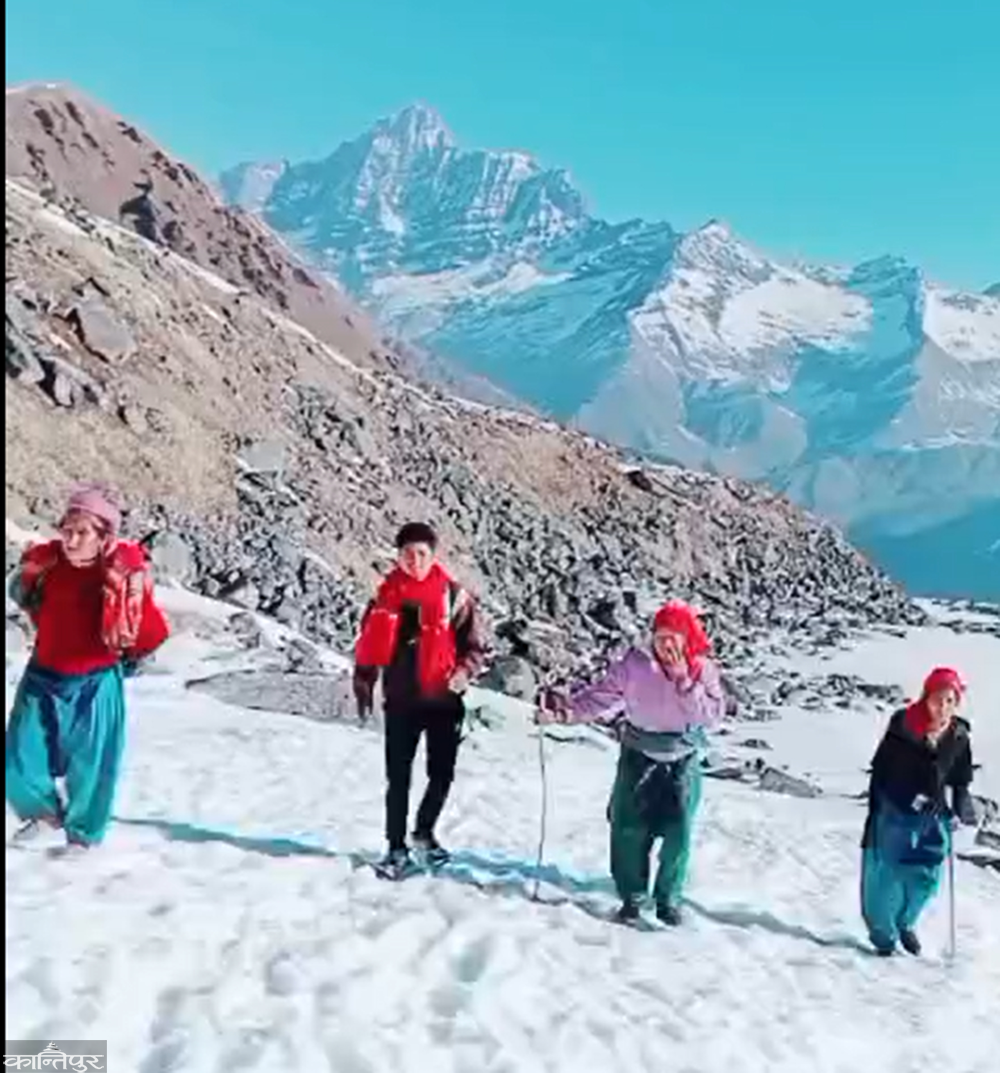
12 people died in 7 avalanches in Darchula, Mugu and Rasuwa along with Bajhang in 080. Among them, 9 people were killed in the avalanche in Bajhang and Darchula in the Far West.
We use Google Cloud Translation Services. Google requires we provide the following disclaimer relating to use of this service:
This service may contain translations powered by Google. Google disclaims all warranties related to the translations, expressed or implied, including any warranties of accuracy, reliability, and any implied warranties of merchantability, fitness for a particular purpose, and noninfringement.
'Hey, Surmadevi is with them' on Friday morning, Kulddeuta called out in all directions, Chakra Bohra of Surma Rural Municipality-2 allowed his daughter Anjana and son Sunil to walk to the lake. Leaving both of them with bowls, he said, 'Don't go down to the snow-covered places, the weather is not good, don't forget to light incense on the way.'
After applying the vaccine, the sisters left the house with a bag full of food, clothes and household items needed for three months with a smile on their faces. There were incense sticks and some red-white flags in the "side pocket" of the
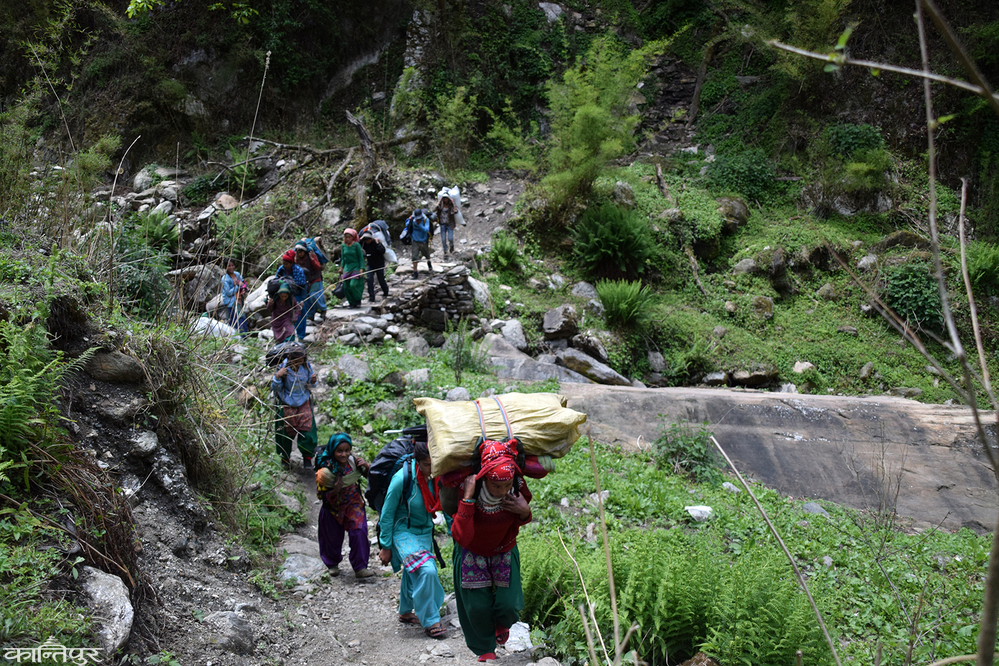
bag. After reaching some distance, they joined the crowd of 15/16 people carrying bags like them. They were climbing towards the Dhanseri Himal region, which is about 4500 to 4900 meters high, to collect all the yarcha. Even though there was passion in the legs, everyone's face showed the same kind of panic .
'There are a lot of avalanches now, so you told me not to go under the snow to look for roots', Anjana explained what her father said, 'If we don't go, the roots are found in the same place, if we go, we are afraid of being torn by an avalanche.' 18-year-old Ramita Dhami and 14-year-old Jamati Dhami of Jayaprithvi Municipality-11 Mayana, three women and girls were buried in the same grave.
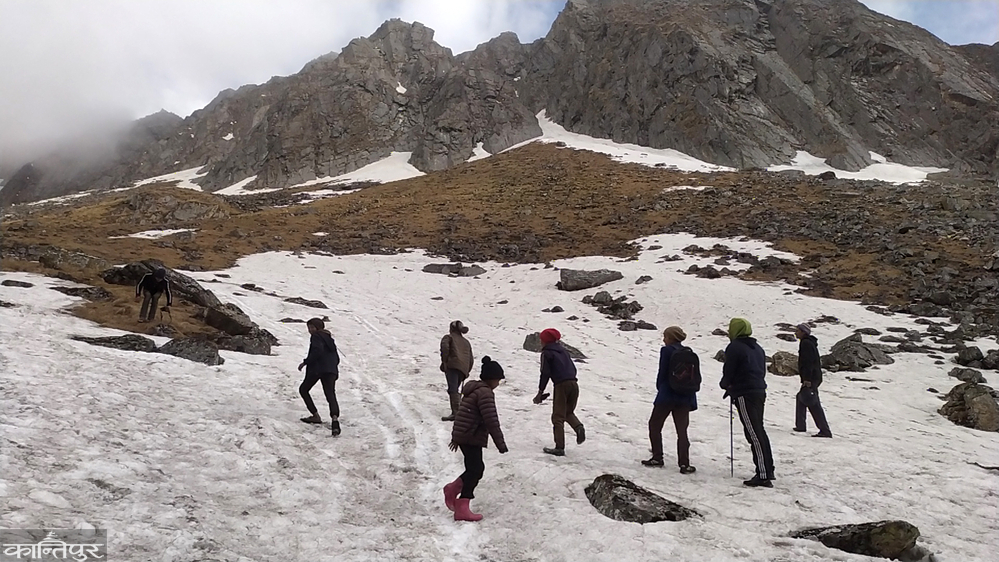
Yarcha collector going to the lake carrying charity goods. Photos: Vasant Pratap Singh.
 Anjana's uncle Babji Bohra and 14-year-old Akash Dhami of Jayaprithvi Municipality-11 Mayana were injured in an avalanche that hit Dhanseri at 11:00 p.m. "If you go to a small pool (the place where the said incident took place), you will remember the (incident) and die of fear," said Anjana. Since it has started, the risk of life has increased for the compiler . "As the temperature is rising all over the world, the temperature in the Himalayas, which should be around minus or zero, is heating up and the snow is melting. Because of this, avalanche incidents are also increasing compared to before," says climatologist Dharmaraj Upreti, "the damage to the local people who go near the mountains and pick herbs is increasing . Residents of the Far West who are still struggling to make a living seem to be more vulnerable than the latter.'
//
Usually: Residents of this region spend the winter time in Bensi (Aul) and when the summer starts in Baisakh, the family goes up to the lake . Some go up to the lake with children and quadrupeds for months to collect yarcha and herbs, while some go to graze sheep and goats. In the Himalayan region, which is considered safer than Aul in terms of disasters during the rainy season, there is an increasing threat to the life safety of Yarcha collectors and locals due to recent avalanches .
In addition, the records of avalanches are found only from February 073 on the Nepal Disaster Management Portal under the Ministry of Home Affairs, which provides information on the disaster risk situation across the country. In which, from 073 February to 081 March, there were 27 avalanches across the country, 25 people died and 8 people went missing. At most 12 people died in 7 avalanches in Darchula, Mugu and Rasuwa along with Bajhang in 080 . Out of these 12 people, eight women and one child died in the avalanche that hit Bajhang and Darchula in the Far West.
This portal does not find records of avalanches across the country in 077 and 074 . However, according to a study with "glaciologist" Thakuri, published in "Researchgate" in June 2017 under the title "Avalanche and snow disaster in the Himalayas of Nepal", it is mentioned that 372 people died in more than 60 avalanches and blizzards across the country during the period from 1922 to February 2020 . Out of which 48 people died in 1995, 59 in 2014 and 23 in 2015. According to the data at that time, most of the avalanches and blizzards seem to go to Everest, Manaslu, Annapurna and Kanjirova region .
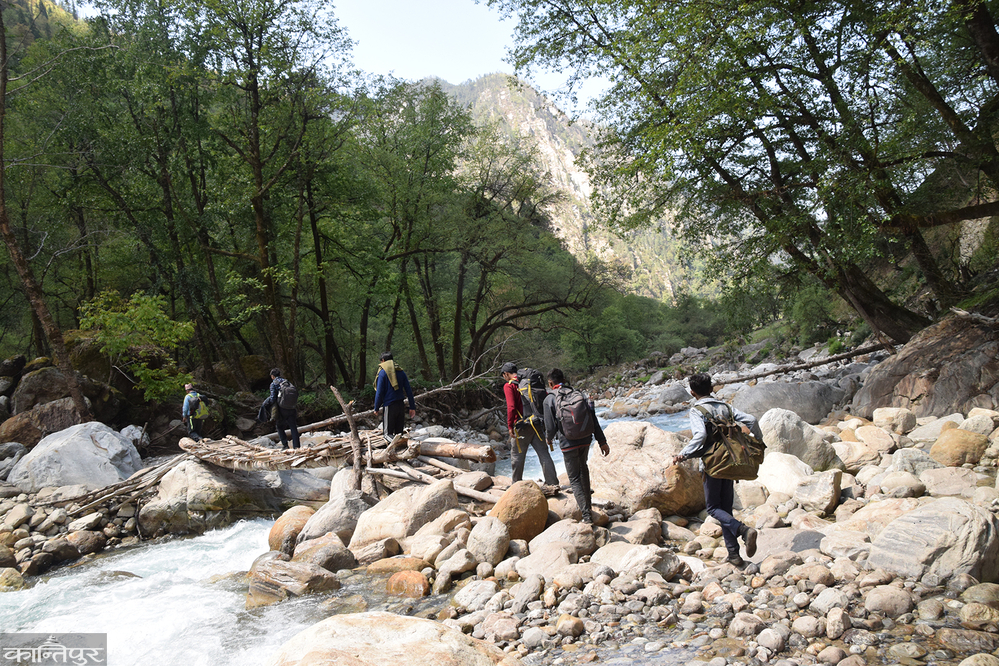
According to the records of the disaster management portal of the Home, there were three avalanches in Bajhang alone, in May and May of 080 and on the 17th of February. No matter what the risk may be, there is no option for the map collectors to search for maps by traversing the Himalayas for three months of the year. After leaving home, they have to walk with their lives in their hands until they return. "You only saw the weight of the back, the weight of greater fear is in the heart," isn't it difficult to walk the road with a heavy load? Giving a roundabout answer to the question, Jeevan Bohra, another Yarcha collector from Surma, said, "If you don't go to the lake, children will be hungry all year round, what can you do if you are afraid?" The sinful stomach had to be fed.'
Jeevan has been continuously collecting yarcha for 16 years. He also told the experience that avalanches have increased in recent years. "There was a fear of falling and slipping before, but the fear of avalanches is more than that in the last four/five years," he said, "Snow avalanches are falling day by day". After a landslide, people flee.' He said that before the landslide reaches the place where people are, they hear the noise and flee to a safe place.
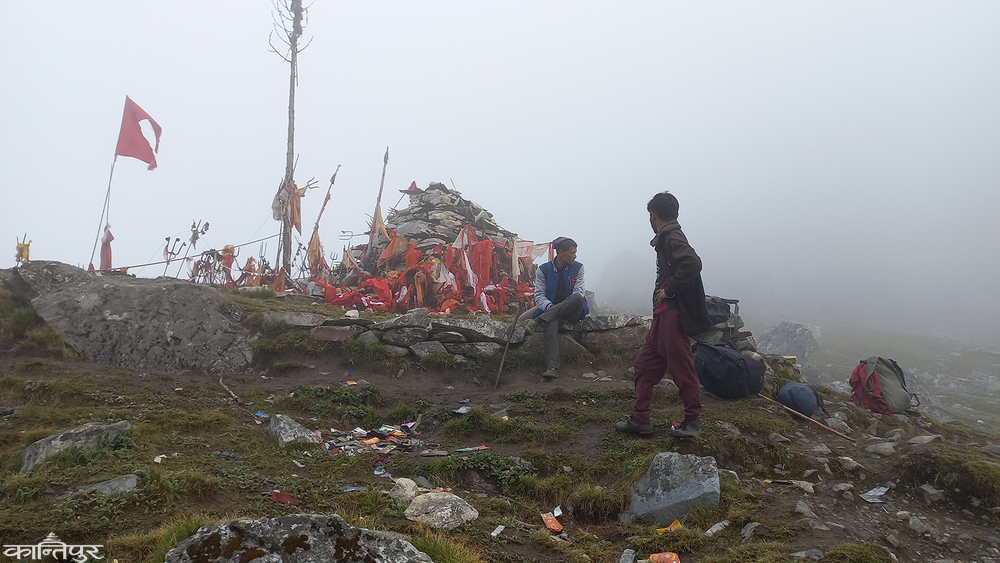
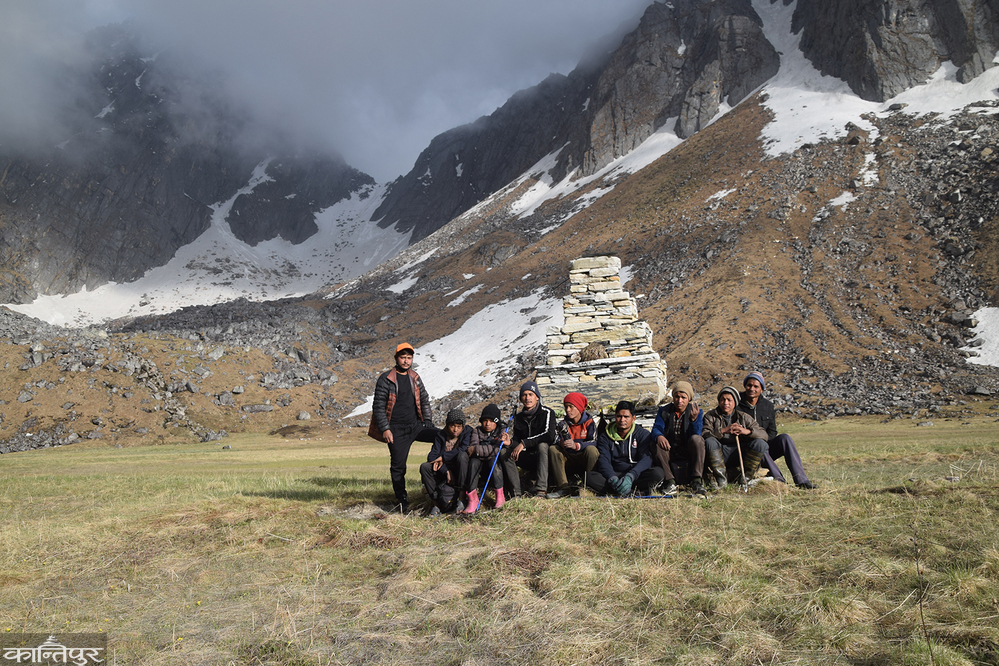
Yarcha collectors who reached the Dhanseri area of Surma
Yarcha collectors say that after the avalanche incidents started to increase, the danger has increased not only in the places where Yarcha are being collected but also in the places where tents have been put up for temporary residence for a long time . On May 19, 2080, Sinki Bohra, who was sleeping in a tent near the Vyansimare mountain, died when an avalanche fell from the tent erected by the Yarcha collector in Surma. His family had been living in that place for 12 years, pitching a tent for three months every year. Last February, an avalanche hit Saipal rural municipality, although there were no human casualties, 25 sheep and goats died.
 19 days before the avalanche in the Dhanseri Himal region of Bajhang, five Yarcha collectors who were living in a tent at Voling near Vyasa-1 Nampa Patan in the neighboring district of Darchula died due to an avalanche. Among them were 38-year-old Kamala Kunwar of Duhun Rural Municipality-4 of Darchula, her 18-year-old son Praveen Kunwar, 45-year-old Nakni Doma Thapa of Saipal Rural Municipality of Bajhang, 28-year-old Ishwari Thapa of Doti Zorayal and 15-year-old Chhimi Somo Thapa. Initially, their bodies were found on different dates after they disappeared in the avalanche.
12 people from Darchula, Doti and Bajhang were trapped in the avalanche. 33-year-old Jhalladevi Bohra Parthi of Surma-1 Dogdi in Bajhang was lost in an avalanche along with her sons while returning to the Himal region after collecting yarcha. In 2077, a Yarcha collector died in an avalanche in Faralkhet of Saipal Rural Municipality.
Similarly, on 22nd of Baisakh in the year 080, three people died in an avalanche at Chankhu Lake in Mugum Karmarong Rural Municipality-1 and 2, who had reached the area to collect rice. The bodies of 40-year-old Tarasinh Sarki, 35-year-old Punn Sarki and 35-year-old Bir Bohra, who went to pick yarcha from Talfi village of Patarasi Rural Municipality-2 in Jumla, were found 32 days after they went missing in an avalanche.
Every year, thousands of people from different parts of the country come to the Himalayan region of these districts to collect yarcha and herbs. They who collect herbs from April to June have to face this kind of risk on a daily basis .
As the number and spread of avalanches have started to affect the local people's lives, experts have suggested that the government should work on risk measurement, preparedness and public awareness. Climatologist Upreti says that the government should start working from data recording. "Government should not keep statistics on human casualties. They should have informed the locals about how much damage is increasing by keeping data on avalanches, how to be safe if people are allowed to go to those places, how to set up tents, etc.," he said. He said that the local government should work to pay attention to the movement of herb collectors and locals.
"Local people's representatives know more about the risks in which places, they can raise public awareness of where and how to go by carrying out scientific mapping of sensitive areas, thus reducing the risk of avalanches," he said.
Saipal Rural Municipality President Manveer Bohra said that due to the increased risk of avalanches, he thought of providing life insurance for 3 to 6 months to the lake-going Yarcha, herb collectors, locals and farmers . "Such incidents are happening every year, sometimes people pass away, sometimes goat herds . Since we don't have the technical skills, it would be better if the central government sends an expert to measure the risk," he said.