When the former king took his supporters to the streets, raising questions about the republic, the old parties were shocked.
We use Google Cloud Translation Services. Google requires we provide the following disclaimer relating to use of this service:
This service may contain translations powered by Google. Google disclaims all warranties related to the translations, expressed or implied, including any warranties of accuracy, reliability, and any implied warranties of merchantability, fitness for a particular purpose, and noninfringement.
Trying to win the hearts of the common people, who were fed up and disappointed when the main leaders of the major parties were trying to gain power, former King Gyanendra Shah went out on the streets in a political demonstration. The Constituent Assembly put an end to the 238-year-old monarchy and established a republic in Nepal on 15th May 2065.
When he made a statement raising questions about the republic and took his supporters to the streets, the old parties were shocked.
In June 2081, the two biggest parties of Nepal, Congress-UML, formed a coalition government and started a new equation. This alliance was formed when President Pushpa Kamal Dahal was sometimes not supporting the Congress and sometimes the UML while using the 'magic' of 32 seats of the Maoist Center, the third party in the Parliament . After the general election of 2079, when Dahal was the Prime Minister by forming two equations, the first and second party Congress-UMA made a history by forming an alliance. However, the government formed with powerful arithmetic could not overcome the extreme disappointment.
In the first point of the seven-point agreement reached between the Congress and UML last June 17, political stability was emphasized mainly by speeding up the nation's development campaign.
'To protect the national interest according to the wishes of the people, to maintain good governance in the country by controlling corruption, to accelerate the nation's development and construction campaign and to form a government of national consensus under Article 76 (2) of the Constitution with the participation of other political parties for political stability . After the implementation of the constitution, the government of national consensus will review the strengths and weaknesses and complexities that have emerged in practice, and will give priority to the necessary amendments to the constitution and the creation of appropriate laws for political stability," the agreement states. 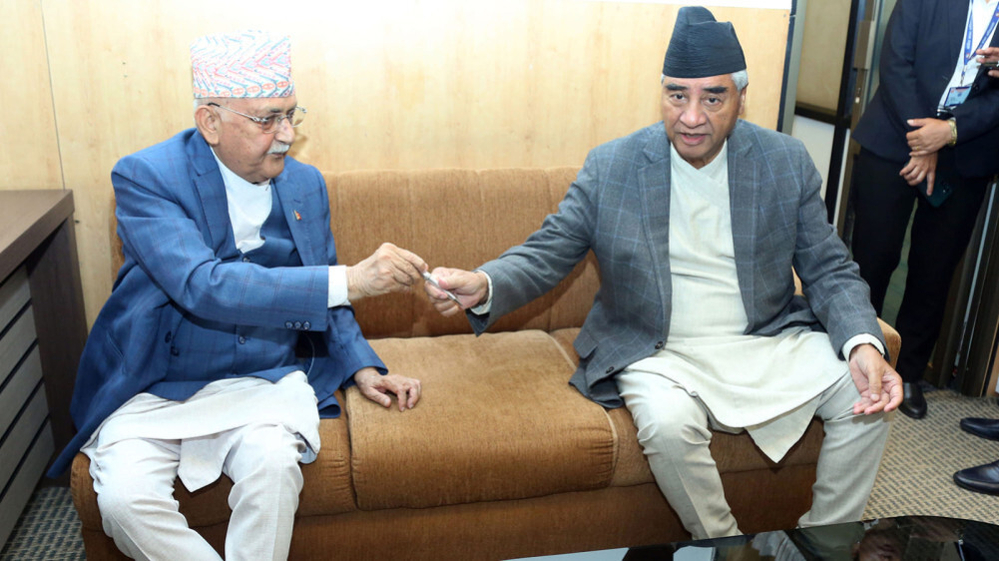 Prime Minister KP Sharma Oli is not satisfied with his work during the nine months of the formation of the coalition government. Although publicly, he has been claiming that the government has moved on the path of stability and good governance.
"With the formation of the government with the participation of a large party, the country has moved on the path of stability, stability, development and good governance," he said in a rally organized in Damak, Jhapa on Saturday, "We have come under the leadership of the government again by the opinion of the people". Now we have decided on stability and stability and have moved forward. You don't have to be under the illusion of destabilists. Oli asserted that five laws have been brought through the ordinance and claimed that the economy which is in deficit has started to rise.
After Oli became the prime minister, the game of making and destroying the government has not come to the surface. Oli seems confident that the government will not collapse after the formation of the first and second party governments. In this way, political stability is seen to some extent. But the government has not been able to overcome the frustration of the common people due to the expected improvement in the country's economic situation.
The Office of the Auditor General has stated that capital expenditure totaled 28.78 percent as of Friday. Capital expenditure is considered an important indicator for improving the economic status of the country. As the government said, the government could not succeed in the work of 'creating hope through despair'. Because of this, common people are dissatisfied when what the government says is not implemented in practice.
Although there is a strong arithmetic in favor of the government in the House of Representatives, the common people are not excited about the work. Professor of Political Science Krishna Pokharel said that even though the government has not done a good job, at least in the future, it is not possible to establish the comment that it is doing a good job.
Congress, UML and Maoists have been leading the government in turn for two decades but failed to enact laws to strengthen federalism. Although they promised to make laws related to police, employees, distribution of rights to strengthen the province, they have been ignoring it after coming to the government. Because of this, the question of federalism has started to arise.
Going to the government in turn, but strengthening the federal democratic system, raising the standard of living of the people, and creating jobs were limited to the slogans, and the royalists started complaining. After a large number of demonstrations in favor of former king Gyanendra Shah, serious questions have been raised about the major political parties. After the promulgation of the constitution in 2072, there has been a situation to be worried about the behavior of the major party towards the republicans who have raised their heads. 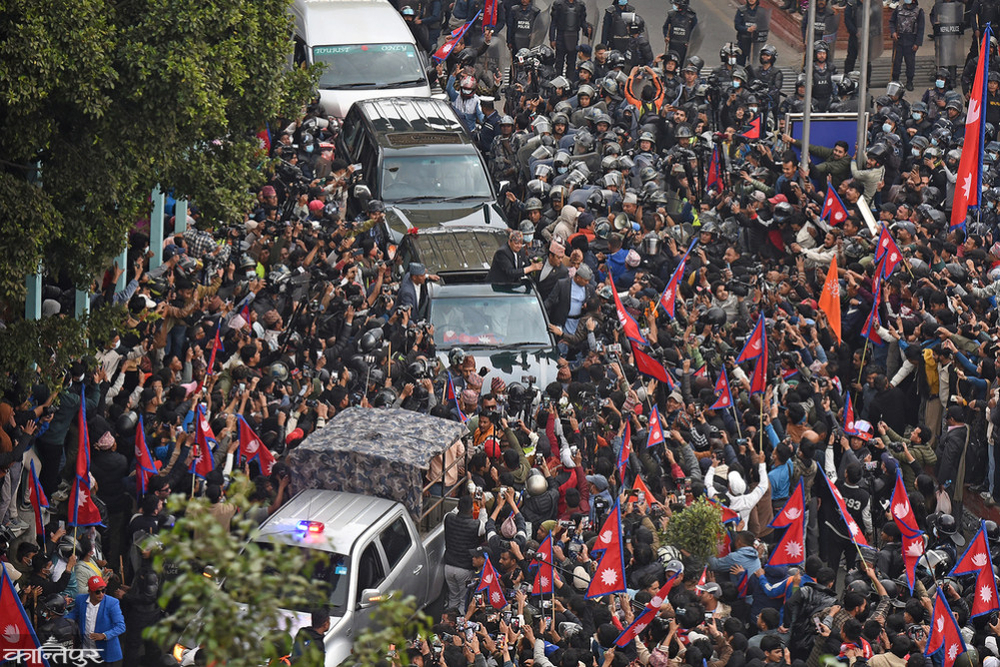
After the promulgation of the constitution, it is a serious matter that the monarchists are questioning the entire system due to the tendency of the major party to go right and left for power. Former Chief Commissioner of Election Commission Bhojraj Pokharel believes that this situation has happened because of the main party. Experts say that if the discontent reaches its peak, the major party will not be able to stop it even if it wants to. The main party should have started to strengthen the system brought by itself. Leaders started to become strong, not the system. The country has become weak again and again," says Pokhrel, "The leaders themselves have dug their own holes. This current situation has been brought about by them. It is in their hands to fall or rise in it.
The government had issued five ordinances in the last week of December to create economic growth, good governance, and an investment-friendly environment. The bill to replace that ordinance has been submitted to the Parliament and approved by the President on March 19.
Bill to amend some Nepal Acts related to good governance promotion and public service delivery, Bill to amend some Nepal Acts related to Cooperatives, Economic Procedures and Financial Responsibility (First Amendment) Bill, Privatization (First Amendment) Bill and Bill to amend some Nepal Acts related to economic and business environment improvement and investment enhancement . The government has been taking it as an important work this year.
Prime Minister Oli visited China on November 17. This year he visited China and signed an agreement on the much talked about Belt and Road Initiative (BRI) framework. After the informal two-day talks held between high officials of Nepal and China in Beijing, the 'BRI Cooperation Framework' was finally signed during Prime Minister Oli's visit to China. Along with this, it was decided that Nepal will officially proceed with the BRI signed in 2017. The BRI framework has a provision to take loans and grants as per requirement .
But despite the occasional discussion about visiting India, Oli could not go to India this year. Instead, on March 20, Oli and Indian Prime Minister Narendra Modi had a one-on-one meeting in Bangkok during the BIMSTEC conference. Earlier, Oli and Modi met in New York on October 7 when they went to the United Nations General Assembly. Although the two leaders met twice, an environment of trust could not be created between Oli and Modi. Because of this, Oli's visit to India, which has been an unannounced tradition, could not take place. After Oli, who wanted to visit India for three months, was not invited, North Chhimek went on a visit to China .
The transitional justice law, which has not been finalized for nearly two decades, can be considered as an achievement in 2081. This is an important agreement between the ruling party and the main opposition party that will have a long-term impact. After this law was approved by the President on August 13, transitional justice has moved towards completion. It is in the process of appointing officers for the investigation and truth-telling and reconciliation commission of missing persons.
Ravi Lamichhane, chairman of Rashtriya Swatantra Party, has been arrested on Chait 22 and sent to prison on charges of co-operative fraud. The Butwal Bench of the High Court Tulsipur had issued an order to send Lamichhane to prison for preliminary investigation in cooperative fraud. Lamichhane has applied to the Supreme Court against the decision of the High Court.
The government failed in the rescue of the flood victims in the second week of October. The government was heavily criticized for not being able to rescue people who were swept away by the flood in Lalitpur's Nakkhu River. 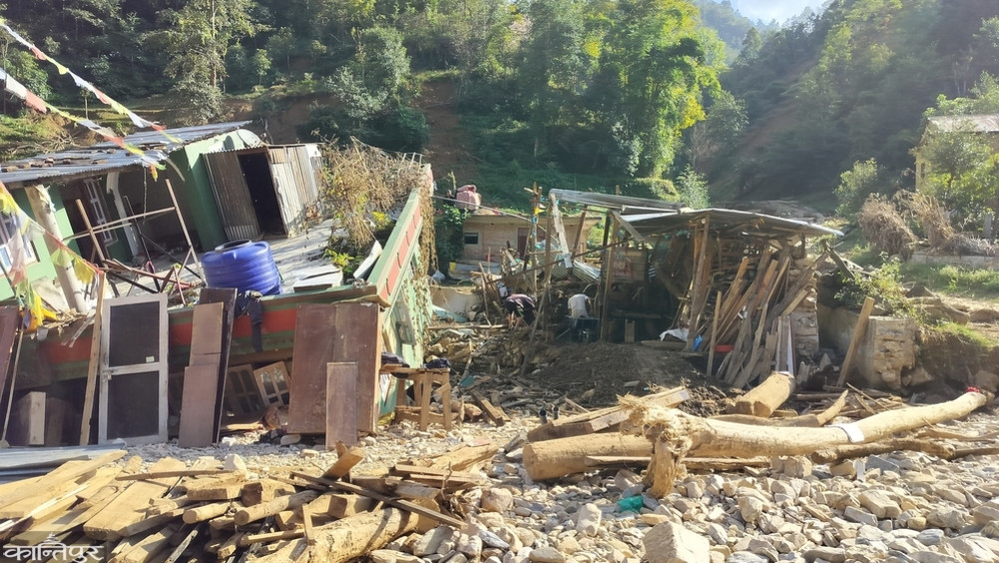 In the second week of October, due to the floods in Kathmandu and the surrounding districts, a lot of money was lost. According to the National Disaster Risk Reduction and Management Authority, Bagmati Province suffered the most damage due to incessant rains from October 10 to 13. Three days of heavy rain killed 250 people and 18 people went missing. 178 people were injured.
Landslides, floods and inundations have caused billions in damage to infrastructure such as schools, health institutions, roads, hydropower and agricultural crops and livestock. According to the authority's data, the damage to physical infrastructure is 38 billion 92 million 34 million, 5 billion 88 million 28 million to agriculture and livestock, 7 million 2 million to education, 2 million 17 million to health and 1 billion 35 million to irrigation. But the government failed to rehabilitate the flood victims.
Local level by-elections held on November 16 . In this by-election, the old party dominated . In the by-election for 44 seats, the first Congress won 19 seats, the second Maoist won 11 seats, and the third UML won 8 seats. In the
election, elections were held for 41 positions, including one municipal head, one deputy head, two rural village presidents, four vice presidents and 33 ward presidents, while Rukum Paschim Putha was unopposed in Uttarganga Rural Municipality-2 along with Oldhunga and Kailali district coordination committee heads.
After leaving the government, the Maoists launched the 'Maoist Terai Madhesh Awakening Campaign with the People'. The campaign, which started from the second week of February, was suspended in the middle of the campaign and the warning against the government and regression was made the main issue. Similarly, the UML, led by the government, conducted a 'roots-centred' awakening campaign in all wards, while the Congress continued its political campaign with regional conventions.
On March 12, after the government removed Kulman Ghising, the executive director of Nepal Electricity Authority, there was a strong protest. The opposition, including the main opposition party Maoist Center, blocked the federal parliament for six days . Prime Minister Oli had to answer about this in Parliament.
February 15 A violent demonstration took place in Tinkune of Kathmandu under the leadership of controversial businessman Durga Prasai. During the demonstration, one person was shot by the police and a journalist died in a house set on fire by the protesters. Prasain, the main planner of the protest, was arrested on Chait 29. The police administration is being criticized for not adopting sensitivity and lack of coordination in controlling the violent demonstration in Tinkune.

