24th Lion's Memorial Day
We use Google Cloud Translation Services. Google requires we provide the following disclaimer relating to use of this service:
This service may contain translations powered by Google. Google disclaims all warranties related to the translations, expressed or implied, including any warranties of accuracy, reliability, and any implied warranties of merchantability, fitness for a particular purpose, and noninfringement.
Gajendra Narayan Singh was my friend even though he was two to four years older than me. He was a Congressman while I was a Communist. But he was a victim in the Congress party from the beginning. Although he was a Rajput, he belonged to an ordinary family. Being politically victimized, he had a friendly relationship with me to share his grief. For the second time V. No. When he went to jail in 2017, we both came to consult each other. His personal ambitions were so much that he was never going to be the leader of the Sadbhavana Party movement in life.
This is the excerpt written by Krishnaraj Burma, the leader of the Nepali Communist Movement, in his book 'Madhesh and Madheshi Movement' discussing about Singh.
vs. After the change of 2007, Tarai Congress was the first party to raise the issue of Madhesh. However, after the party's defeat in the 2015 elections, Terai Congress leader Vedananda Jha changed his political direction and entered the panchayat. However, Singh left the Congress during the Panchayat period and created the identity of a leader who fought for Madhesh. He was known as a leader who constantly fought in favor of Madhesh.
As the communist leader Burma suspected, Singh never put his personal ambitions first. His position in politics became high because he gave the issue of Madhesh a top priority. When the panchayat was at its height for 30 years, Singh tried to raise the voice of Madhesh by forming the Nepal Sadbhavana Parishad. After the merger of Terai Congress, Singh raised the issue of Madhesh.
Hark Gurung's 'Migration Study Working Group' was opposed to the report titled Internal and International Migration of Nepal prepared in 2040. Gurung's report said that the number of immigrants, i.e. people of Indian origin, was increasing in Terai districts.
Singh strongly opposed Madhesh residents being called foreigners. As political parties were banned at that time, Singh opened the Nepal Sadbhavana Parishad. Leader Hridayash Tripathi remembers that the Gurung Report raised questions about the existence and nationality of the Madhesi. The report also included many suggestions for Nepalization in Madhesh. However, due to the opposition of some Madhesi leaders including Singh, Tripathi said that the then government hesitated to implement it.
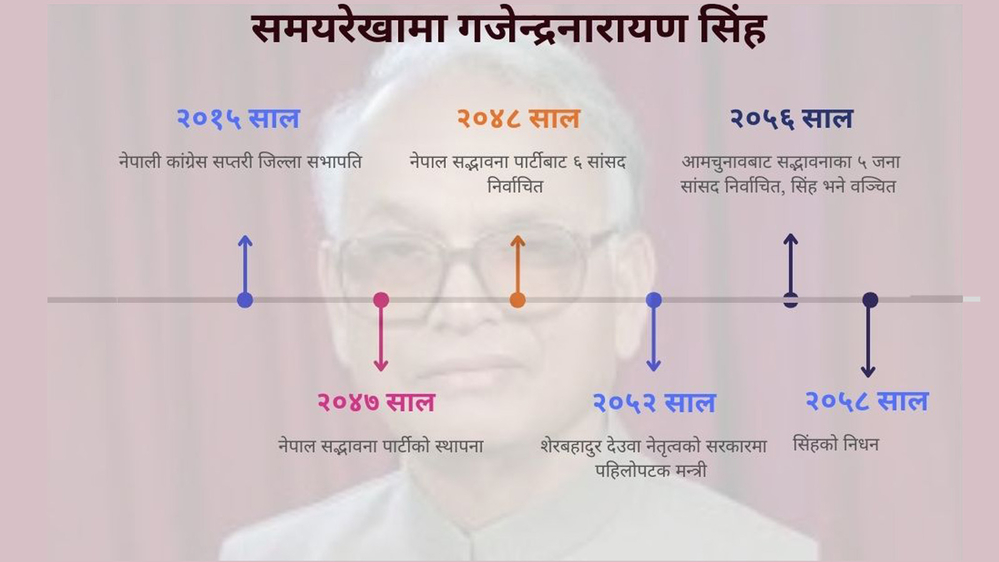
After the political change of 2046, he changed it to Nepal Sadbhavana Party and advanced the issues of citizenship, identity and representation. Since then, Singh's contribution to the issue of Madhesh is considered to be a big one.
Journalist Basant Basnet has written in his book 'Awe of 72' - Singh from Saptari Koiladi was the Saptari district president of Nepali Congress in the general election of 2015. Gajendra Narayan was also one of those who campaigned for a democratic multi-party system with the Congress in the 2036 referendum. Singh is a person who has emerged creating a different image among the leaders who have reached the leadership level from the Madhsi community. After the change of 2046, he organized and institutionalized the political demands of Madhesh.
vs. After the establishment of Nepal Sadbhavana Party in 2047, Singh gave first priority to the issue of solving the citizenship problem in Terai-Madhesh. At that time, he raised the voice that all those living in Nepal should be declared citizens of Nepal and given citizenship until the day the new constitution of 2047 comes into effect. At that time, he made it a political issue by saying that at least one million Madhesi were still deprived of citizenship certificates.
Likewise, the inclusion of the Nepalese army was another important issue he raised. He demanded that at least 10,000 Madhesi youth should be recruited into the Nepali Army. Similarly, he raised the demand of 50 percent reservation for the Madhesi community in every type of government service. The main political demand was that the number of constituencies should be increased to 50 percent in Madhesh and the Terai region should be considered as a unit and declared as an autonomous province. He raised the voice of the need to take the country to a federal structure and form an autonomous province when he opened the Sadbhavana Party and introduced a new debate regarding the government structure.
Hindi should be declared as the national language, Census should be conducted by an impartial commission, and the protection of cultural identity of Madhesi should be the political issue of the party. Throughout his life, he has been raising the issue that the democratic system cannot be strengthened by depriving the Madhesi community, which makes up half of the country's population, of proper representation in the governance.
2046 On the night of 26th Chait, democracy came to the country after the agreement between the King, Congress and Left Front. However, Singh was not satisfied only with the change in the system . "Democracy came, but it had to come for the Madhesi too." Marichaman went, Ganeshman came. There was no difference for the Madhesi,' Rajendra Mahato has written what he said at that time in his book 'Adhura Kranti' as follows, 'Democracy must come for the Madhesi too. We have to fight a second time for the democratic rights of the Madhesi.'
Although the system changed, the Madhesi were far away from the access to governance and identity. This fight for change and its achievement did not shorten its distance. How is Gajendrababu happy? In fact, he was very visionary,' Mahato wrote in the book remembering Singh.
With those issues, the goodwill of the leadership was burned in the 2048 election. In the 2015 elections, the Terai Congress was completely boosted . However, in the first election after the restoration of democracy, 6 MPs including Singh were admitted to the House of Representatives.
Sadbhavana was recognized by the National Party . Gajendra Narayan Singh was elected from Saptari, Hridayash Tripathi and Trioginarayan Chaudhary from Nawalparasi. Similarly, Shyamsunder Gupta, Santprasad Chaudhary Tharu and Mirzadilsad Veg were elected from Kapilvastu from Rupandehi . Rameshwar Yadav's presence in the upper house was due to good faith after getting a seat in the National Assembly.
For the first time, a party that carries regional issues and speaks the voice of Madhesh as a whole was admitted. The rule to come to the Parliament at the beginning of the national dress tour was broken by the MPs of Sadbhavana led by Singh. All of them entered the parliament building in dhoti kurta and gamcha. Tripathi, who has been active in the party since the establishment of the Sadbhavana Party, remembers that even when the king presented the policy program in the first parliament, he went in his own clothes.
"On the days when the policy and program were presented, it was requested from the Parliament Secretariat to at least wear a scarf and cap," Tripathi said, "then we were planning to listen to the policy program from outside." But, due to the skills and wisdom of the then speaker Damannath Dhungana, we went to the parliament in our own clothes.'
Sadbhavana Party reached Khumchin in the hung parliament after the mid-term elections of 2051. Only 3 seats were won. However, the Parliament's number math increased the importance of that seat . That started the journey of Sadbhavana's ascension to power.
On August 27, 2052, Singh became a minister for the first time in the government formed under the leadership of Sher Bahadur Deuba. He got the responsibility of supply minister . During the tenure of the Parliament, the government kept changing. Sadbhavana Party participated in almost every government. During that period, Singh himself became a minister several times.
Kathmandu always accused him of being pro-Indian regarding the demand being put forward by Sadbhavana. But, in reality, he was a patriot. Kamal Thapa, who is in the cabinet with him, has written about him, 'Gajendra Narayan was established as an influential leader of the Terai in Nepali politics after the restoration of the multi-party system. He made the rights and interests of the Nepali people living in Madhesh a major issue.'
Thapa remembers Singh in the book 'Blockade and Geopolitics' published this year and wrote, "Many people knew him as a leader who was inclined towards India". However, although he was soft towards India, he was aware of Nepal's rights. Despite interference in Nepali, he spoke Hindi in Parliament. He always used to wear dhoti and kurta to Parliament.'
Thapa has also mentioned the incident of Singh wearing Daura-Suruwal and inspired him to wear Dhoti-Kurta. Thapa and Singh were together in the cabinet led by Deuba . Their seats used to be together. After becoming a minister, Singh started visiting parliament and formal functions.
One day Thapa said to him, 'Gajendrababu . Daura-Suruwal is very suitable for you. He chuckled. The next day he gifted me a set of dhoti-kurta and said, I wore Daura-Suruwal . Now you also wear dhoti-kurta . Suits you too . That behavior of Gajendraji made me emotional, my respect for him increased.'
Although 5 members of Sadbhavana got entry into the parliament from the general election of 2056, Singh himself remained deprived of it. At that time, because the Congress brought a single majority, the process of coming to the government of Sadbhavana was stopped.
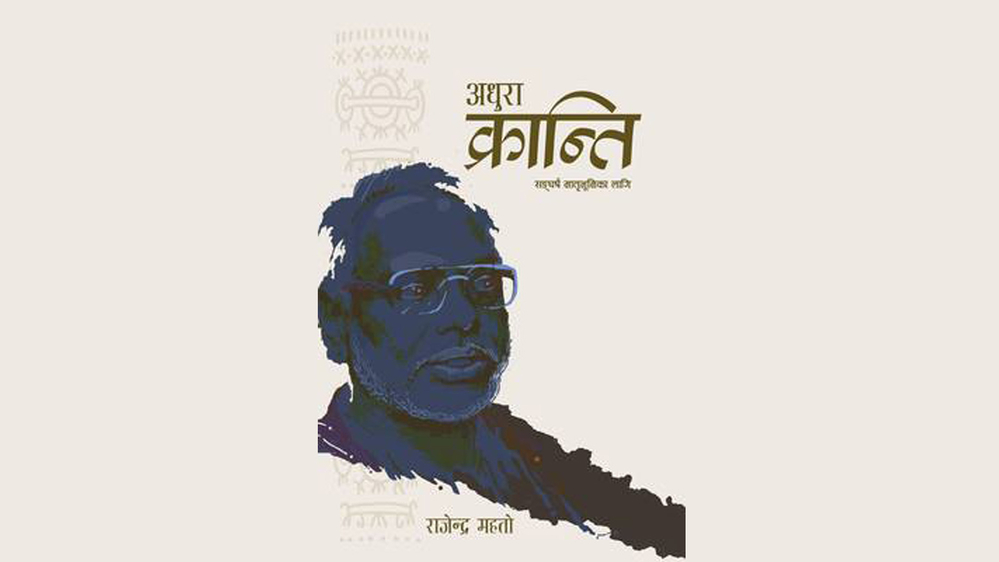
Singh left the world on January 10, 2058. His followers are celebrating his 24th Memorial Day on Thursday . Mahato writes, "With the passing away of Gajendrababu, the main pillar of Madhesh fell". The people of Madhesh became orphans.'
He died of a heart attack. Tripathi, who spent a long political life with Gajendra Narayan, says that he is a very fearless, anti-discrimination and true democratic leader. "As long as he was alive, he remained unwavering in his cause and stance," said Tripathi, "After his death, the party was devastated." However, even the little achievement that Madhesh or other backward communities have now goes to him. The issues raised by him and the expanded form of the movement are the later Madhesh movements.'
After the death of Singh, party vice president Badri Prasad Mandal became the acting president. However, he could not continue the political aims and issues taken up by Singh, so he surrendered himself to the shelter of the then king . In October 2059, Gyanendra overthrew the Deuba-led government and took power in his own hands. Meanwhile, Mandal also became a minister.
Mandal got the responsibility of Minister of Agriculture and Cooperatives and Local Development in the cabinet formed by Gyanendra on 25 October 2059 under the leadership of Lokendra Bahadur Chand after deposing the elected government. Tripathi said that the decay in the party started from there. For the first time after Mandal moved towards Raja, the party was divided on the basis of ideas and principles.
Then Nepal Sadbhavana Party (Anandi Devi) was formed under the chairmanship of Singh's wife Anandi Devi Singh. The party was involved in street protests for the fight for democracy. After the success of the Jan Andolan, the Sadbhavana Party became more fragmented.
Most of the leaders of Sadbhavana were scattered . No one was ready to accept someone's leadership. Half a dozen parties named Sadbhavana were opened. There are still two parties named Sadbhavana in the party registration list of the Election Commission . However, they appear only in the party registration list. Activation is nowhere . Kavita Kumari is the leader of Nepal Sadbhavana Party and its old paw election symbol. Similarly, Nripendra Kumar Singh is the president of Rashtriya Sadbhavana Party and appears in the Commission's list.
Dozens of leaders including Hridayash Tripathi, Rajendra Mahato, Anil Jha, Rameshwar Rai Yadav, who made political identity and height in the Sadbhavana party in the past, have broken ties with Sadbhavana. They are leading different parties or are in other parties .

