We use Google Cloud Translation Services. Google requires we provide the following disclaimer relating to use of this service:
This service may contain translations powered by Google. Google disclaims all warranties related to the translations, expressed or implied, including any warranties of accuracy, reliability, and any implied warranties of merchantability, fitness for a particular purpose, and noninfringement.
UML leaders Bhim Rawal, Binda Pandey and Ushakiran Timsena who questioned the decision of businessman Meen Bahadur Gurung to donate for the construction of the UML headquarters were recently prosecuted. Rawal has been expelled so as not to lose organized members, while Pandey and Timsena have been removed from their duties for 6 months.
Pandey and Timsena clarified on November 12 that "commenting that the decision to make a party headquarters with the donation of a single person is wrong is not a matter of action". Rawal, who is inactive in UML, did not think it necessary to give an explanation. Last week, the UML central secretariat meeting took action saying that the explanation was not satisfactory. 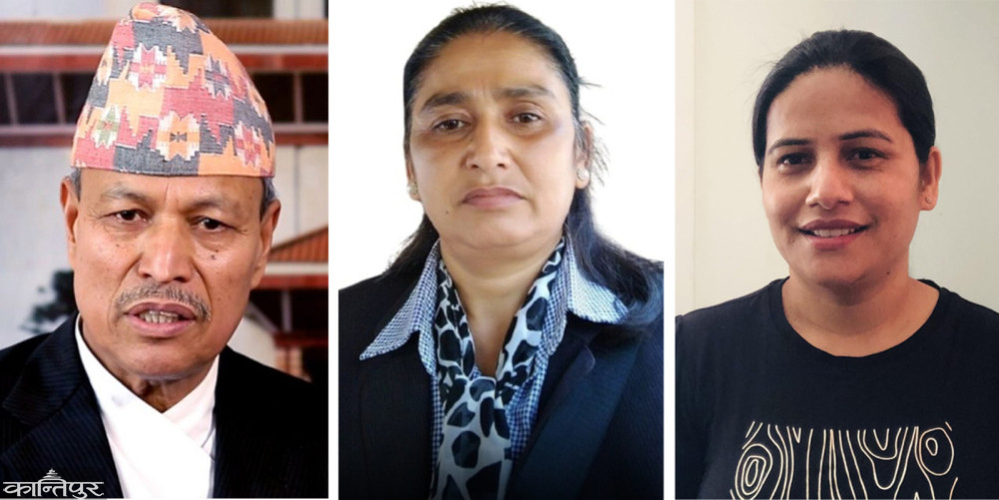
Similarly, in the second week of November, UML suspended Lumbini state MP and former minister Durga Prasad Chaudhary as a party member who expressed that it was wrong for the party to donate land from Gurung.
It has been commented that the democratic centralism (internal democracy) that UML is saying is weak due to this incident. Lately, UML President KP Sharma Oli has authority. Because of this, different opinions are like prohibition. According to an official of UML, there is no need to have a different opinion on the decision made by the original leadership (Oli).
A research published recently has concluded that the internal democracy within the parties is declining. A recent research conducted by the Policy Research Institute under the Government of Nepal on the title of 'Role of Political Parties for the Institutional Development of Democracy' has mentioned that overall democracy is weak in the institutional development.
Congress, UML, Maoist Center, Janata Samajwadi and RPP have been seen to have a weak role in the institutional development of democracy. Since those parties are leadership-oriented rather than policy-oriented, internal democracy is weak, and the study has concluded that they have failed in the institutional development of democracy as a whole .
research has concluded that due to the policies taken by the five parties, not only democracy but also the electoral system is becoming more expensive .
The research of Muktiram Rizal, Ashok Pandey, Arjun Kumar Thapa and Gopal Acharya has determined that democracy will be institutionalized only if the internal democracy of the parties is strong.
'Political policies are also policy (original policy) so it must be policy-oriented . However, in the recent days, examples of the weakening of policy aspects in Nepali politics have been exposed from leadership-oriented (not policy) activities in political party congresses," the research concluded.
It is stated in the research report that only if the policy taken by the political party can be transformed into the policy of the state, democracy will be properly institutionalized.
The research has shown that internal democracy has not been practiced because those parties do not operate in a lawful manner according to the constitution, factionalism is rampant, and those who hold different opinions are being punished.
'There is no ideological discussion within the political parties of Nepal, the party is not run in a lawful manner, members take action when they raise questions about the weaknesses of the leadership, they oppose factions but build their own factions, when selecting candidates for elections, they choose the position of advantage rather than efficiency and leadership ability. As it was found in the study that there are activities such as adopting the system, voluntarily changing the provisions of the law made through the legislative convention, this means that political parties In addition to the weakness of internal democracy, their institutional development also seems to be affected. Therefore, the parties have no choice but to act according to the constitution, party statutes and laws. According to the survey conducted by the
Policy Research Institute, internal democracy is in danger due to factionalism within the party said . The Communist Party has been practicing internal democracy as 'democratic centralism'. According to the
 survey, 90 percent of people think that internal democracy is in danger because of factional political dominance in the parties. Likewise, 89 percent of them are of the opinion that new leadership is possible only if the parties are moral. Similarly, 87 percent voted that although internal democracy and other matters have been improved in the constitution of political parties, it has not been implemented in practice.
The main leadership of the party misused it by creating factions and sub-factions to strengthen themselves. "96 percent of the participants in the survey said that there is a problem of the leadership gaining power, creating factions and abusing it," the conclusion said.
to the extent that 78 percent of them have held the view that there is a lack of democratic culture within the parties even though there are provisions in the constitution, laws and laws. They have run the party by circumventing the constitution, laws and laws. While the democratic process is their basic mantra.
research has concluded that the parties formed according to the law have problems in implementing the same law . 41.81 percent said that the Election Commission should bind the parties themselves rather than binding the parties to the law. Likewise, 80 percent have mentioned that there is a problem in the implementation of the law related to parties. 90.91 percent of the participants in the
survey voted that their activities should be kept under the supervision of the regulatory body right from the party registration. During the investigation, 92.73 percent of the participants concluded that democracy could not be institutionalized because independent performance could not be effective due to the party shadow in the Election Commission.
Lack of good governance and financial transparency
In the research report, it has been found that although Congress, UML, Maoist Center, Janata Samajwadi and RPP have their own political principles, their leadership behaviors are similar.
'Though there are some theoretical differences between the existing political parties and their leaders, it was found in the study that there is no fundamental difference between all the parties and their leaders in practice. 90 percent of the participants were of the opinion that regardless of what is said in the party theory, when the political parties come to power, their intentions and corrupt character are seen.
Research has shown that when parties aim to win elections anyway, it has an impact on good governance and financial transparency. "More than 85 percent of the respondents said that when the parties intend to win the election, it has an impact on good governance and financial transparency," said the research. break The financial resources of the parties are opaque
Research has shown that even though political parties take donations during elections, congresses, and other times, they are opaque.
'During this study, although political parties receive financial support through various means (donations from religious businessmen and party workers, extortion, party-based NGOs, donors, privatization of public assets and fees through the promotion of officials, etc.), only membership fees are accounted for in the party's financial resources. It has been found that it has been shown in the test,' it is mentioned in the research .
82.22 percent of the participants in the study were of the opinion that for the operation of political parties, either the government should provide expenses or it is essential to make legal clarity and transparency about the sources of expenses they incur. "Therefore, it seems necessary for the regulatory body to be serious about the fact that the existing provisions are not sufficient to ensure the financial transparency of the parties," the report said. It is mentioned that the political parties included in the
study did not disclose the property details of the officials and members of the central committee of the party after the convention. Information about this was not reported to the Election Commission.
'Since political parties are public institutions, their officers and members should automatically be people (officials) who hold public positions and they are not obliged to submit and publicize their assets in accordance with the law. The report concluded that the parties are opaque. In the
research report, it is mentioned that the Election Commission has not been able to make the parties responsible and has not been able to monitor the expenditure during the election period. "In addition to punishing those who spend more than the limit set by the commission, in addition to modifying the method of election campaigning and suggesting a way to appeal to the voters at a low cost, it is necessary to implement the actual monitoring and evaluation mechanism of the candidate's election expenses," the report said.
It has been pointed out that it is very necessary to determine the maximum limit of the amount of voluntary financial support that the political party receives from any person and organization and that the party provides to anyone. When a person and organization provides voluntary financial support to a political party in this way, it should also be made mandatory to disclose its source. For this, it can be arranged that individuals and companies who provide voluntary financial grants to recognized political parties should be able to show the expenditure of said grants for the purpose of tax assessment,'' the report says, 'When the relevant political party submits its annual financial statement to the Election Commission, it can only receive voluntary financial support in accordance with the law. Arrangements should be made to declare and submit (verified by the relevant party's compliance officer).'
Election Supervision Committee Nepal (2017) during the supervision of the House of Representatives elections of 2074, it was revealed that direct candidates in the House of Representatives elections spent an average of 2.13 million rupees. "In the present context, all stakeholders are raising concerns that the details of the election expenses submitted by the candidate to the commission are not genuine, and it seems that it is not possible to further study this aspect and regulate such opaque activities that are against the rules," the research report states.
In the general election of 079, the candidates who stood up in the direct election who spoke formally said that they spent more than that .
Suggestion to publicize the asset details of the leaders
According to Section 53 of the Political Party Act, 2073, a person elected as an official and member of the Central Committee must submit the asset statement to the central office of the relevant party within 60 days of being elected and the statement must be recorded and published within one month. There is an arrangement but the parties do not seem to do it . In terms of the fact that elections are becoming more expensive, almost all the participants in the research agreed that financial transparency is a challenge because the actual expenses are more than the limit set by the Election Commission.
In this study, 95 percent of the participants said that the trend of excessive spending in elections has increased and because of this, it is difficult for honest, qualified and capable people with low income or who want to participate in financial waste to reach the leadership. .
"In order to put an end to the situation where spending limits are set only in the code of conduct, but only those who spend large sums of money in practice win the elections, the Election Commission and the parties should seriously review and move forward the provision of micro-monitoring and strict action," the report suggests .
Even though the Election Commission will issue the code of conduct for the parties, it is mentioned in the study that the leaders of the party win the election by influencing the voters by spending more than the commission.
There is a need for the political parties themselves to strictly follow the code of conduct and in case of violation of the code of conduct, the political parties should cooperate in the process of proceeding by the regulatory body according to the provisions of the law and rules. It is necessary to strengthen the internal democracy of the parties as the democratic system will be stable only if there is competent leadership from all the parties and such a process will give the right leadership to the country,' the report states.
The Act on Political Parties, 2073 stipulates that it should be mentioned in the statutes of the respective parties in order to be subject to the Act on Political Parties and other prevailing laws, but when reviewing the statutes of all the five political parties participating in the study, the statutes of any party clearly state the work, duties and rights of that party. It seems that it has not been mentioned.
'The political parties of Nepal have not been able to reform themselves and considering the needs of the country in the current world environment, the party's agenda and policies need to present the meaning of the constitution, the country's policy needs in the party activities, so the political party as a public organization should have a leading role in making the policies needed by the state' Recommendations are given in the report .
'During the study, it is not seen that the state policy and the party policy are mutually supportive, so the role of the Election Commission as a regulatory body is strengthened to practically implement the activities of the political parties under the Constitution of Nepal and the Act on Political Parties and to reduce the policy gap between the state and party policies. Need to be,' the suggestion says.
Parliamentarians focus on development projects rather than policy making
The main role of MPs of political parties should be focused on policy making, but they seem to be more focused on the development of their respective constituencies .
'Political parties should take seriously the reality that the parliamentarians representing the party are more interested in development project transactions than policy making and the bureaucracy is controlling the role of political parties in public policy making' Since the active role of political parties is seen as inevitable at every stage of the policy cycle, it seems necessary to increase the active participation of political parties in policy making and implementation accordingly Among the various aspects, it has been seen in the study that there is a 'passive role of political parties'.
Although the principles are different, the behavior is the same
In the study, it is mentioned that Congress, UML, Maoist, Jaspa show the same behavior after coming to power, even if the ideas and principles are different.
"In the study, 90.90 percent of the participants said that regardless of what is said in the party theory, when political parties come to power, their wrong intentions and corrupt character are more visible than their own principles," the study report said, "More than 85 respondents said that when the parties intend to win the election, it affects good governance and financial transparency." and should be transparent but through various means (donations from businessmen and party workers who believe in the party, extortion, party-based NGOs, donors, public property Fees through privatization and promotion of office bearers) despite receiving financial support, there is a trend of showing only the membership fee in the financial resources of the party in the audit,' concludes the research . In the
study, 82.22 percent of the participants gave the opinion that either the government should provide the expenses for the operation of the party or it is imperative to make legal clarity and transparency about the sources of expenses they incur.
The team that investigated the Election Commission's statistics prepared the report after the details of the main party's central office, interviews with leaders, experts and people interested in politics.
Researcher Ashok Thapa said that the fact that internal democracy is weak in major political parties of Nepal has been found. Due to this, he says, there is a problem in institutionalizing democracy in the country.
It has been seen during research that internal democracy is weak in any party. Financial transparency is not even in any angle. "There is no consistency in the party's manifesto, party management method," he said, "because the opinion, decision and opinion of the party chief is applied, it does not seem that different opinions are respected." Therefore, the internal democracy is very weak.' He said that the country's democracy could not be institutionalized because the indicators of democracy are weak because the
parties themselves are not transparent and democratic. The report suggests that the Election Commission should play a role in bringing Nepal's political parties on track.
'There is also a question about the election role . As it should be evaluated, it has not happened . It seems that the parties have dominated the commission's decision, he said.
Thapa says that the research shows that the parties are not transparent even in the selection of leadership in the party's convention and the selection of candidates in the election.
Professor of Political Science Krishna Pokharel said that the country's democracy will be institutionalized only if the parties practice democratically.
UML Deputy General Secretary Pradeep Gyawali claimed that democratic centralism is being practiced within the party. "It is possible to debate within the party system in a lawful manner," he said. It is possible to argue with different opinions. There is no intention to undermine internal democracy. This

