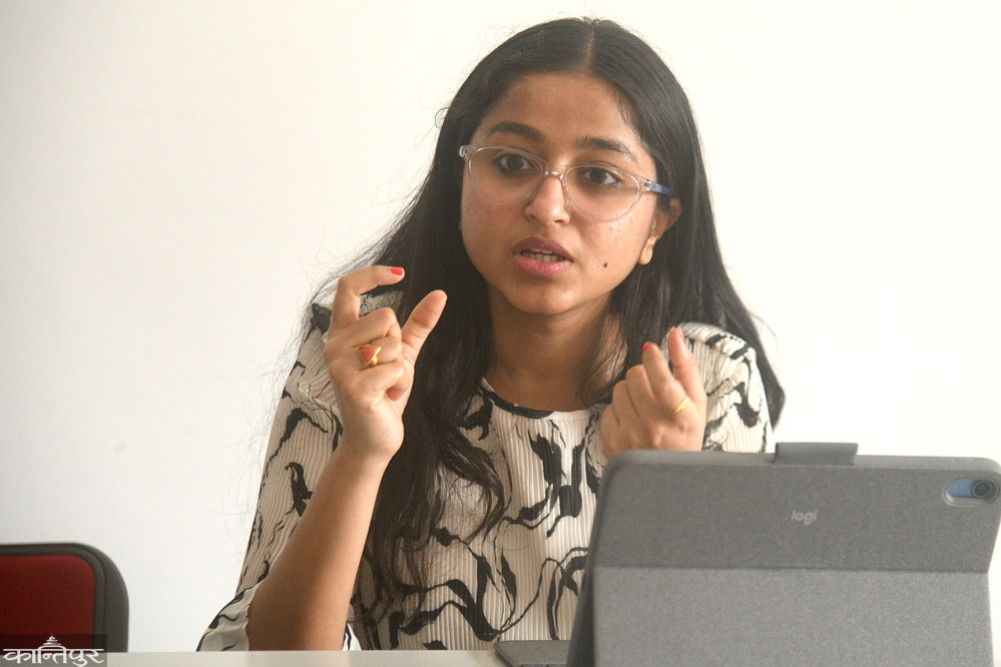
Tanuja Pandey, a leader of the Gen-G movement, says in an interview with Kantipur, “The current government seems to be working in the exact opposite direction to the reasons for the Gen-G movement.”
We use Google Cloud Translation Services. Google requires we provide the following disclaimer relating to use of this service:
This service may contain translations powered by Google. Google disclaims all warranties related to the translations, expressed or implied, including any warranties of accuracy, reliability, and any implied warranties of merchantability, fitness for a particular purpose, and noninfringement.
Some of the leaders of the Gen-G movement of 23 and 24 Bhadau entered the elections, while others chose the streets and their professional continuity. Tanuja Pandey, a leader who held talks with the army leadership on the night of 24 Bhadau, falls into the second category. Although she is not directly involved in politics, she is keeping a sharp eye on and criticizing the government's activities. Through her posts on social media platforms and responses in public media, one feels that she is playing a counter-role. In terms of their assessment of the early days of the strong government formed through the elections led by the Gen-G movement led by them, Kishore Dahal and Gaurav Pokharel spoke to Kantipur:
The word 'Tanuja' means 'daughter'. That is, child. The current government was born from the Gen-G movement you launched, that is, it is the child of your movement. In this context, what is your analysis of the journey from the Gen-G movement of Bhadau to the present?
The Gen-G movement was called by people of our age group. However, people from all groups and communities participated in it. Before that movement, the state was not able to provide the basic services it should have to its citizens. It was not even able to fulfill its minimum obligations. That is why there was ‘frustration’ among people. Meanwhile, the then government suddenly closed social media platforms. Whereas, social media was a ‘civic space’ for our generation. Their questions were raised there. Citizens do not always have to come to the streets to raise their voices, social media is used as an alternative. They raise questions from there. But at that time, it seemed as if the government was trying to suppress the voice of citizens by creating social media. It felt like it was escaping accountability.
However, we did not think that the Gen-G movement would reach such a large scale . The events at that time were beyond the imagination of the protesters . That pain is also beyond our imagination . However, we have completed a journey and arrived here . We should evaluate the current government formed after the election by comparing it with the previous governments . I think that the current government seems to be working in the exact opposite direction to the reason for the Gen-G movement . The opposite practice is being practiced on many issues raised by the movement . It seems that the mistakes of the previous governments are being repeated . This is a big problem in itself .
You did not seem satisfied with the work of the government . What kind of work do you disagree with ?
The question of whose lives were lost in the Gen-G movement should be seriously examined . If we look at the names and surnames of the deceased, it is understood that they were mainly from marginalized communities. Those who were killed were at the forefront of the movement. They may not have been recognized as the leaders of the movement. However, the current government's behavior towards the marginalized class is not satisfactory. This issue can be viewed and understood by taking the squatter settlements into the context. The way the government treated the squatter settlements, it seems that the government has gone against the interests of the people who were at the forefront of the movement, on whose strength this government was formed.
Second, the core essence of the Gen-G movement was transparency and accountability. In a parliamentary democracy, the Prime Minister is expected to address the nation and be responsible/answerable to the people through the parliament/MPs. However, it seems that the ruling party is now realizing that being strong in parliament does not mean being accountable, but rather getting 'immunity'. But the people electing and sending representatives does not mean giving them ‘immunity’. We have not given them special privileges, we have given them the responsibility of representation. The Gen-G movement was also carried out with this thinking. Therefore, it is dangerous to understand the people’s ‘mandate’ as ‘immunity’.
 Third, during the movement, there was certainly a complaint among the people that the government did not ‘deliver’. But in my opinion, the process is more important than ‘delivery’. While ‘delivery’ shows the result, the process shows the intention. If a person is trying to do something, his intention is seen in the process. But now, it seems that some people from the ruling party are making a statement like ‘we have come to deliver, we do not have to follow the process’. It seems that the ‘rule of law’ is ignored and only the result is important. This is also against the core spirit of the Gen-G movement. Because we did not create a movement to remove one wrong and bring in another wrong . We did not look for a new god . We did not look for another savior because we were fed up with KP Oli or Prachanda . We did not look for a hero, we did not look for a savior . We only wanted the state to fulfill the minimum obligation it had to fulfill .
The tendency to take the people's 'mandate' as 'immunity' is now creating a big problem . Now, the tendency to do whatever is visible, gets 'clicked' on social media, is increasing . But there seems to be little effort to look at the long-term consequences of that . The state is not a structure that runs on the basis of 'trends' and 'viral content' on social media . State governance is not 'content creation' . If politics starts being limited to the 'content' of social media, it will go in a dangerous direction . Now, the feeling of 'self-censorship' is increasing . I fear that we are moving towards a ‘soft authoritarian’ trend. It is not possible to say what the final outcome will be right now, but the signs are not good. Perhaps the style of the previous government and the current government may be different, the process may be different. But in the end, I do not think the result will be much better than the previous government.
There is a proverb in Nepali – ‘When a snake bites and runs away, a python eats it.’ You have analyzed the government’s work in such a way that it indicates that we are heading towards the ‘face of a python.’ Are we heading towards a difficult situation?
It has not been long since the government was formed. It may be too early to draw final conclusions so soon. But there is a saying in English – ‘The morning indicates the day.’ If we consider the government’s period so far as the morning is concerned, this period has not been very pleasant.
Let us look at Nepali society as an example. Citizens' opinions do not always agree with each other. Opinions may differ. But there are some issues that unite us all. But when it comes to the issue of national sovereignty, geographical integrity, and national pride, we usually stand in the same place. But this time I saw the exact opposite situation. The people's representatives of independent countries, elected and sent by the sovereign people, presented themselves on the issue of their own country's land in such a way that it seemed as if they were trying to prove Nepal itself as an invader. Moreover, a large crowd was seen defending such expressions and applauding them.
The question has arisen whether the sacrifice and spirit of movement of so many people were ultimately used only as a means of gaining power. The people came to the streets to prevent the leaders from betraying the country and the people. The question of nationality and sovereignty is a matter above the people. Even when insensitive statements from the Prime Minister on such issues are taken for granted, it is natural to worry about what will happen in the future.
There is another issue. There is a word in English - 'good looking culture', that is, a culture that looks good from the outside but does not see the problems inside. One of the reasons why previous governments failed was such a culture. There was a tendency to not criticize just to stay around the government and to continue supporting whatever the government does. The same trend seems to be repeating now. No one is allowed to make mistakes just by looking different from the youth and old parties. For example, some time ago there was a debate on the issue of student organizations. If we look at the history of Nepal's democratic movements, the student movement is an integral part. The right of students to engage in politics and form organizations is a fundamental right guaranteed by the constitution. But the government also seemed to have a problem with that issue.
To what extent do you think the current government leadership has assimilated the spirit of the Gen-G movement and the expectations of the people?
The victims of the movement are still demanding justice. Seeing that, the government leaders should have had a problem. But I am surprised to see that such an issue does not cause a problem, but rather that they are offended by someone calling them ‘dead’. Because even a dead body contributes to society and nature. Ultimately, it merges with nature and from there the cycle of new life begins. It contributes until the last moment. Perhaps we have underestimated the ‘dead body’.
Today, the Rashtriya Swayamsevak Sangh (RSS) has two-thirds of the power. If necessary, the government has the power to change the policy direction of the country. There is an opportunity to take Nepal in a new direction. But it does not seem to have realized that responsibility and opportunity. Instead, they are feeling insulted because someone called them ‘dead’. I cannot compare them to that either. Because even a dead body contributes something till the end. But now some people are seen sitting silently, without asking any questions, and only supporting. There is a saying – history repeats itself but in a terrible form. So I wish them all the best – may the people not have to chase their own leaders on the streets again tomorrow.
May the hope and faith with which they have come this far not end here. Now they have a lot of political capital, public support. That is their greatest strength. But I hope that it does not become the reason for their political end. Honestly, I want the current government to succeed. Because the failure of this government is not just the failure of a government. The hope of thousands of youth who stood in favor of change is the failure. Faith in democracy is weakening. More seriously, faith in humanity is weakening. So, even while criticizing the government, my wish is for the government to be successful. I want the change that the people are looking for to be realized in practice.
I still remember today, how excited there was when KP Oli was elected about 10 years ago. People from east to west applauded and had high hopes. But later, the same people were disappointed. I want the same fate not to repeat itself with the current leadership. I want the trust with which the people have given me the opportunity to do so to be preserved.
 It has been three months since the government was formed under the leadership of Balendra Shah. In the meantime, how do you see Prime Minister Shah's work style in terms of the essence of democracy, the basic pillars of the constitution, and his commitment to the parliamentary process?
Nepal has a President as the head of the nation, whether that person is Ram Chandra Poudel or someone else. But the current Prime Minister's statement on Facebook at that time (during the Gen-G movement) asking us to go and talk to the army seems to show what his democratic thinking is. One fact on the question of whether he believes in democracy or not is that he participated in the elections, reached the parliament with a referendum, and has now become the Prime Minister. In that sense, it cannot be said that he does not accept the democratic process. But looking at some of his public statements and behavior, some questions certainly arise. The activities that have taken place so far have made many issues 'crystal clear'. In fact, the group that believes in democracy within the Rashtriya Swayamsevak Sangh (RSS) is 'checking and balancing' him. If he is left alone, I cannot say what will happen.
The current government says that those in power have prioritized good governance and transparency. There is also a background of the arrest of some high-ranking officials. Don't you think the government is doing some really good work? When understanding Nepal's problems, we cannot draw conclusions by looking at just one or two symptoms. The disease has spread throughout the body, and treating one organ cannot cure all diseases. It is not that the government has not done anything. One or two issues may have been addressed. Some attempts may have been made to introduce some laws. But the real problem of Nepal was never just about whether a policy was made or not. Our problem was structural. Our state structure has long been of a nature to protect only certain groups and benefit only certain classes.
We talk a lot about democracy, but we have never seen its actual practice sufficiently. That is why there have been so many struggles and movements. The government may now be trying to reform the laws related to Nepalis living abroad, the work that is being done through ordinances, or the rape law. But that was not the main complaint of the people. Instead, the citizens complained that power was misused, power was used beyond its limits, and state resources were consumed by only a limited group and others had to pay the price for it. This was the question raised by the Gen-G movement.
Everyone knows that we raised our voice against 'nepotism'. The movement raised the question that the tendency of people in power to give opportunities to their own people and people from their own circle is wrong. Today, relatives may not be directly appointed. But it should be understood that there is not much difference between 'nepotism' and 'favoritism'. Yesterday, KP Oli was questioned not because of Radhika Shakya, but because of the power structure around him. Today, too, from personal secretary to minister selection, from ticket distribution to distribution of responsibilities, the same trend is visible. Therefore, the problem is not the person, but the trend.
Another important issue is accountability. It seems that in the history of Nepal, there has rarely been a leadership that has so easily ignored the people's questions despite receiving such a large public opinion. At least past leaders used to listen to criticism, respond, or publicly express their opinions. That is not seen now. Even when the debate on national sovereignty is ongoing, the leadership seems to be spending time on small disputes on social media rather than addressing those questions. The serious questions raised by the people remain unanswered.
The government is doing some work, but mainly doing things that are immediately visible, immediately discussed, and easily go viral on social media. But running a state is not 'content creation'. 'Visibility' and effectiveness are not the same thing. Just because a topic is seen a lot on social media does not mean that it is being done right. If the state always runs after 'visibility', then real problems cannot be addressed.
I will add one more topic here. I also consider the Gen-G movement as an expression of class consciousness. The slogan was – ‘My father is in the car, your father is in the river.’ It was pointing out the inequality within the society. But later the interpretation of the movement was limited to only being against ‘nepotism’. Whereas the question of the movement was deeper – Who is paying the price of the state’s policies? Who is paying the price of development? Who is being deprived of opportunities? Even today, those who are most affected by the state’s failures are the same lower class, lower-middle class and marginalized communities. But the irony is that those who create the narrative of change are mostly people from the middle class.
Even today, many people are saying ‘we have to wait five years’. But the day the cost of daily life starts to become unbearable, employment opportunities start to decrease, and concerns about the future of their children start to increase, the middle class will also start asking questions. I wish that such a day does not come. Because, history has shown – ‘visibility’ alone does not sustain a government. Results, justice and credibility towards the state evaluate the success of the government.
The government is currently holding discussions for amending the constitution. You were also invited. Why didn’t you go?
There are those who say that the constitution of Nepal has provided justice. There are also those who say that their issues have not been addressed. I believe that the constitution is changeable. Its very nature is flexible. It must also adapt to changes over time. This constitution is the result of the struggle our ancestors have been fighting for democracy for 70 years. But at this time, the question has arisen – who is leading the debate on amending the constitution? Under whose leadership are the discussions taking place? This is an important issue. For example, I have no problem with the fact that Asim Shah, the coordinator of the task force formed to amend the constitution, was previously a monarchist. In a democracy, one is allowed to express one's opinion. But the problem begins when people seem to change their identity and views in a day. It is not a stable view to be in favor of the king today and in favor of democracy tomorrow. When this happens, questions arise.
The process of amending the constitution is not a hasty one. It is a very sensitive issue. Even a 'comma' or 'full stop' has a meaning in the constitution. Such a document should be taken seriously. We received a call from the task force two days ago for discussions. They did not contact us formally on time. We only found out after the name appeared on social media. No formal invitation was received. But that is not the only problem. But it is not realistic to expect constitutional amendment or major changes within a two-day timeframe. A group with limited expertise like ours cannot decide what changes to make in two days. Preparing a document like the constitution in a short time frame or making major changes is not an easy task.
 Even though you did not participate in the working group's discussions, what kind of amendments should be made to the current constitution in your opinion?
Issues such as republicanism, secularism, federalism, and proportional inclusiveness and proportionality are like the basic pillars of the constitution, which should not be changed. These issues are 'non-negotiable'. In my personal understanding, the demands of Madhesh when the constitution was promulgated should be addressed in a very fair and just manner. There is still a large section that is dissatisfied with the constitution. Their demands should also be addressed. What I personally feel is that it is not appropriate to completely revise the constitution or make major changes in a hurry.
You questioned the government's working style. But many people say that the government should wait for five years because it is trying to do good. If it is not doing well according to the assessment at that time, it should be punished through elections, right?
Just think, what would happen if you left your children for five years and said, 'Let's see if it deteriorates later'? Therefore, governance is good only if the government is held accountable from the beginning. Instead of talking about rebuilding after it has deteriorated, we should warn them from the beginning. Otherwise, the previous government could have been told, 'Let's wait another five years'. Why should the people come to the streets? Therefore, the argument of 'Let's see for five years, we will know later' is not right.
Those in the government are saying, 'We will deliver'. It seems that the people who form the government support the government's work. But you, the so-called Gen-G leaders, are expressing dissatisfaction. Is the problem with you?
It's not that we don't call good work good. I didn't like some of Sudhan Gurung's style from the beginning. But yesterday, Home Minister Sudhan Gurung apologized to the squatter families. I liked that. We evaluate the government by comparing it to the movement. I don't think the sacrifices and hardships that were made in the movement were necessary for the work that is being done now. I think that some of the work that is being done now could have been done by the previous government. I'm not saying that we are 100 percent right. But it's not right to try to move forward by reversing basic democratic values. We are not only opposing the government's style of working, we are also making suggestions. We are not their enemies. We just want the government to run well.
Based on the report of the investigation committee formed under the leadership of Gauri Bahadur Karki to investigate the incidents of 24 and 24 Bhadra, the then Prime Minister KP Sharma Oli and several others came under the purview of action. But the Human Rights Commission report has also come out, in which it has been said that Gen-G leaders and some in the government should also be brought under the purview of investigation. What is your analysis of this?
I am not saying that the Human Rights Commission report is wrong just because I have friends. There is a legal process for investigation. Work should be done based on that standard. Personally, I think that some names may still be left out. The main point is that the report has not convicted anyone. The report has recommended an investigation. Therefore, I do not believe that the investigation process should not be started just because they are protesters. If an investigation is recommended, the process should proceed accordingly.
In my opinion, the government should make clear rules and procedures and proceed with the investigation. Because even now some people feel that injustice has been done to them. If the investigation does not proceed, some people in the ruling party may also feel that injustice has been done. Such a view is also heard in public. Therefore, if the investigation is stopped, injustice may be done to all parties. Instead, it is better to make clear rules and move the process forward. Ultimately, no one can escape accountability.
In some incidents, various parties have a role. I myself have heard discussions about our security agencies and law enforcement agencies. But those issues do not come up in public debate. Therefore, the government should make the necessary legal arrangements as per the recommendations of the commission and move the investigation forward. If someone feels that injustice has been done to them, there is the Supreme Court and other legal bodies. Therefore, someone's name may have been left out of the commission's report, there may have been injustice. But I am not ready to conclude that the entire report is wrong just because someone's name is in the report.
You also made an agreement with the previous government. What is the status of its implementation?
It seems that the government is also trying to address some issues including ‘out of country voting’. Some progress can be considered made on those issues. The preamble to the agreement mentioned the issues of various classes and communities that have been oppressed in Nepal so far. The emotional and political issues of past movements were also mentioned. Therefore, it was expected that this government should also address those issues. But the way the state has been oppressing sensitive communities one after another in recent times has caused concern. Not only that, there are still complaints that some of our friends who were arrested during the movement have been illegally detained. Their families are still seeking justice. Our injured friends are also demanding justice.
Some issues may take time. Issues of law, policy and institutional reform are not immediately resolved. There is a process and it also takes time. But the problem arises when the government seems to be going in the opposite direction on the fundamental question. If instead of addressing the fundamental issues raised by the movement, the opposite practice is seen, then the question arises of what is the meaning of such a large public support and mandate. So my concern now is, is the government really responsive to the feelings of the movement and the expectations expressed by the people? Or, is that mandate only being used as a means to reach power?