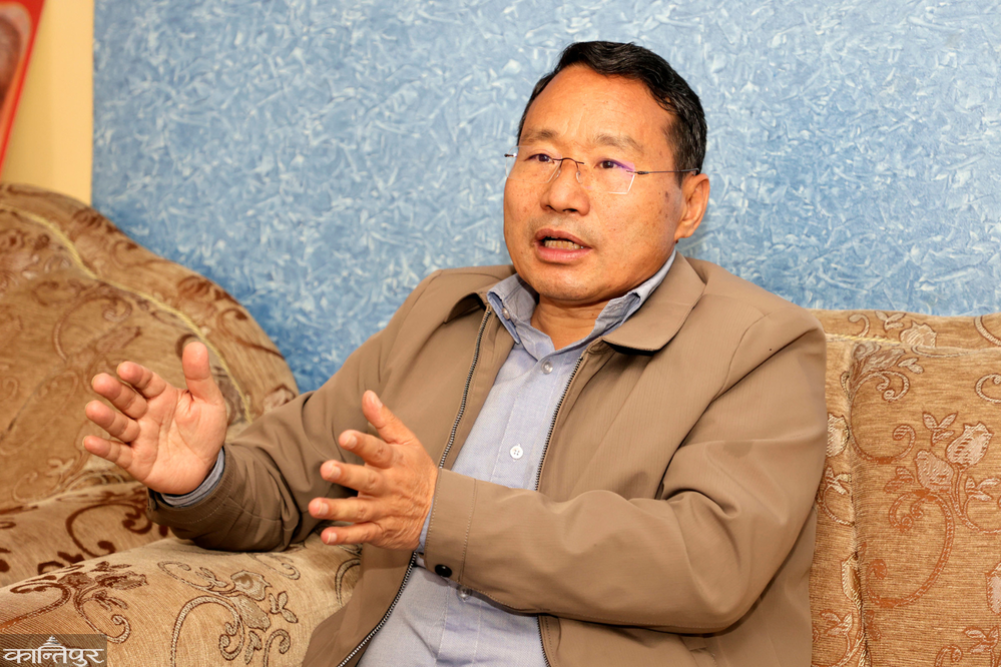
In an interview with Kantipur, he said, ”An expert finance minister like Wagle should have discouraged the trend of not spending at all, not having enough resources, and taking on too much debt. But he failed to do so.”
We use Google Cloud Translation Services. Google requires we provide the following disclaimer relating to use of this service:
This service may contain translations powered by Google. Google disclaims all warranties related to the translations, expressed or implied, including any warranties of accuracy, reliability, and any implied warranties of merchantability, fitness for a particular purpose, and noninfringement.
The first budget of the Rashtriya Swayamsevak Sangh (RSS) government, which won almost two-thirds of the seats in the House of Representatives in the 21 Falgun elections, has been made public. The budget presented by Finance Minister Swarnim Wagle on Friday mainly seeks to please the middle class. Wagle, who has been criticizing large budgets in the past, has made public a budget of 2124 billion with a target of borrowing more than 657 billion. The budget is also being criticized for being scattered, creating a basis for increasing inflation, and failing to adopt a policy of 'big push' in relatively specific areas. In this context, Yagya Banjade and Kishore Dahal spoke to former Finance Minister Barshaman Pun for Kantipur: As a former Finance Minister, what is your comment on the 2124 billion budget presented by Finance Minister Swarnim Wagle on Friday?
The language of the budget is very beautiful. The Finance Minister has reflected his grasp of the Nepali language in the budget. However, the budget sounds ambitious in many areas. We have accused them of 'populism', and that is also evident in the budget. They have put in programs that people like. They have focused on whether such programs are popular or not rather than whether our resources and ground realities support them.
Overall, the budget is ambitious. The size is also large. The amount of debt is also large. An expert Finance Minister like Swarnim Wagle should have discouraged the current trend of not spending at all, the trend of not having enough resources, the trend of taking more debt, that is, making a deficit budget. But, he could not. Whether his own desire worked in this or the pressure from the head of the government and party leaders worked, it will be revealed over time. We had heard that there was pressure to make a budget of up to 25 trillion. That was not enough. But it was not a 'realistic' budget.
You called the budget ambitious. Where does that feel?
Let's talk about the resources. He has given discounts in many places. He has also said that he will raise 14 trillion in revenue. That is a very difficult task. Such a goal seems ambitious and impractical. He has said that the internal and external debt will reach 6.5 trillion. This will upset the balance of the overall economy. He says that he has created an investment-friendly environment for the private sector and has encouraged investment, but where are the resources after taking more than 4 trillion internal loans himself? There are some contradictions like this.
On the other hand, topics ranging from robotics to AI are good. When I was the Finance Minister, I had brought a budget with a 'focus' on IT two years ago. That is also possible. The IT decade was declared to create 1 million direct and 1.5 million indirect jobs in 10 years and export IT services worth 30 trillion in 10 years. Now the Finance Minister is also trying to take that direction. But the basis for it is not strong and the programs are not supporting it.
The Finance Minister has said an economic growth rate of 7 percent. The 16th Periodic Plan has also set the same target. But the Finance Minister has also said an inflation rate of 6 percent. That did not work out. Inflation should be kept below 5 percent. Because, the target that will be met as soon as we announce it is inflation. After setting a rate of 6 percent right now, everyone will set prices accordingly. However, on the other hand, if economic growth does not meet the target, it will have a negative impact on the overall economy.
There are some big announcements on infrastructure, but it does not seem that the budget has been allocated accordingly. I had suggested to him – ‘We are in a federal system. It is envisaged that seven provinces and 753 municipalities will be ‘growth centers’. Similarly, we only built infrastructure in the hills, east-west or postal highways, but we could not connect them and work for ‘growth’. I had put forward the concept of ‘packaging’ it in economic programs. But it could not be implemented. Areas like Kathmandu, Pokhara, Chitwan, Bhairahawa are our ‘growth centers’. Bring programs that will lead to rapid economic development by focusing on these areas.’
The Finance Minister has brought such programs in a new way. Yesterday it was called the 'Gandaki Triangle', now it is called the 'Gandaki Quadrilateral'. Similarly, my suggestion was to make each of the seven provinces unique and based on their own characteristics and develop an identity for development. The Finance Minister said that Karnali should be made a hub for herbs. The Far West should be made a hub for religious tourism. We had also put forward a program to make Madhesh a hub for agro-based industries focusing on fish and other agricultural products. Now the Finance Minister has put forward the Madhya-Madhesh Quadrilateral Development Program. I am very pleased with the concept. It is also ambitious. However, I have not seen a policy and budget to support it.
You said that some programs could not be implemented even after you put them forward. They would not have been ambitious when you put them forward, but if the current government brought them forward, they would have been ambitious?
 Such programs are ambitious both yesterday and today. The budget, programs and structures to support them are meaningful. For example, I had allocated two billion on behalf of the government for the Gandaki Triangle in the 'PPP model'. Accordingly, it was said that the private sector would also participate and that it would be 'packaged' by giving incentives and incentives in specific sectors. Nothing has been seen now. Therefore, the question has arisen as to how the announcements will be implemented. Resources are needed, or is it just an appeal to the private sector? This raises doubts. That is why I find that the budget is not clear on such issues.
The target has now been set to raise 1.4 trillion in revenue. Is this ambitious? Or is it possible if we try and improve our structure?
If we improve our structure, establish good governance and motivate taxpayers, it is not impossible. In fact, it will even exceed the target. However, the size of the informal economy has increased significantly. When I was the Finance Minister in 2068, experts used to say that the informal economy was around 40 percent. It must have increased even more now. Even if we consider 40 percent, it should be reduced. It is good to be able to reduce it.
On the other hand, we also have an open border. We all increase customs duty on cigarettes. We also think that maximum tax should be imposed because they are harmful to health. We also increase it on alcohol and beer. But we had formed a team from the Ministry of Finance and studied this. There is smuggling in the border area and such goods are available at cheap prices across the border, so we need to change the customs and tax rates to reflect that reality. Otherwise, even if we increase the tax rate with good intentions, we will not be able to get the expected revenue. We will not be able to strengthen the economy. Eventually, we will reach a point where jobs and other opportunities will be lost. Then, it seems that the average tax on beer was increased by seven percent. However, last year, there was a seven percent
'revenue growth', and then 17 percent revenue and business also grew in the same proportion. Therefore, as soon as the tax rate was made rational, production, trade and revenue increased. Even now, it seems that the tax on tobacco products has been increased. I don't know how logical that is. Practice will show.
We have said that we will encourage our products. But the policy seems to be inconsistent. For example, let's look at electric vehicles. Now, the conflict in West Asia has disrupted the 'supply chain' and petroleum products have become expensive. In the past, electricity was made cheaper up to 150 units targeting the middle class. The use of 'induction' had barely increased. It was health-friendly, environmentally friendly and our own products were sold. But now, the policy of imposing 'VAT' above 50 units has been taken. As soon as this happened, the users of 'induction' would have been discouraged. Whereas, the country imports gas worth 40/50 billion. People would have returned to using gas. Because it was cheaper for them.
On the other hand, electric vehicles were also made more expensive. Whereas, petroleum products are becoming more expensive. Environmental risks are also increasing. At such a time, the Finance Minister made a mistake by making electric vehicles more expensive. What influenced him? There are other issues. For example, you said that you have abolished excise duty on more than 300 items. But you abolished excise duty on items that are not used much, but it seems that it has been increased on daily use items and domestic products that should be given relief. A detailed review of such issues will be done gradually.
You have called the budget distribution-oriented. Also, there is criticism that the lower class is not included even though the middle class is included. What is your analysis of this context?
The personal income tax rate slab has been reduced by 10 percent targeting the middle class. This does not seem very 'reasonable'. The personal income tax exemption limit has been increased from Rs 5 lakh to Rs 1 million. This seems right to me. However, there is no concrete relief and employment programs targeting lower class farmers, laborers, squatters, landless and unemployed youth. It seems that the market is thinking that everything will be done. Otherwise, in the past, the state would intervene from time to time through programs like the Prime Minister's Self-Employment Program and the Youth Self-Employment Program. Programs that would create employment would be announced. There seems to be a lack of such programs now. Overall, the budget seems to please the middle and upper classes a little but does not pay any attention to the people at the grassroots level.
It seems that the budget was also brought keeping in mind the local elections. The number of Dalits is large. The expenditure on nutrition of children from that community has been increased from five hundred to one thousand. The night duty allowance of nursing staff has been doubled. Similarly, the transportation expenses provided to women health volunteers have been increased by fifty percent. However, for two-thirds of farmers, there is no issue of power tillers, production equipment, or markets. Bringing a farmer-centric program would have provided relief to crores of people, not lakhs. Leaving this aside, programs promoted on the community and social media were encouraged. It seems that the mindset is that it will also benefit the elections tomorrow. Whereas, one sector should have been looked at. Which could have driven the entire economy. Could have raised the living standards of millions of people, could have had an impact. Leaving such a sector, only small pockets have been given attention. This is not bad in itself. However, it would have been better if a program had been introduced to transform the large sector.
The issue of middlemen is very much raised. At one time, when you were the Finance Minister of your own party, the issue of middlemen entering the rate manipulation was raised. Do you suspect that something like that has happened this time?
 So far, nothing like that has been seen. Right now, we have only heard the budget speech from outside. We have to look at the numbers regarding tax rates. That takes time. But those who welcome it today may think that tomorrow or the day after tomorrow it will increase here and there too. In one or two places, the middle class may feel the same. For example, it has been said that VAT will be imposed on electricity exceeding 50 units. On one hand, it is said that it will be relaxed and on the other hand, it has been tightened. It has been said that excise duty has been abolished on some 'items', salaries have been increased and at the same time 6 percent inflation has been announced. In other words, it seems that 6 percent inflation has been increased. Three percent tax has been imposed on education and health. It is the middle class that goes to private schools and health centers. यतातिर खुकुलो गरिदिने र अर्कोतिरबाट कस्ने नीति देखिन्छ ।
हामीसँग भ्याटको एकल दर थियो । यस पटक बहुदर ल्याइएको छ । हाम्रो कर्मचारी प्रशासन र कर प्रशासन त्यसका लागि क्षमतावान् छ ?
यहाँ दोहोरो चरित्र देखियो । बजेट भाषणमा ‘मूल्य अभिवृद्धि करमा बहुदरको सान्दर्भिकताबारे अध्ययन गरी सुझाव पेस गर्न उच्चस्तरीय सुझाव समिति गठन गर्नेछौं’ भनिएको छ । तर यसअघि मूल्य अभिवृद्धि कर १३ प्रतिशत र शून्य प्रतिशत रहेकामा पाँच प्रतिशतको व्यवस्था पनि गरिएको छ । यसरी अध्ययन गर्ने पनि भन्ने र बहुदरमा पनि जाने काम गर्नुभएको छ । यसो गर्नु नैतिक रूपमा पनि ‘डबल स्ट्यान्डर्ड’ हो भन्ने लाग्छ । अर्कोतिर, अलिकति अध्ययन गरेरै भारत जीएसटीमार्फत बहुदरमा गएको थियो । तर उनीहरूले त्यसमा समीक्षा गर्न खोजिरहेको देखिन्छ । हामीले छिमेकसँगको बजारमा प्रतिस्पर्धा हुँदा कि पूरै छुट दिनुपर्ने कि १३ प्रतिशत भ्याट लगाउनुपर्नेछ । अर्कोतिर, हाम्रो एउटै दरलाई पनि व्यवस्थित ढंगबाट उठाउन नसकिराखेको र कार्यान्वयन पनि गर्न नसकिराखेको स्थिति छ । यस्तो बेलामा बहुदरमा जाँदा झन् ठूलो विचलन आउने हो कि भन्ने लाग्छ, खासगरी हाम्रो कर प्रशासन संरचनागत रूपले तयार हुन नसकेको अवस्थामा । त्यस्तै यस्तो विषयमा अध्ययनपछि नै निर्णय लिएको भए राम्रो हुन्थ्यो । तर यता अध्ययन पनि गर्ने र उता बहुदरमा पनि जाने काम राम्रो भएन ।
ठूलो आकारको बजेट ल्याउने र पछि घटाउने प्रवृत्ति छ । यसै वर्ष पनि १९ खर्ब ६४ अर्बको बजेटलाई १६ खर्ब ८८ अर्बमा झारियो । अहिले पनि २१ खर्ब २४ अर्बको बजेट ल्याइएको छ । तपाईंलाई के लाग्छ, अहिलेकै आकारको बजेट अन्तिमसम्म कायम रहला वा घट्ला ?
स्रोत जुट्न समस्या देखिन्छ । त्यसैले कटौती हुने हुन्छ । अर्को, बजेट कार्यान्वयन गर्ने हाम्रो क्षमता नै छैन । प्रशासनिक र प्राविधिक जनशक्तिको जस्तो क्षमता हुनुपर्ने हो, त्यस्तो क्षमता छैन । भोलिका दिनमा ‘रिफर्म’ गर्दै जाँदा सम्भव हुन पनि सक्छ । तर यही वर्ष नै भने सम्भव छैन । यसर्थ कतिपय ठाउँमा स्रोत नजुट्ने र कतिपय ठाउँमा कार्यान्वयन गर्ने क्षमता नपुग्ने जस्ता कारणले पछि बजेट संशोधन गर्दा दुई–तीन खर्ब नै घट्छ जस्तो लाग्छ । अहिलेको बजेट १९ वा साढे १९ खर्बतिर आउला जस्तो देखिन्छ ।
यतिबेला बलियो सरकार छ । जनताको पनि ठूलै अपेक्षा छ । त्यसैले केही गर्नका लागि 'बिग पुस’ नै चाहिन्छ, 'नर्मल पुस’ ले हुँदैन पनि भनिन्छ नि ? बजेटमा त्यस्तो देखियो त ?
बजेटको आकार ठूलो बनाउँदा पनि त त्यसैअनुसार क्रमभंग गर्न सकिन्छ नि त । तर त्यस्तो बजेट भएन भन्ने हाम्रो टिप्पणी हो । तैपनि ठीकै छ, उहाँहरूले ठूलो आकारको बजेट ल्याउनुभयो । तर यो ‘सेक्टर’ मा यसरी ‘बिग पुस’ गर्ने भन्ने त देखिएन । एकातिर महत्त्वाकांक्षा देखाएको जस्तो, ‘बिग पुस’ दिनुपर्ने ठाउँ छुट्याउन नसकेको जस्तो देखिन्छ । उत्पादन वृद्धिमा ‘बिग पुस’ गर्ने हो भने ६० प्रतिशत हाराहारी जनशक्ति संलग्न कृषिको उत्पादन बढाउने विषय आउँछ । सहुलियत दिन्छौं, बजारको सुनिश्चितता गर्छौं, यति लाख मान्छे रोजगार र स्वरोजगार हुन्छन्, अर्थतन्त्रमा यसरी योगदान पुग्छ भनेर शृंखलामा काम गर्न सकिन्थ्यो । तर बजेटमा त्यस्तो केही छैन ।
यद्यपि, आईटी सेक्टरलाई ‘पुस’ गर्न खोज्नुभएको जस्तो देखिन्छ । मैले दुई वर्षअगाडिकै बजेटमा देशमा एउटा क्षेत्र दिएर, त्यसलाई सेन्टर बनाएर, वर्क प्लेसका रूपमा अघि बढाउने भनेको थिएँ । त्यहाँबाट सफ्टवेयर डेभलप गरेर बिक्री गर्न आवश्यक विद्युत्, वाइफाई लगायतका सबै सुविधा दिने योजना अघि बढाएको थिएँ । हाम्रै सरकारको पालामा २०६५ सालमा ‘बिग पुस’ गरिएको थियो । हाइड्रोमा लगानी गर्ने पैसाको स्रोत नखोज्ने, १० वर्षलाई ट्याक्स फ्रि, अर्को ५ वर्षलाई ५० प्रतिशत फ्रि भनेर आह्वान गरिएको थियो । त्यसैले गर्दा अहिले बिजुली नै निर्यात गर्ने ठाउँमा पुग्यौं । त्यस्तै, सिमेन्ट उद्योगसम्म बिजुली र खानीसम्म बाटो पुर्याइदिने भनिएको थियो । अहिले सिमेन्ट पनि निर्यात गर्ने ठाउँमा पुगेका छौं ।
यसपालिको बजेटमा पनि यस्तै ‘बिग पुस’ खोजिएको थियो, जसले अलि ठूलो खालको ‘रिफर्म’ गराउन सकोस् । तर अहिलेको बजेटमा सबै भए जस्तो देखिन्छ । तर, हामी वामपन्थी पार्टीका अर्थमन्त्रीलाई बजेट छरेको भनेर आलोचना हुने गरेको जस्तो अहिलेका अर्थमन्त्रीले पनि बजेट छरेकै देखिन्छ । तर पुग्नैपर्ने ठाउँमा नछरेको जस्तो पनि देखिन्छ । महत्त्वाकांक्षी बजेट ल्याएको जस्तो पनि देखिन्छ, तर समग्र अर्थतन्त्रलाई चलायमान बनाउने र धेरै मान्छेलाई रोजगारी दिने ठूलो सेक्टरमा भने बजेट नपुगेको जस्तो पनि देखिन्छ । बजेटमा यस्ता विरोधाभास छन् । तैपनि हेरौं, ठूलो जनमतबाट आएको पार्टीका अर्थमन्त्रीलाई ‘शंकाको लाभ’ दिऔं, उहाँले केही गर्नुहुन्छ होला ।
पश्चिम एसिया युद्धको असर देखिन बाँकी नै छ । खाडी मुलुकबाट कति नेपाली फर्किने हुन् थाहा छैन । तर आन्तरिक रूपमा रोजगारी सिर्जना गर्ने कार्यक्रममा खासै देखिएन भनेर तपाईंले भनिहाल्नुभयो । अब धान रोपाइँको समय सुरु हुन लागेको छ । मल आउने पश्चिम एसियाको 'सप्लाइ चेन’ बिथोलिएका कारण यहाँ पनि मल अभाव हुने र किसान पीडित हुन सक्छन् । अहिलेका यस्ता सवाललाई बजेटले छोएको छ ?
 अर्थमन्त्रीले पहिलेको सिस्टममा काम गरेको हुनाले अप्ठ्याराहरू देख्नुभएको छ । उहाँलाई थाहा छ । प्रधानमन्त्री र अरू साथीहरूलाई हेर्दा एउटा कुरा भन्न सकिन्छ– उहाँहरू कमसेकम ‘रियालिस्टिक ग्राउन्ड’ मा आउन खोज्दै हुनुहुन्छ । पुराना पार्टीले ‘ऋण ल्याएर देश डुबाए’ भनिन्थ्यो तर अहिले अहिले उहाँहरूले साढे ६ खर्ब ऋण लिने भन्नुभएको छ । अहिले ऋण ३० खर्ब छ । प्रत्येक आर्थिक वर्षमा साढे ६ खर्बका दरले ऋण लिने हो भने उहाँहरू ५ वर्ष सरकारमा बस्दा त अर्को ३० खर्बभन्दा बढी ऋण ल्याउनुहुन्छ । यो वास्तविक स्थितिलाई उहाँहरूले बल्ल स्विकार्नुभयो । हामीलाई ऋण ल्याएर देश डुबाए भन्ने उहाँहरू नै हुनुहुन्थ्यो तर अहिले सबैभन्दा बढी ऋण लिने पनि उहाँहरू नै हुनुहुन्छ । अबको प्रश्न हो– ऋण लिएको रकम उत्पादनमूलक क्षेत्र, पूर्वाधार र रोजगारी सिर्जनामा खर्च हुन्छ कि हुँदैन ? उहाँहरूको परीक्षा पनि यसमै हुन्छ ।
आन्तरिक र बाह्य ऋण नल्याई नहुने रहेछ भनेर उहाँहरूले स्वीकार गर्नुभयो व्यवहारले, तर झन् बढी लिनुभयो । यसमा भने हाम्रो आलोचना छ । त्यस्तै ट्याक्स छुटको कुरा गर्नुहुन्थ्यो । तर स्रोतको चापलाई कसरी सम्बोधन गर्नुहुन्छ ? कि, ‘ऋण ल्याएर घिउ खाने’ हो ? ऋण लिने र तलब बढाउने हो भने हाम्रो अर्थतन्त्र कहाँ पुग्छ त ? त्यसैगरी उहाँहरूले पुराना पार्टीहरूले सुशासन कायम गर्न सकेनन् भन्नुहुन्थ्यो । तर अहिले एकातिर प्रोत्साहन र अर्कोतिर नियन्त्रणको मिश्रित नीति लिनुभएको छ, जसले गर्दा त्यहाँ स्वार्थ समूहहरू छिरिसकेको जस्तो देखिन्छ । जस्तै, ‘इलेक्ट्रिक भेहिकल’ मा पहिले किलोवाटमा करको दर थियो, अहिले मूल्यमा भनिएको छ । यसले पुँजी पलायन हुने बाटो पो खुल्ने हो कि भनेर मान्छेले आशंका गरेका छन् ।
रास्वपाको वाचापत्र, सयबुँदे कार्यसूची, नीति तथा कार्यक्रम सबैमा हेर्दाखेरि पनि आगामी दशकदेखि औसतमा ७ प्रतिशतको आर्थिक वृद्धि, तीन हजार डलर प्रतिव्यक्ति आय, मध्यम आय भएको मुलुकमा पुग्ने जस्ता लक्ष्य देखिन्छ । यो सरकार पाँचै वर्ष जाने हो भने त अहिलेको बजेटलाई आधारका रुपमा पनि लिन सकिएला । तपाईंले त्यो आधारलाई कति बलियो देख्नुहुन्छ ?
मैले अघि पनि भनें कि आधार कमजोर छ । किनकि, ऋणैऋण लिएर देश नै डरलाग्दो ऋणमा डुब्ने खतरा छ । अर्को पक्ष, हामीकहाँ दुईतिहाइ जनसंख्या कृषकको छ, यो ठूलो सेक्टर हो । यस क्षेत्रमा ‘रिफर्म’ गर्दा धेरै मान्छे लाभान्वित हुन्थे । तर यस क्षेत्रलाई चोखै छोडिदिनुभयो । कृषिमा आधारित उद्योगलाई प्रोत्साहन गर्ने, उत्पादनलाई ‘सप्लाई चेन’ सँग जोड्ने शृंखला तयार गर्नुपर्नेमा त्यस्तो देखिएन । आईटीमा ठीकै छ । तर यो क्षेत्रको समग्र ‘इकोसिस्टम’ कसरी तयार हुन्छ ? हाम्रो जस्तो भू–अवस्थिति भएको देशमा आईटी क्षेत्रमा लागेर आफ्नै ठाउँमा बसेर युवालाई रोजगार बनाउँदै सेवा निर्यात गर्न सक्छौं । यो ठीक छ । तर, प्रोत्साहन कसरी गरिन्छ, समग्र ‘इकोसिस्टम’ कसरी बन्छ भनेर हेर्न बाँकी छ ।
अर्कोतिर पूर्वाधारतिर वा अरू क्षेत्रमा पाँच वर्षमा यसो गर्छौं, तीन वर्षमा यसो गर्छौं भन्ने छ । त्यो लक्ष्य नराम्रो होइन । तर त्यसैअनुसारको बजेट विनियोजन भएको देखिँदैन । अर्को पटक बढ्ला भन्न सकिएला । ७ प्रतिशतको आर्थिक वृद्धिदर नभई मध्यम अर्थतन्त्र हुँदैन । जनताका आकांक्षा पूरा हुँदैन । तर, ‘रियालिस्टिक’ ढंगले हेर्दा आर्थिक वृद्धिदर तीन प्रतिशतभन्दा मुनि छ । यसरी हेर्दा अन्तरविरोध देखिन्छ । हुन त अहिले पहिलो बजेट ल्याउनुभएको छ । तर यसलाई पनि पाँच वर्षसम्म जोड्नुभएको त देखिएन । सिक्दै जानुहोला ।