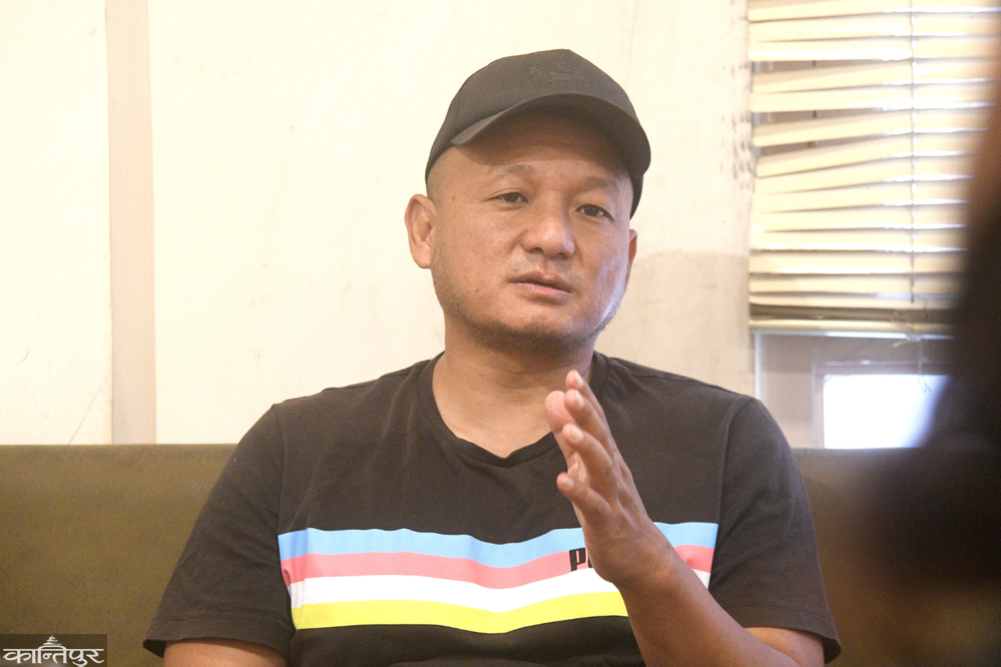
In an interview with Kantipur, Ninglekhu says - It is said that the Prime Minister easily solved the problem of squatters and removed the settlements. The narrative is being made that all the squatters left the settlements willingly. When this work was done at the barrel of a gun, the people would have so-called supported it.
We use Google Cloud Translation Services. Google requires we provide the following disclaimer relating to use of this service:
This service may contain translations powered by Google. Google disclaims all warranties related to the translations, expressed or implied, including any warranties of accuracy, reliability, and any implied warranties of merchantability, fitness for a particular purpose, and noninfringement.
Sabin Ninglekhu is a geographer. He has done his PhD on ‘Interrelationship between Urban Planning, Urban Poverty and Landlessness’ from the Department of Geography and Planning at the University of Toronto, Canada. Ninglekhu, who is studying and researching urban poverty, land/landlessness, local planning and governance, and social movements in Nepal, spoke to Kantipur on Saturday about the problems of squatters in Nepal, the state’s inhumane treatment of squatters without a specific plan, and solutions: The issue of clearing squatter settlements, using dozers, and relocating riverside residents has been a long-standing issue in Nepal. The discourse of two classes, squatters and ‘hukumvasi’, has also become established. What should be the minimum humanitarian and legal standards for clearing public land, green areas, or road encroachments? Our constitution clearly mentions humanitarian and legal standards. There are also such provisions in the Land Act and the Local Government Operation Act. These legal documents say that in the first phase, the actual identification of squatters should be done. That is, who is truly landless? Who is not? The constitution says that the data should be collected and separated. Then, on the basis of that, a ‘master plan’ should be prepared and a clear framework for rehabilitation and rehabilitation should be made. In the case of Kathmandu, it was agreed to move forward with a similar system. About three years ago, when the then mayor, the current Prime Minister Balendra Shah, was the mayor, he signed an agreement with the National Land Commission on the basis of the constitution and the land act. The agreement clearly stated that the identification of landless Dalits, squatters and unorganized settlers would be done with their participation, the metropolis would allocate resources and use scientific technology to go for rehabilitation and rehabilitation. Even now, if there is a lack of knowledge or process, the same agreement can be revived. Because this issue basically falls within the purview of the metropolis. Why did the federal government intervene? This is a separate question. The structure of the federal democratic republic was built on the basis of the articles and clauses of the constitution. However, in practice, those constitutional provisions have not been followed. Even the legal precedents established by various government mechanisms have been ignored. The orders and precedents of the Supreme Court have been disregarded, which has weakened the dignity of the judiciary. The articles of the constitution have been bypassed and the legal path shown by the Land Act has also been ignored. Such an issue should be taken forward on the basis of humanity, by making a lawful plan, and by involving the affected communities in the decision-making process. However, neither the process was adopted according to the constitution, nor were the concerned citizens involved. On the other hand, such an action by the federal government directly is against the spirit of federalism. According to the federal structure, local levels are assigned their own jurisdiction and responsibilities. Issues like squatter management basically fall within the scope of the local government. The intervention of the federal government in it is against the spirit of the federal system. Overall, the policy lines are clear. But whether or not to implement those policies in practice depends on moral commitment. The problem now lies in the lack of moral clarity.
Even when he was the mayor of Kathmandu Metropolitan City, Balendra Shah prioritized the issue of removing squatter settlements over other issues. Earlier, the Baburam Bhattarai-led government also tried to find an alternative arrangement when using dozers, but no long-term solution emerged. Within a short time after Balendra became the Prime Minister, strict action was taken against the squatters again. Why has the government prioritized this issue? How should this be understood?
The government's approach to this issue seems one-sided and biased. This government has a large public opinion and close to two-thirds of the power. Even when Balendra Shah took over the reins of the government, he has shown a determination to complete the unfinished work when he was the mayor, which is surprising. Has it come to a point where he should focus on removing a settlement, leaving other priorities aside? In this process, the state is trying to do what the state is trying to do by mobilizing the power of the city police, Nepal Police, and the Armed Police Force, which clearly shows Balendra's bias.
The Prime Minister should have coordinated such work with the local government-metropolitan city and given it an executive role. Given sufficient time, an exemplary process based on social justice and consensus could have been adopted, which could have won the hearts of the people. He cleared the settlement in a single day. The people of the squatter settlements themselves say that they are ready to be relocated if there is an alternative arrangement, who have been living in precarious conditions on the river banks for years. However, they have also demanded that the right to housing given by the constitution be ensured. They are also afraid of the heavy rains of Asar and Shrawan. As citizens of the country, they have sought the right to housing according to Article 37 of the constitution, which the state must fulfill.
This should be seen as a 'social contract', i.e. the relationship between the state and the citizens. The constitution defines this relationship. The squatter residents had indicated that they were ready to find a solution through dialogue and cooperation. However, there was no need for sudden use of force and intervention. There is a tendency to engage in populist politics in this - like a decision made under pressure to show quick results. Even when he was mayor, Walendra tried to remove street vendors, peddlers, and other low-income groups. Even now, the same continuity is visible in his style of work.
Although not planned, there was an example when Baburam Bhattarai was the Prime Minister from a humanitarian perspective. He tried to remove slums with a housing project. It may not be a complete solution, but at least it was an example of 'humanity' incarnated. At that time, the state tried to provide the citizens with a minimum basis for housing. However, such a humane aspect is not seen in the current process. If the state had been able to give the message that 'we have prepared a place to live for you' while leading, it could have given different results.
Looking at Walendra Shah's style of work, it is alleged that there is a tendency to remove poor communities in the name of making the city 'clean'. How can the poor be kept in the city by throwing poverty out of the city?
His approach to poverty must change, the change must not be superficial, but deep and structural. There is a deep-rooted belief in the psychology of society that when we see the poor, we see them as ‘trash’, ‘disorderly’ or ‘problems’. There is a tendency to see the poor as a source of fear, fraud, dishonest or even as potential criminals. This view is not only economic, but also linked to ‘aesthetics’. When we look at the poor community – we do not see tidy houses, gardens or urban beauty. Instead, the mindset of seeing them as ‘trash to be removed’ dominates. This same psychology portrays the poor as an element to be removed in the name of creating a ‘beautiful city’. Walendra follows this thinking. However, the real problem lies in that same perspective. Unless this thinking changes, inclusive urban development is not possible.

As soon as we remove that negative perspective from our minds, another plan begins to emerge. When we look at those whom we call poor in economic terms, we begin to see many other types of capital that they carry with them – their skills and arts, their contributions to building the city. Many members of squatter and landless families do various labor-intensive jobs in the city – security guards, restaurant and hotel cleaners, dishwashers, domestic work (washing clothes, cooking) in upper and middle class homes, and others. The contribution of these workers is extremely important to the daily life, services, and economic system of the city. Isn’t that how cities are built?
According to the concept of ‘production of space’, a city is not just a static structure, but a socio-economic process that is constantly being built. That ‘space’ is being produced through the labor, time, and contributions of workers. If that labor suddenly stops, the daily life of the city comes to a standstill. All service systems, large and small, in one way or another, rely on the contributions of those workers. These workers are often working for low wages, at rates below social justice and due participation. Therefore, a city should not be understood simply as the structure of large buildings or roads. The basic foundation of city building is the continuous contribution of workers, which needs to be more exposed and acknowledged.
Rashtriya Swayamsevak Sangh (RSS) President Ravi Lamichhane used to say that he would go to the slums of the slum dwellers with a dozer to pat their chests. Prime Minister Balendra Shah gave a speech before the elections to make the slum dwellers happy. However, the behavior is different now. Have they also used the slum dwellers and poor communities as a vote bank like the old parties and leaders?
Let's turn to their election slogans and activities. There are still videos of them reaching out to the slums of not only Kathmandu, but also in different districts and joining hands with the landless and slum dwellers and asking for votes - promises like "vote for me, I will make your life successful or turn the juniper growing in the sky into gold and drop it in your yard" have been made in those slums. Balendra Shah also made similar commitments in places including Jhapa. This is the subject in the pledge. Among the 100 points related to governance reform of the government, it was mentioned that the first step was to collect data and rehabilitate it. However, when comparing the election campaign, promises, election speeches and current behavior, it is clear that this party has also used these communities as vote banks. In the context of criticism that the old parties have turned the squatters into vote banks, the current political practices do not seem to be completely different from that.
The Supreme Court had directed that the settlements along the river banks be removed only after arranging alternative settlements for the actual squatters. But why could it not be implemented as per that order?
The Balendra government does not seem to have complied with the court order at all. The Metropolitan City, Land Commission, National Slum Front, government and non-government organizations are stakeholders in the data collection indicated by the Supreme Court's decision. However, the police reached the squatters' settlements and collected data based on a few questions. And, the dozer was used based on the data collected by the police alone. It is said that tomorrow the Prime Minister will easily solve the problem of the squatters and remove the settlements. It is being said that all the squatters have voluntarily left the settlements. There is no possibility of a movement with so many security agencies. If the people are so-called to support this work at gunpoint, they will not die either. The court has been violated.
This is a displacement of squatters carried out in an extremely unjust and inhumane manner. This is forced displacement, because there was no violence here. It is not necessary to see a person falling down after being shot for violence to occur. People experience violence internally. When they are frightened, they sit in pieces, cannot walk, are paralyzed, cry, are scared, children are sitting in fear. Recently, such a scene was seen in Thapathali – when their house collapsed, two sisters – five and three years old – were seen closing their eyes and worshipping an invisible God. What psychological impact will those children have now? Has anyone thought about it? They have become compelled to watch the bulldozer demolish their house while crying. This is a terrifying violence carried out by the state. People are confused – where will they go tomorrow? They do not know anything. Because the government that runs the bulldozers does not have a concrete plan.
What are the main problems of squatters in Nepal?
Because cities are expensive, people are living on the banks of rivers. Although not 100%, this is the main reason for a large percentage. Second, they are not getting even the basic services provided by our local government – water, electricity. We do not have secure employment. Whether it is the employment programs brought by the government or the programs brought by the private sector and the market – if those issues ensure employment security, the number of squatter families in the settlements will also decrease.
Is the number of squatter settlements and people in Nepal decreasing or increasing?
Squatter settlements and households are decreasing. The Nepal Settlement Protection Society and the National Squatter Front are working to solve our problem by collaborating with the state in a new way. The Land Act, amended for the eighth time in 2078, has made clear provisions to distinguish between squatters and ‘hukumvasi’. People in squatter settlements are becoming entrepreneurs – some earn money through YouTube, some run InDrive and Pathao. There are also squatters who have come out here because they can make a living by moving out. The reason is that the size of the settlements is not increasing, but decreasing. No new settlements have been added in the last decade and a half. After the peace process, a new settlement was added in Kathmandu. Now, the number of urban poor has increased, which is a national problem.
What is the history of urban squatters? Why does the government always chase them away?
People migrated from villages to cities for various reasons. Some due to natural disasters, some due to conflict or some other reason. Squatters say – I made this forest and bush a village. That is why I should have been given some right over it. However, since the state or political party did not have the will or a specific plan, this issue remained pending for years. And while the problem persisted, many NGOs and INGOs working on urban poverty came.
The Balendra-led government targeted those living on government land and public land to make them squatters. How will this affect the landless squatters and existing settlers across the country?
It is impossible to understand what the impact will be without knowing what the government is trying to do. Is the squatters being taken to a stadium or not? That is also unknown. It is said that they will be taken to an ashram or a lodge. Is it being taken there or not? That is also unknown. How many days will they be kept there? That is also unknown. Here, people are forming a kind of opinion based on the commotion. When the kind of information that should come, does not come, its impact is psychologically violent. What will be the impact on their daily lives? That is clear. People will be disturbed by the garbage, shelter and cotton. The government must have some long-term plan for them. This government has not seen any plan other than saying, 'I will use a dozer to make you invisible from the city or make you invisible'. That is why there is no specific answer to it. Apart from the character of the government, the problem is at the structural level. Urban planners or engineers and architects should have been involved in solving this problem. The master plan that engineers and architects draw, focuses on urban poverty. The government has not done that.
It is said that managing the many problems related to squatters, unorganized settlements or land is challenging. Is that just a saying or is it really challenging?
When I talk about the rights and issues of squatters as a researcher or scholar, it is different. When I have to talk as a mayor or prime minister, it is different, or when I have to talk as a member of the National Planning Commission, different challenges will suddenly appear before me. However, based on what I understand, I do not think that the solution is that challenging. This is not Bombay or South Africa or Kenya or Bangkok with its large 'slum areas'.
The number of squatters here is a door-to-door number. If there is a strong will to manage it, it can be done. However, when asked why attention has not been paid to that, it may be an 'ideological' matter, a matter of a different ideology or a matter of a kind of psychology. And, this is also a class matter. Again, this is a class matter. All squatters live in a lower-class life. The daily life of those living in state institutions is the ‘school of thought’ they grew up in. The mentality that has been trained and developed by that school of thought is the eye of the squatter problem. The problem that is understood by the mentality that has been ‘trended’ by that daily life is different. Therefore, the idea of a solution is also different.
Land is not just paper – it is also connected to infrastructure, services, livelihood and local self-government. Why do we often limit our debate in Nepal to land deeds?
This is not only a problem in Nepal, it is a problem all over the world. When the idea of ‘enclosure’ came in Britain, that is, what we call ‘commons’ – the idea that this is your property, this is my property instead of everyone’s public property. This led to the sale of land as private capital. On that basis, the ownership of land by citizens and their rights began to be determined. Nepal also adopted it after it came to a certain period in history.
The problem lies there. It lies in private capital. It lies in saying I need a private house. That is what creates civil rights – the ‘Red Book’ comes to the ward office. After that, how much money will be allocated for the waste management? How much money will each youth club get? Which neighborhood’s road or the road in front of which neighborhood’s house will be paved? All that is determined in the Red Book. However, only those who can have their say in that Red Book are the ones who are the rich in the land there. However, if you want to talk, go to any neighborhood and see, there are more people living in dormitories than homeowners in that neighborhood. However, those living in dormitories never speak. That is also visible in elections. If you look at the current election statistics, the population that cannot vote is more than the voting population of Kathmandu Metropolitan City. What about Kathmandu? The same is true of any city. Rather than removing slums, the tension that exists is related to slums, and working together with those communities makes it democratic and legal.
When the state makes arrangements for the rehabilitation of squatters, is it enough to just provide houses or should it also provide employment, transportation, schools, health, access to markets, and community networks? How can it be connected now?
It's good that the state has provided everything. The state has its own resource limits and its own 'framework'. It has to work within that. For example, where in the Kathmandu Valley is public or private land suitable for the rehabilitation of this settlement? That can be done from door to door. Because the Rashtriya Swayamsevak Sangh (RSS) has also talked a lot about digital technology in its manifesto. It means that everything should be solved digitally. Google Maps, Open Street Mappings - a kind of blueprint can be prepared by 'geo-coding' open spaces from all of these. Where are the vacant spaces in the Kathmandu Valley, in what condition are they, how close are they to the market? All of that should be considered. Basic needs, service provision structures or how close or far are schools and health posts? All of that should be analyzed and arrangements should be made to accommodate the actual squatters.
If the state cannot rehabilitate them or solve this problem properly, what will be the life of the squatters? What form can this problem take in the future?
 My biggest fear right now is that the largest investment in the development concept that will come or be drawn will go to hydropower. We sell the energy we produce to neighboring countries and 'generate revenue' from it, increasing our GDP. It is said that our rivers will be used for energy to produce AI data centers. Why did I link this to urban poverty or land? All the settlements living on the banks of the rivers are already in trouble. More problems are sure to increase. There will be no crops. Displacement will take a terrible and frightening form.
What can the state do to help the squatters live a dignified life?
This work could have been done yesterday. However, it can be done today too. It is enough for the current Prime Minister Balendra Shah to come and spend two hours with the displaced. Let's not make a big deal out of it. Where did you come from after the round table? What are you doing? What do you think would be right to do tomorrow? It is enough to say, ‘Let’s talk.’ That is enough. Now, according to our Limbu culture, the state has cut off the heads of the squatters. Now the state must raise their heads. That is, the state must now make a deal with the squatters. Our Prime Minister should immediately address the squatters who have just raised the settlement with a dozer and move forward to make a deal.