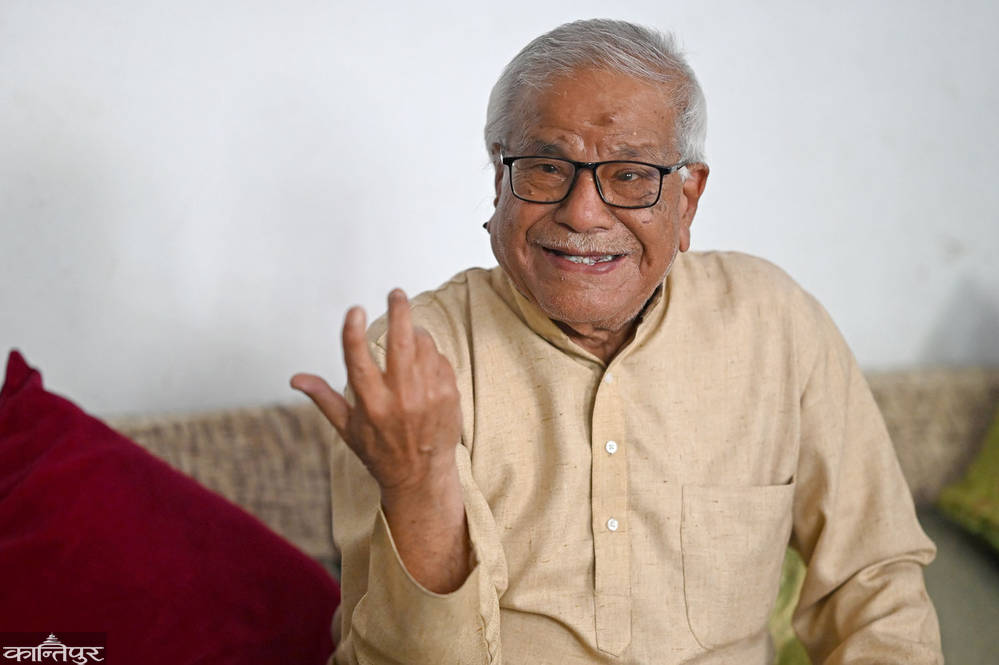
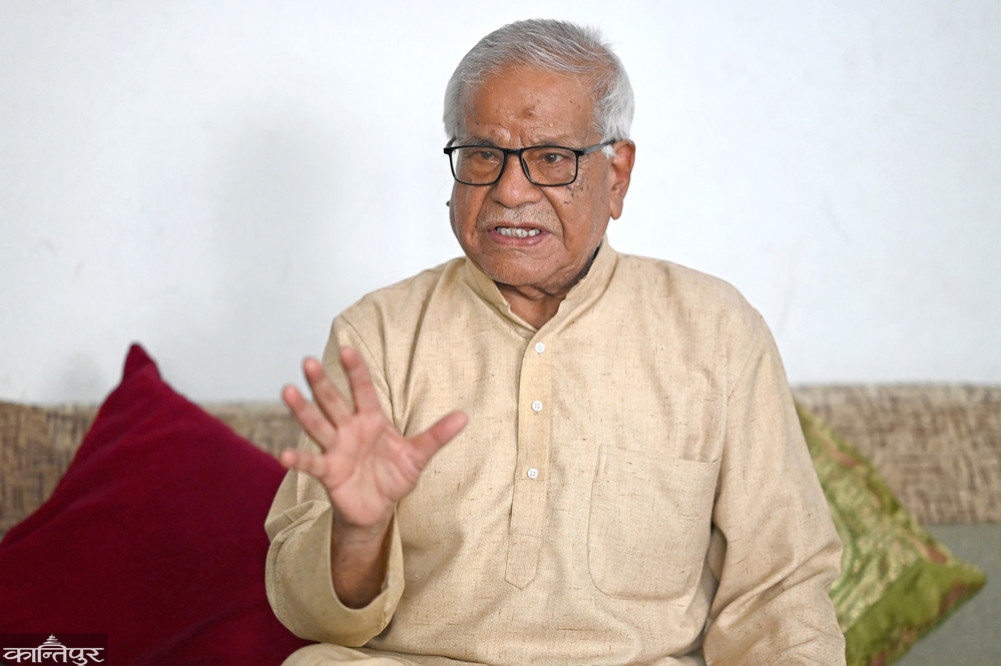
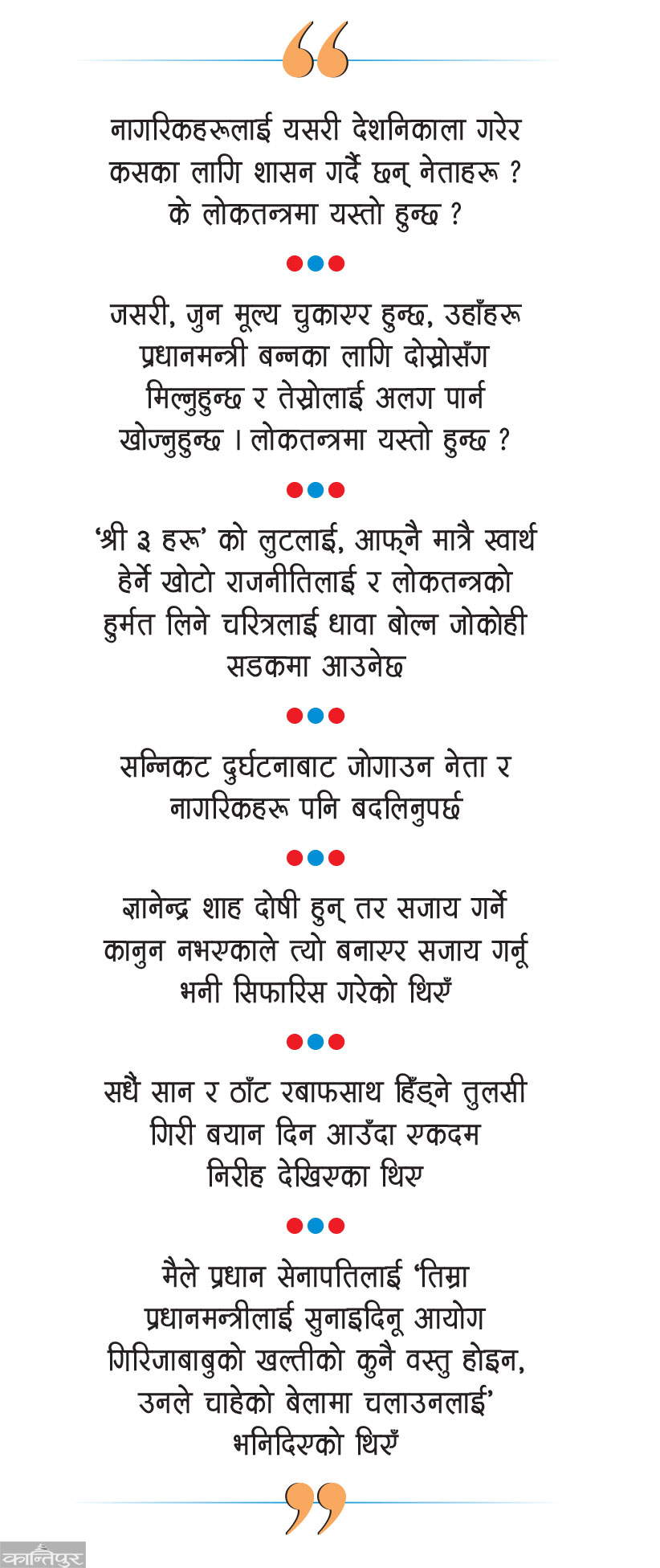
For whom are the leaders ruling by deporting citizens like this? Does this happen in a democracy?
We use Google Cloud Translation Services. Google requires we provide the following disclaimer relating to use of this service:
This service may contain translations powered by Google. Google disclaims all warranties related to the translations, expressed or implied, including any warranties of accuracy, reliability, and any implied warranties of merchantability, fitness for a particular purpose, and noninfringement.
It has been 20 years since the second popular movement of 2062/063 was successful. Democracy Day is celebrated on May 11 to commemorate that day. But there were such types of government disorder and distortions during the royal regime, now there are also in the democratic/republican regime.
The health of democracy has worsened due to the fact that people and tendencies who are guilty of suppressing people's movements are entering the government structure. In this context, Ghanshyam Khadka of Kantipur had a conversation with former Supreme Court judge Krishnajang Rayamazhi, who is also the coordinator of the high-level commission formed to investigate the repression in the second people's movement. He concluded that he was guilty. The commission also recommended that Shah should be prosecuted by law and the rest should be prosecuted according to existing laws. However, he was not prosecuted. Today, they are on the streets to change the system. What do you say about this? Maybe the scene would have been different if the action had been taken. But when it is too much, people rebel. A similar commission was formed under the chairmanship of Justice Janardan Lal Mallik to investigate the suppression of the 2046 mass movement. The Malik Commission had given a report to the government with recommendations that these people are guilty and that such action should be taken against them. However, it was done secretly. Society did not recognize the culprits, nor was anyone prosecuted. After investigating the suppression of the second people's movement, we received the report of the Mallik Commission from the Ministry of Home Affairs for study after much effort. I saw that some of the convicted people who were asked to recommend action in that report were also involved in the suppression of the second mass movement.
Perhaps if he had been prosecuted according to the recommendations of the Mallik Commission, there would not have been repression in the second people's movement, and impunity would not have prevailed. There was rule of law. And, if the rule of law had prevailed, perhaps no one would have taken to the streets for the second mass movement. However, that did not happen. Leaders who are said to have fought for democracy forgot about democracy and considered only their own interests.
It not only increased impunity, but also disrupted the rule of law. Finally the king got an excuse to be active. When the king did something he shouldn't have done, he put on the same old face again and became a master in the suppression of the second people's movement.
The condition of our report is the same. With a lot of effort and courage, we identified the culprits and recommended action against them, but it was not implemented. Perhaps if it had happened, impunity would not have been institutionalized in the country, the rule of law would have prevailed. However, for this, the leaders also had to improve.
It is the old character of the state not to prosecute the perpetrators of human rights violations. Before you went to the commission, didn't you think that the old disease would also affect the prosecution of the culprits of the second people's movement?
That's what I thought. Therefore, when the government led by Girijababu asked me to become the chairman of the high-level inquiry commission after the restoration of the parliament, I refused several times. Because I knew very well that our leaders do not have the character to punish the culprits of the mass movement. However, Krishna Prasad Sitaulaji came to my house daily and said that he should lead the commission anyway.
He also tried to assure me several times that the recommendation given by me would be 100% actionable. In the discussion among the leaders of the seven parties, a list of former judges was made and discussed one by one on who should be made the chairman of the investigation commission. When there is a discussion on my name, when some party does not accept someone, and some party does not accept it, all the leaders said that it would happen if he was there. This was narrated to me by Sitaulaji. And, 'this is the reason why it cannot happen without a husband', he repeatedly requested to accept the presidency.
Prime Minister Girija Prasad Koirala himself was saying in public meetings that we have made a mistake, now we will correct it. Even my well-wishers started suggesting me to take the leadership of the commission, saying that after so many people's movements, the leaders would have realized that the culprits of the people's movement must be punished. On the other hand, there were also many who said that you are getting into this trap in vain, the recommendation is not implemented. In such a dilemma, I took the leadership of the commission only after making them admit that the implementation of my report would be certain. However, whatever was suspected, it happened in the end. While preparing the
report, were you sure that it would be applicable? I took over the commission thinking that
would be done in the beginning. It was also said that since it is a commission formed by the proposal of the seven parties, its work will not be ignored. But that belief didn't last long. Within a month and a half of starting work, I found out that they would carry the old legacy of impunity. How did you know
?
How the leaders began to be non-cooperative in taking statements and investigating. He showed indifference in sending his subordinates to the statement.
how to show depression?
When I cut a letter to the then Commander-in-Chief Parajung Thapa asking him to come for a statement, he did not come. It came only after the second or third taketa. And I asked why you didn't come earlier. He said something amazing.
When we called him, he was going to Pokhara. Prime Minister Koirala himself also looked after the Ministry of Defense at that time. As the head of the relevant ministry, the general asked him whether he should go to Pokhara or what to do as he had to make a statement. Until then, it's fine. Koirala said that I will tell the chairman of the commission, you should go to Pokhara.
He himself said with me that "even if the boss doesn't want me to go, there is no need to keep coming." Then I got really excited. I told him at that time that I should tell your Prime Minister that the Commission is not a thing in the pocket of some patriarch, to be used whenever he wants. This happened many times. The ministers did the same. We started having to bring people into the statement. Journalists used to come to the office of the
commission every day. They asked where the work of identifying and prosecuting the culprits of the mass movement had gone. Inside, the situation was different. And after one day, I stood in front of the media and said, "If this is the case, I will announce my resignation and inform the people that I will not be allowed to work." After that, it finally happened, the grief stopped. And those who were called to the statement started coming slowly.
The commander-in-chief also came after that? It is a
. When he didn't come on the day he was called, the journalists came and asked the army, Teren, what are you going to do next? Come next time.
What was the state of mind of the accused when they came to give a statement? No one can be called legally guilty until the
case is decided by the court. However, those who were accused of human rights violations in suppressing the popular movement and whose letters were cut off to appear for statements, came to the commission in a state of fear. It seems that how many will be imprisoned. They came with food and bedding and clothes.
Tulsi Giri, the then Vice President of the Council of Ministers, also felt the same way. I saw Giri with great admiration when I was a student. He was the Prime Minister in the Panchayat. After the collapse of the Panchayat, he went abroad. He came again after the king took power. And he was made the vice president of the Council of Ministers. Since he was the head after the king, he was in a way like the prime minister.
I had always seen a smile on his face who always walked with grace and elegance. However, when he came to give a statement at the commission's office in Harihar Bhavan, he looked very innocent. The guards only let in those who came to give statements through the door. Others who came with him left outside. Giri was the only one who walked through the doors of that deserted commission. His eyes showed that there was fear in his heart. After entering the door, I saw great confusion about where to go and what to do. That's what I call the office's
I could easily see through the window. It didn't take long for me to realize that he was scared. And I went out on my own. Come on, welcome to the commission. I helped him mentally prepare for the statement by talking earnestly for about fifteen minutes. During that time, he revealed that he has come to the commission with his wife and helpers with food and medicine because he might be imprisoned.
And how was he assured that he would not be imprisoned?
Even if he is imprisoned, later when the recommendation is implemented, it will be after the trial in the court, the commission will take the statement and not arrest him directly. And suddenly his mood had changed. To break the story, even before he came, he called Dilliraj Acharya, the spokesperson of the commission, and asked him why he would keep me in jail. Acharya has said that he will only take statements. However, he thought that he would be arrested from time to time. So he came with endowments. That's why I was so scared when I entered.
The then king Gyanendra Shah also cut a letter for statement. Wasn't Tulsi Giri the highest-ranking person who gave a statement to the commission after he did not come?
, it was Giri. The letter to Shah was cut, he did not come. Even if he did not come, we recommended what to do.
What did Tulsi Giri say in the statement?
He openly said that suppressing the people's movement was to blame, and the king was also to blame. If the king is not guilty, they are not guilty.
Did the commission agree with this argument?
My point of view was the same. The status of the king was made ceremonial by the 2047 constitution. Ceremonial posts have no executive role. A person who does not have an executive role does not have to take any job.
However, the king had given up the ceremonial role. He became the Chairman of the Council of Ministers without leaving it. After the government began to run under his active leadership, he naturally had to take on the consequences.
Was this the reason for recommending that the then king should be prosecuted?
They must be able to understand the essence of the 2047 constitution. That constitution says that the king will remain within the constitutional scope. Because of that, he does not need any laws. It didn't even matter. However, the king had already crossed the limit of the constitution and had taken the power in his own hands.
The constitution and laws did not only touch Mr. 5. However, the Chairman of the Council of Ministers ie the Prime Minister could be punished if he made a mistake. Gyanendra Shah was not the king at that time, but the chairman of the council of ministers. Even if the Chairman of the Council of Ministers had been replaced by someone else, he would have been punished if he made a mistake. Having said that, I was of the view that there could be no question of law without Shah. His vice president Tulsi Giri also has the same opinion.
After the Shah took power in his hands and practiced active monarchy, the citizens rose up in resistance. He was naturally blamed for the suppression of the popular movement at such a time. But the thing was, the law did not mention anything about what kind of punishment should be given if the king made a mistake. Therefore, I recommended that he be guilty, but since there is no law to punish him, he should be punished, and I wrote that part of the judgment and recommendation myself.
It took 6 months to submit the report and recommend the names of the culprits to the commission which was formed for two months. What happened during this period? How many people were drawn into the statement and investigation?
We have prepared a list of the Cabinet Chairman, Deputy Chairman and all Ministers, heads and senior officials of all three security agencies, heads of administration and other such high-ranking people. We discussed who might be involved in suppressing the movement and exploiting the resources of the state and what their possible roles might be. At first, we called people from the lower level and questioned them. In this way, we started research from a long list and in the end we cut letters to about three and a half hundred people to come to the statement. Among them, the chairman of the Council of Ministers and 201 others were found guilty.
Royalists demonstrated at Tinkune on 15th of last Chait. And, in the process, there was a lot of arson, looting and vandalism. Two people died. How have you analyzed it?
The level of chaos, corruption, misrule and robbery that has been created - you have to see it to understand the current events. People have extreme despair. By organizing it, a situation has been created where whoever organizes it to cause a violent situation can happen. This is the failure of leaders. This is the result of looting in the name of democracy. This is the situation caused by selfishness and selfishness of Oliji, Deubaji and Prachandaji. I still see the danger that something terrible could happen. Anyone will come to the streets to attack the loot of these 'Mr. 3', the false politics that is only interested in their own interests and the character that respects democracy.
On what basis did you get to this squeeze?
If the 'Mr. 3' do not correct themselves immediately, I see that this situation will inevitably come sooner or later if they continue to do narrow-minded politics to count themselves.
What my study tells us is that leaders are not clear on the concept of democracy. I am not objecting to this. Their character is telling. Democracy is not just a jargon. It has a distinctive character. Democracy has certain values and beliefs, which demand behavior accordingly. If someone is not dedicated to the values of democracy by heart, word and deed, then it will be revealed by his character. Like a
, now unfolding from our 'Mr. 3's'. They are not interested in anything other than being the prime minister. As, at the cost of paying, they align themselves with the second to become Prime Minister and seek to alienate the third. Does this happen in a democracy? Even in India, a coalition government is formed, but there is stability. For a certain period the government is working there. Every day we have the possibility of government formation and dissolution. For that he could do anything. This is not politics, nor is it a democratic practice.
In a democracy, values should define character. It is not forced. I said this in my first meeting with Prachandaji, who had recently come out of underground politics during the commission's investigation.
What did you say to Prachanda?
They had just come in armed. The commitment to democracy was in words but it could not be said whether it is in practice or not. What I told Prachandaji at that ambivalent time was that in the revolution, people who are angry or have made a mistake may be shot, killed, harassed or threatened. However, that does not work in a democracy.
In this, people's hearts should be won not by using force, but by faith and conduct. For that one must be completely devoted to its values and beliefs. So, I told him – it is not easy to do politics in a democracy. In this, before you can say that you will change others, you must be completely changed.
The leaders did not change. They were not devoted to the value and recognition of democracy. Because of that, they are ruining this country for their narrow happiness and selfishness. No youth today wants to live in this country. It is drawing the conclusion that no citizen can do it in this country. Therefore, every day there is a huge crowd of people leaving the country at the airport. For whom are the leaders ruling by deporting citizens like this? Does this happen in a democracy? It has been two decades since the
mass movement. About two dozen people sacrificed their lives to bring full democracy. More than 4,000 were injured and a large amount of public and private property was destroyed. What was the significance of all these sacrifices, before this disappointment?
Those who courageously consented to martyrdom but refused to become victims of autocratic rule, even if they were alive today, would be dismayed to see this plight. This frustration has reached its peak. Which day is about to explode causing great damage. We all have no choice but to change to save it from imminent disaster. Citizens must also be changed, leaders must also be changed. There is no alternative to democracy. However, this situation cannot be called democracy.
After Gyanendra deposed the parliament and became the chairman of the council of ministers, I was invited by the palace to be the minister of law. At that time I was a sitting judge of the Supreme Court. As I humbly returned to the King's secretary, I am not in the nature of politics. Because, there was no way I could go to the government which was made by the value of democracy.
After taking power, Gyanendra once called people from different areas at Gokarna resort and took their opinion. Kar had also gone here. what did you say
Yes, I was invited too. One hundred and one Swanamdharis have been present there to suggest to the king. The order of the palace was that you should give your opinion within three minutes. It was not something that I could recall or say in three minutes, but what I told the king was that no constitutional king rules anywhere in the world. If used, it will harm the king. No matter how corrupt the Prime Minister is, he should be allowed to rule. Because citizens have the privilege of not electing a corrupt person again. But the king did not listen to that. Eventually the monarchy ended. Now he is the one who is protesting that even if Gyanendra is a constitutional monarchy, it will happen.
If these three leaders "Mr. 3" do not improve themselves, it will be Gyanendra's fault. Because, in a democracy, this level of bullying is not acceptable. No one can survive by neglecting the value and recognition of democracy. It ultimately harms itself. Today, the way in which the very essence of democracy is being destroyed in order to get to power by introducing chaos into everything, it only increases the perpetrators. Because people wake up against it and no one cares when people wake up.