Local level has the authority to grant permission, approval and add classes to open schools, principal appointment now from local level
We use Google Cloud Translation Services. Google requires we provide the following disclaimer relating to use of this service:
This service may contain translations powered by Google. Google disclaims all warranties related to the translations, expressed or implied, including any warranties of accuracy, reliability, and any implied warranties of merchantability, fitness for a particular purpose, and noninfringement.
The government has amended the Education Regulations 2059 to prohibit people with political party membership from becoming members of the school management committee. The revised regulations have given the local level the authority to grant permission, approval and add classes to open schools. The appointment of principals will also be made by the local level.
According to the revised regulations passed by the Council of Ministers on Friday, teachers will no longer be allowed to be transferred without completing at least 3 years of permanent service in a school. The transfer criteria have been set in the regulations to address public complaints that permanent teachers are transferred to jobs that are more convenient or affordable as soon as they are appointed. ‘While transferring, basic level class teachers will be transferred to the same level and subject teachers will be transferred only to vacant posts in the relevant subject,’ the revised regulations state.
There were allegations that teachers were previously hiding vacant posts and were being manipulated to transfer teachers who suited them. There was a provision to obtain permission from various bodies including the school, management committee, local level and the Education Development and Coordination Unit for transfers.
Now, if a teacher post becomes vacant, information has to be provided to the local level and the central government's Integrated Educational Management Information System (IEMIS) within 7 days. An arrangement has been made to request applications for teacher transfers online or through public notice. It is believed that this will make vacant posts transparent and increase healthy competition in transfers. 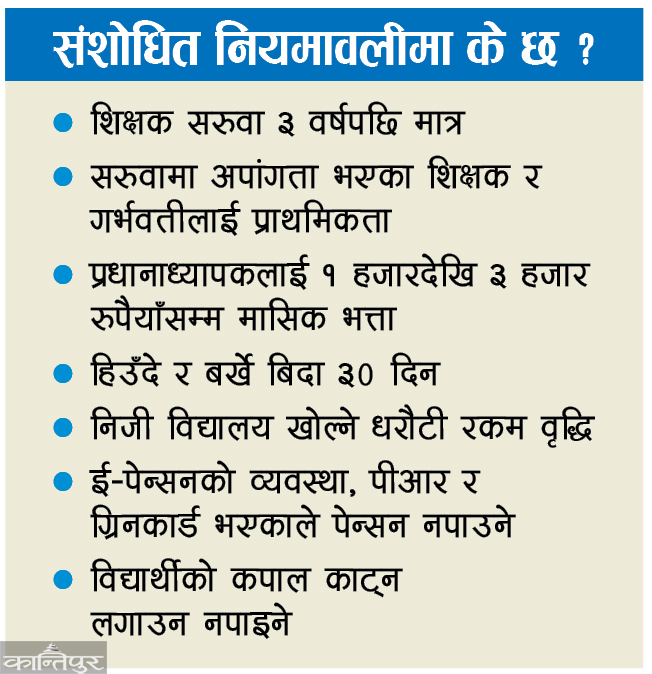
Harish Prasad Bhatta, policy and legal expert of Education Minister Sasmit Pokharel, says that the education regulations have been amended for three reasons. 'It takes time to come up with an education act.' The aim is to immediately resolve the problems seen, implement the new government's governance reform action plan, and implement some court orders,' he said. 'The regulations are temporary management. Our focus is on bringing an education act.' The regulations will come into effect after being published in the gazette.
The revised regulations mention giving priority to pregnant women, women with disabilities, and women with children under two years of age in teacher transfers. In the case of other teachers, a provision has been made for calculating points in transfers. It is said that teachers will be transferred through a competition with a total of 65 points. 35 points have been set for seniority, 20 for educational qualifications and 10 for training. Earlier, seniority was given priority in teacher transfers. But even in the changed system, stakeholders say that since seniority is given the highest points, only old teachers will be given priority in appointments.
Educationist Abhishek Ghimire said that the system of specifying a 3-year period for transfers and providing information about vacant posts will increase transparency in transfers. But he comments that the government, which has a close to two-thirds majority, has delayed by amending the regulations rather than issuing a new Education Act.
The regulations also specify the body and process for transferring teachers. Within a local level, the same local level will transfer teachers. At different local levels within the district, the Education Development and Coordination Unit will transfer only with the consent of the local level. Teachers who are in the same grade and subject can also apply for transfer by mutual agreement. However, teachers who are transferred mutually will not be allowed to transfer again before completing 5 years. If a teacher who is a principal has to be transferred, the consent of the relevant local level will be mandatory. The Ministry of Education claims that the new rule will prevent irregularities in the teacher transfer process and that transfers will be made based on need and merit, not on the basis of access.
The regulation has prescribed the appointment process and qualifications of the principal. The responsibility of appointing the principal has been given to the local level. Earlier, there was a provision for the principal to be appointed through the School Management Committee. Now, to become a principal, a permanent teacher with a bachelor's degree at the basic level and a master's degree at the secondary level will have to be appointed. Earlier, there was a rule that principals could also be appointed based on seniority.
The allowance received by the principal has been increased from 1,000 to 3,000 rupees. Earlier, the principals of secondary, junior secondary and primary schools were receiving monthly allowances of Rs 500, Rs 300 and Rs 200 respectively. Now, the principals of secondary schools will receive a monthly allowance of Rs 3,000, those of basic classes up to Grade 8 will receive Rs 2,000 and those of basic classes up to Grade 5 will receive a monthly allowance of Rs 1,000.
Sudam Gautam, President of the Principals' Association, said that although the amendment to the regulations is positive for the time being, the issues of matching posts, teacher-student ratio, responsibility of principals and teacher professional development have not been clarified. He said that a new Education Act should be issued soon for that.
The revised regulations have given additional powers to the local level. The local level has fully got the right to grant permission, approval and add classes to open schools. The responsibility of school regulation has been assigned to the local level. This authority was with the Coordination Unit (formerly the District Education Office). The role of the local level has also been increased in the formation of the School Management Committee and the selection process of the chairperson and members.
Now, ward chairpersons, ward members, teachers and employees will not be allowed to sit on the school management committee. The regulations stipulate that members of the committee should not have been members of any political party for at least 5 years. Some local levels had been nominating ward chairpersons and members to the management committee.
Corruption, rape, human trafficking and smuggling, vandalism and arson, drug sales, distribution and trafficking, money laundering, illegal wildlife trafficking, organized crime, passport misuse, caste discrimination and untouchability, kidnapping or criminal offenses involving moral turpitude are also not allowed to become members of the committee.
The municipality's education chief, ward representative and CEO will take forward the process of forming the management committee. Earlier, there was a provision for schools to call parent meetings. The regulations state that there will be only secondary and basic levels in schools. According to which the basic level has been established as grades 1-8 and secondary level 1-12. The division of primary level 1-5 and lower secondary level 6-8 in the regulations has been removed. Until now, teacher appointment and selection has been done at the primary, secondary and secondary levels.
After the decision to give public holidays on Sundays also increased the educational losses, the period of winter and summer holidays has been reduced through the regulations. These holidays have been reduced from 45 days to 30 days. The minimum number of days that schools will be open throughout the academic session remains the same as before, 220 days.
The work facilities received by teachers have been stopped. The regulations had a provision that two representatives of the Nepal Teachers Federation would get work facilities in the ministry for the work of the federation. The amendment has stopped such work, saying that teachers should be engaged in teaching and learning. However, the provision for participation in training, meetings, and seminars with the permission of the local level has been maintained.
The regulations have further clarified the school adjustment policy. Earlier, there was a provision that schools with low student numbers and inadequate infrastructure could be adjusted. The regulations state that schools can be adjusted based on road access expansion, school bus operation, establishment of residential and model schools, and low population growth rate. ‘If the walking distance between schools is less than half an hour or if it can be reached by school bus in half an hour one way, the local level can adjust or integrate schools,’ the regulations state. It is mentioned that schools with zero student numbers must be adjusted.
The deposit amount required during the establishment of private schools has been increased. According to the new arrangement, a deposit of 1 million for the secondary level and 500,000 for the basic level will have to be deposited. Earlier, the deposit amount was only 50,000 to 200,000.
The regulation further defines special education and provides for special teacher posts. The teachers working there have also been determined. ‘Special education may be provided to children with visual impairment, low vision, deafness, mental retardation, intellectual disability, hearing impairment, autism or severe physical disability,’ the regulation states. There are 36 special schools, 380 resource classes and 36 integrated schools operating for such children across the country. Earlier, teachers were working there with the approval of the Special Education Council. Now they will be converted into special teacher posts and provided with appointment, service conditions and facilities like other permanent teachers. The regulation states that teachers there will be provided with lump sum benefits according to the years they have been working so far. In the permanent posts, the Teacher Service Commission will appoint permanent teachers.
In the interest of students, the revised regulation states that no activity that negatively affects the physical, psychological or psychosocial condition of students will be allowed in the classroom. The regulations prohibit acts such as insulting, discriminating against children, cutting their hair, exposing them to the sun, etc.
It has been arranged that 20 percent of the total scholarships provided by schools should be provided to talented students in the sports field. There was a provision that private schools should provide scholarships to 10 percent of poor, disadvantaged and talented students among those admitted. The amendment includes talented students in the sports field. The regulations mention that an e-pension service will be started to make the pension process of teachers modern and hassle-free. The National Bookstore has made arrangements to provide e-pension authorization letters and use an online portal for this. Currently, there is a compulsion to go from the district unit to Kathmandu with documents for pension. There is a new arrangement that teachers who have obtained a local residence permit (PR/Green Card) from a foreign country will not receive pension.