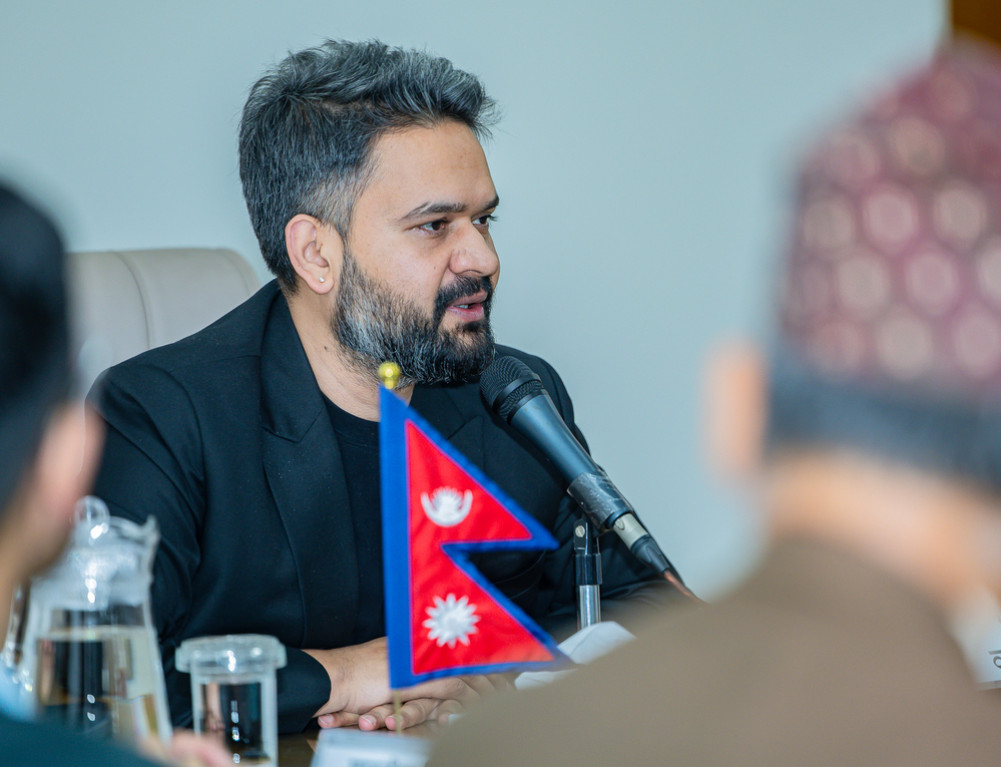
The Chancellor became powerful in the university after the ordinance abolished the appointment of the Vice-Chancellor, Registrar and other officials and removed the institutional representation of professors, students and employees in the university assembly.
We use Google Cloud Translation Services. Google requires we provide the following disclaimer relating to use of this service:
This service may contain translations powered by Google. Google disclaims all warranties related to the translations, expressed or implied, including any warranties of accuracy, reliability, and any implied warranties of merchantability, fitness for a particular purpose, and noninfringement.
Contrary to the advice of experts to remove the Prime Minister from the position of Chancellor of all universities, the government has made the Prime Minister more powerful as the Chancellor by bringing an ordinance. The government has already removed the Vice-Chancellor, Rector and Registrar of 16 universities by bringing the ordinance.
In the report of the Higher Education Commission 2075, experts had suggested that the Prime Minister should be removed from the position of Chancellor in all universities. The Policy Research Foundation had also suggested that the government remove the arrangement of the Prime Minister as the Chancellor. While the government brought an ordinance and abolished the appointment of Vice-Chancellor, Rector and Registrar, the arrangement of the Chancellor has not been amended. The government has also abolished the appointment of higher-level officials in health science institutes where the Prime Minister is the Chancellor.
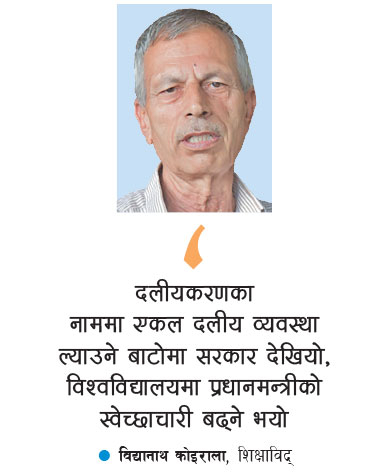
Educationists say that the government's latest move has further strengthened the Chancellor. Educationist Bidyanath Koirala commented that instead of removing the Prime Minister from the position of Chancellor by issuing a new Act on Higher Education, the office bearers were removed through the reverse process. 'The wisdom of making the Prime Minister the Chancellor is a bad idea. The Prime Minister must be removed from the position of Chancellor. It is wrong to change the office bearers of the university as soon as the Prime Minister changes.'
The government has amended the TU Act, 2049 BS through an ordinance and removed the institutional representation of the Nepal Professors' Association, TU Professors' Association, TU Employees' Association and Independent Students' Union in the university's highest body (Senate). Instead, the Prime Minister and the Chancellor will now be able to directly elect members of the assembly from among professors, students and employees. There is also a provision for the Prime Minister to directly nominate members by removing nominees from the assemblies of other universities.
The provision that the king is the chancellor The 2028 TU Act also had a provision that the chancellor could nominate most of the assembly members . The student and professor representatives were nominated from among them. Earlier, there was a provision to nominate 1 person each from the Nepal Professors' Association, TU Professors' Association, TU Employees' Association and 2 from among the chairpersons of the Independent Students' Union. Instead, there has been a provision to nominate five members, including two women, from among the teachers of TU. There has been a provision to nominate 2 members, including one woman, from among the students and one member from among the employees. The assembly will be chaired by the Prime Minister and the Chancellor.
Now almost all the members of the TU Assembly will be elected by the chancellor and vice-chancellor. In all other universities, the chancellor has been given the right to choose professors, students and staff representatives. ‘Professors, students and staff had been raising their voices in the Senate as the opposition. Now, if all the members are appointed by the Prime Minister, the Prime Minister will also present the agenda and make decisions,’ said a professor at TU, ‘The Prime Minister’s direct interference and monopoly in all universities will increase even more.’
The provision that the king is the chancellor
The 2028 TU Act also had a provision that the chancellor could nominate most of the assembly members
. The student and professor representatives were nominated from among them. Educationists and academics say that now students and professors are appointed directly according to the wishes of the Prime Minister.
 The High-Level Education Commission report 2075 BS had recommended that the university be run by a conservation committee or 'board of trustees' comprising academics. The then education ministers Sumana Shrestha and Mahabir Pun had also initiated the process of removing the Prime Minister from the position of Chancellor. Pun resigned from the post of minister, expressing dissatisfaction that an ordinance with a provision to remove the Chancellor from the Prime Minister was not recommended by the Council of Ministers.
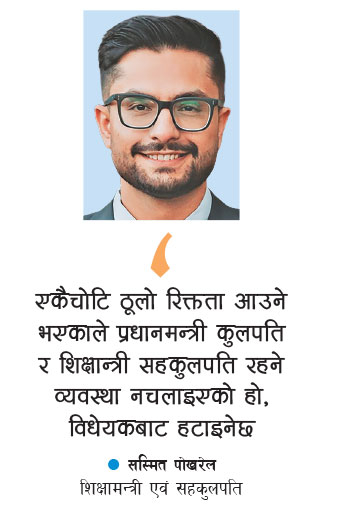
Education Minister and Pro-Chancellor Sasmit Pokharel, on the other hand, says that in the first phase, partisanship and party interference in the educational institution will be removed, and in the second phase, the Prime Minister and Education Minister will be removed from the position of Chancellor and Pro-Chancellor. 'Eliminating partisanship and party interference is the first priority of this government. Appointments are made on the basis of merit in the places where they are removed,' he replied to Kantipur's query through his secretariat, 'Removing only the Vice-Chancellor and other office bearers has created a huge vacancy in the university. "The reason for not removing the Chancellor and Vice-Chancellor at once is that there will be a bigger vacancy." He informed that the bill to make the Prime Minister the Chancellor and the Education Minister the Vice-Chancellor will be submitted to the Parliament.
Educationists have commented that the decision to increase the number of members that the Prime Minister and Chancellor can nominate in the assembly and to remove deans from their posts by interfering in the jurisdiction of vice-chancellors in Kathmandu University and other universities is an attempt to impose a single-party system in the academic sector. Educationist Koirala said that the government is taking the opposite path by saying that it will stop partisanship in universities. "The government is on the path of introducing a single-party system in the name of partisanship. Now the Prime Minister's arbitrariness in universities is increasing," he said, adding, "The university assembly is also a place to listen to the opposition."
Nepal Professors' Association President Ramesh Kumar Joshi objected to the government's move to remove institutional representation of professors, employees and students. ‘If the university is not for professors, students, and employees, whose is it? The government will answer,’ he said. ‘What model of university is the Prime Minister himself trying to create by selecting and appointing Senate representatives?’
He suspected that the government was adopting a policy of increasing interference in the university. ‘Since the establishment of the university, the professors’ association has been in the Senate, I don’t understand why it has been removed now,’ Joshi said. The professors’ association has demanded that the government correct the arrangement made by the ordinance.
Tribhuvan University Professors’ Association President Basant Dhakal commented that the ordinance was brought to prohibit the provision for critical thinking and asking questions in the university. ‘Will only those appointed by the Chancellor and Vice-Chancellor run the university?’ he asked. He said that the government has directly interfered with the autonomy of the university. ‘The dictatorial tendency of the government was seen. Even during the reign of the king and the Panchayat, we professors and students’ elected representatives used to be in the university assembly. Now that it has been removed, it will not give good results,’ he said.
 SBU presidents Deepak Raj Joshi of TU Central Campus and Bishnu Pokharel of Prithvi Narayan Campus in Pokhara were members of TU Sabha. They have expressed dissatisfaction over their removal by the ordinance. They demand an immediate reconsideration of the ordinance. They have issued a joint statement and claimed that the government decision has interfered with academic freedom and democratic practices. They allege that the government is trying to weaken TU Sabha by removing student representatives who came through the elected process and increase political interference. Objection from civic leaders
Civic leaders have also expressed objections saying that the government has interfered in the university in the name of partisanship. A statement jointly issued by 28 civic leaders including Nilambar Acharya and Pitambar Sharma said, "We oppose direct interference in academic freedom in the name of ending partisanship. The government's act of removing them through an ordinance in a manner reminiscent of the 'Pajani' of the Rana regime has flouted the rules, procedures and the rule of law."
They have stated that the government's move has opened the way for further politicization and single-party control. They have expressed concern that the simultaneous removal of officials from their posts, contrary to the independence of the university and academic dignity, has increased government interference in the university. They have also objected to the ban on professional organizations including student organizations.
Demand for applications for the appointment of vice-chancellors
The government has started the process of appointing vice-chancellors in eight universities. The Selection and Recommendation Committee formed to recommend names for the appointment of vice-chancellors of various universities issued a notice on Friday and called for applications.
Vice-Chancellors, registrars and deans of all universities and health science institutes have been removed
The recommendation committee formed under the chairmanship of Education Minister Pokharel includes Education Secretary Chudamani Poudel and National Planning Commission education member Resu Aryal Dhungana. Minister Pokharel said that the procedure has been implemented to make the selection of university leadership transparent, merit-based and fair. 'An expert committee will be formed to evaluate the appointment process of university vice-chancellors and the selection process will be carried out through open competition,' he said in a video message made public on Friday.
The University Act, amended by the ordinance, has specified the qualifications of vice-chancellors, rectors and registrars. So far, the act had not specified the provisions related to qualifications. It is said that the vice-chancellor should have at least a doctoral degree. He should have at least 10 years of experience in research and academic fields. He should be at least 40 years old. The academic qualifications of the rector have also been specified according to the vice-chancellor.