This bill has decided on issues such as where and how the SEE exam will be conducted, whether teachers will have political affiliation, how private schools will give scholarships, whether there will be an education office in the district or not.
We use Google Cloud Translation Services. Google requires we provide the following disclaimer relating to use of this service:
This service may contain translations powered by Google. Google disclaims all warranties related to the translations, expressed or implied, including any warranties of accuracy, reliability, and any implied warranties of merchantability, fitness for a particular purpose, and noninfringement.
The Education, Health and Information Technology Committee has completed the discussion on the School Education Bill 2080 and prepared to submit it to the House of Representatives after passing the bill with a report. Everyone is interested in this matter, which has been complicated for a long time, because it is a matter related to the future of 7 million students. This bill has decided on issues such as where and how the SEE exam will be conducted, whether there will be political affiliation of teachers, how private schools will give scholarships, whether there will be an education office in the district or not. We have tried to explain in a question-and-answer manner what are the 7 main points of interest included in it.
What is in the bill about SEE, class 8 and class 12 exams?
The SEE exam which is being conducted under the central government at the national level has now been decided by the bill to be conducted by the state government. Such an examination should be conducted in coordination with the National Examination Board. It is mentioned that other arrangements related to the operation of SEE will be as provided in the provincial law. In the bill, it is mentioned that the class 8 exam will be conducted by the local level. The National Examination Board will conduct the Secondary Education Passing Examination of Class 12 as before.
What will the Early Childhood Development Center (ECD) look like now?
So far ECD program has been running for 1 year in community and 4 years in private. But the Bill has changed that . Now ECD will be conducted as a two-year program in all types of schools, including private and public. "No school will be allowed to operate early childhood development and education for a period of more than two years," the bill states, "Early childhood development and education can be conducted in public schools for a period of two years from the date specified by the government after ensuring resources." To be appointed as an ECD Facilitator (Teacher), the educational qualification should be at least Class XII or equivalent. It is mentioned in the bill that their wages, service conditions and facilities will be as provided in the local law. But the bill also provides that the minimum wage and benefits specified by the federal law should not be lower than the minimum wage.
Private school profit or non-profit?
The School Education Bill has provided for private investment schools to be gradually made non-profitable . "Private investment schools should be operated in a public welfare and service manner," it is said in subsection 9 of section 4 of the bill. The establishment and operation of private schools has been kept open. The committee agreed that the parliamentarians should set a year and register the amendment to make private schools non-profit. Since 2072, the registration of private schools in the company model has been banned, but the bill has opened it up. Those who want to establish a private investment school will have to apply for permission at the local level. If a social, religious or welfare organization wants to operate a school with the aim of not making a profit, they can establish it under the educational guthi. It has been arranged that the school run by the company can also be transformed into an educational group. It is arranged that the state will encourage the schools that go to educational Guthi . It is mentioned that there will be partial or complete exemption on land registration fee, vehicle import, educational material/laboratory material purchase fee. Schools that are already registered but not in operation will automatically be cancelled. 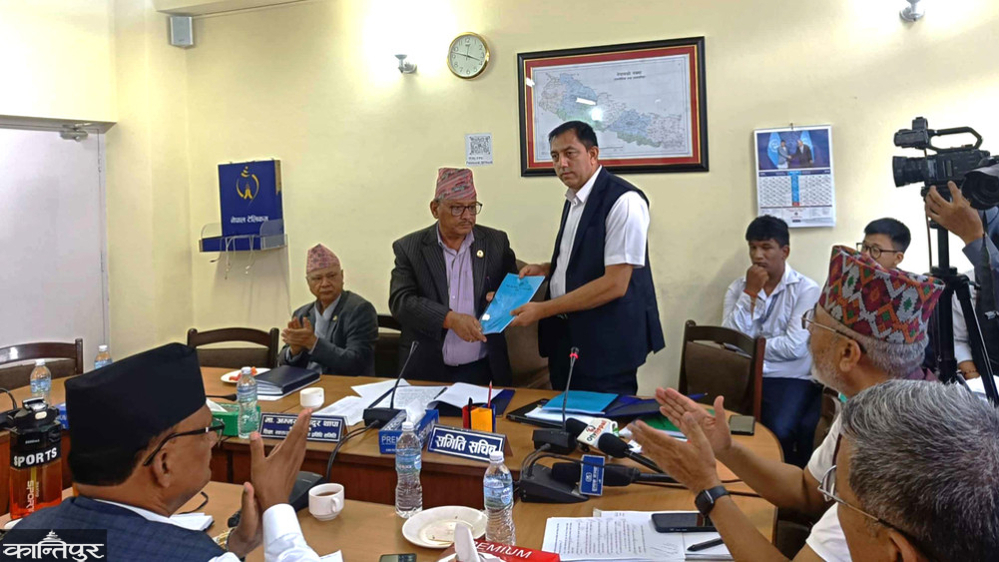
How many students should private schools give scholarships?
It has been arranged that 10 to 15 percent of the students will be given full scholarships by private schools. "Privately funded schools must provide the scholarship as a full scholarship as specified in the prevailing laws related to education," the bill states. The Compulsory and Free Education Act 2075 stipulates that 10% of the scholarship will be given to up to 500 students, 12% to 800 students and 15% to more students. It has not been fully implemented. Full scholarship is defined as tuition, examination fees, textbooks and educational materials, clothing, transportation, etc., and facilities provided by the school. Although there is an agreement that the private schools with residential facilities should also provide these facilities under the scholarship, the matter of how many people or percentage is yet to be decided . While distributing the full scholarship, 50 percent poor and needy students and 50 percent meritorious students will have to be selected through competition. Only poor and underprivileged students can get the clothing facility. The selection of students for the scholarship will be done by the local level concerned.
Is there an education office in the district?
The bill does not envisage an education office in the district . Instead, there will be no Education Development and Coordinating Unit in each district to carry out the education related work assigned by the state government. The unit will coordinate with the Ministry of Education of the state government. It is mentioned in the bill that the work and duties of the unit will coordinate with the local level of the respective district on education-related matters, and will do the work specified by the association, state government, examination board, teacher service commission.
What should be the qualification of a teacher ?
In the case of basic level classroom teachers, they must have passed the graduation level in any subject and the subject teachers must have passed the graduation level in the related subject . Earlier it was enough to pass class 12 to become a primary level teacher. For secondary level teachers, they must have passed master's degree in the relevant subject . The age limit is 35 years for men and 40 years for women. But there will be no age limit for permanent teachers to participate in open competition . Temporary teachers are also provided with no age limit for one time . So far there was a system of primary, lower, secondary and higher secondary teachers . Now there will be only secondary and basic level teachers . At the basic level, there will be classroom and subject teachers. All of them will be divided into third, second and first level.
What's in the bill about teacher conduct? The
bill has made some provisions about the conduct of teachers . It is mentioned that the teacher should observe time, regularity and discipline. Teachers are prohibited from engaging in political activities. It is said that teachers should not receive donations, treatment, donations and help. Establishing or operating a company and making business arrangements have also been prohibited. Teachers are also banned from protesting and striking. "Teachers shall not demonstrate, participate in closed strikes, arrest, obstruct, surround, pressure, stop teaching or obstruct children's right to study or incite others to do so," the bill states.
Other news/thoughts related to this
Should private schools provide full scholarships with accommodation

