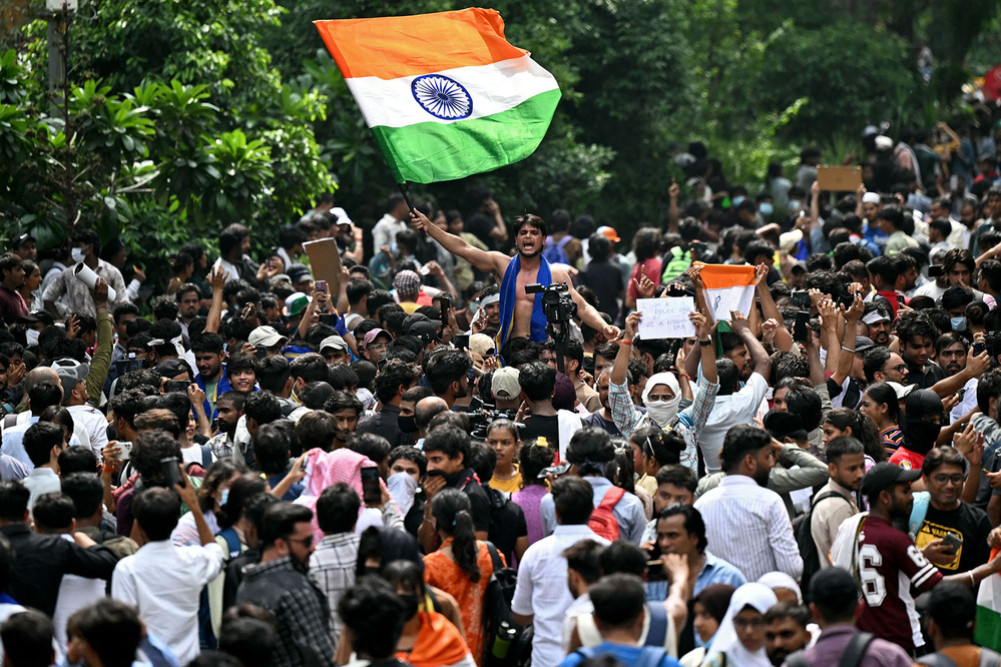
Education Minister Dharmendra Pradhan resigns; although the historic youth movement has been suspended after the government agreed to fulfill all demands including compensation and withdrawal of cases, the debate over the role of Indian media outlets and their credibility continues.
We use Google Cloud Translation Services. Google requires we provide the following disclaimer relating to use of this service:
This service may contain translations powered by Google. Google disclaims all warranties related to the translations, expressed or implied, including any warranties of accuracy, reliability, and any implied warranties of merchantability, fitness for a particular purpose, and noninfringement.
July 20, 2026, the road from Jantar Mantar in New Delhi towards the Parliament building was filled with crowds of youth. A peaceful protest and creative slogans against the government were underway. But suddenly, the police cracked down and charged with batons. Videos of police repression went viral on social media within moments. However, the next day, the headline of the Indian mainstream media ‘The Times of India’ read—‘Police Stop Protesters’.
The news included details stating ‘70 arrested, 118 police and 60 protesters injured’. There was a stark difference between the police excesses seen on the streets and the newspaper’s report. The news was trolled on social media for distorting reality. This made it clear that the Indian ‘mainstream’ media had taken a blatantly pro-government stance. However, a few select media outlets, including ‘Dainik Bhaskar’, made it their cover story, calling it the ‘biggest protest in 14 years’.
Youth had taken to the streets from June 6, demanding the resignation of Education Minister Dharmendra Pradhan over the leaking of the question paper for the National Entrance Test (NEET) for admission to MBBS, BDS, and other undergraduate medical and health-related educational programs, as well as other irregularities in the exam. The movement was led by the ‘Cockroach Janata Party’ (CJP).
After the controversial ‘chain’ remark by Chief Justice of India Suryakant, the CJP, which had started as a satirical campaign on May 16, called for a ‘Chalo Parliament’ march on July 20 to intensify the movement. The protest reached its peak with this march and the 26-day hunger strike by educational and environmental activist Sonam Wangchuk. Unable to contain the extreme anger of the youth spreading from the streets to social media and the nationwide public pressure, Education Minister Pradhan finally resigned on July 25, taking moral responsibility for failing to control the exam mafia. After Pradhan’s resignation and the government’s agreement to fulfill all demands, including compensation and withdrawal of cases, this historic movement has been suspended.
Although the youth movement has been suspended, the debate over the role and credibility of Indian media continues. In particular, there was keen interest in how the mainstream media covered the youth movement. Most mainstream media outlets followed the style of ‘The Times of India’. As a result, not only newspapers but also television correspondents covering the protests faced public outrage at the protest sites. Videos of reporters from India’s so-called ‘big’ television channels being surrounded and chased away by protesters are all over social media. The crowd continuously chanted, ‘Down with lapdog media!’
According to the international news agency Reuters, a television journalist, Dev Kotak, was even mistreated by protesters while reporting. Protesters vented their anger at mainstream TV channels, accusing them of being ‘pro-government’ and ‘government supporters’. Reuters reported that the youth labeled Indian TV reporters as ‘lapdog media’ and drove them off the streets.
On one hand, it was difficult for mainstream television journalists to set foot on the streets, while on the other, the same crowd welcomed independent journalist Ravish Kumar, who works through YouTube, with applause. According to Reuters, protesters easily accepted independent journalists from digital news platforms like ‘Newslaundry’, YouTube creators Akash Banerjee, Kavya Karnataka, Samdish Bhatia, and others. Only with them did students confidently share their grievances and issues.
Akash Banerjee, who left ‘Times Now’ to create content on YouTube, told Reuters that declining trust in traditional news media has helped attract audiences to independent online platforms. ‘The rise of alternative digital media is precisely because the media stopped questioning the government; otherwise, this wouldn’t have happened,’ he said.
Similarly, Manisha Pande of Newslaundry also said that years of growing frustration with mainstream television news had spilled over into the movement. ‘Earlier, we had prime-time news against propaganda and bias,’ Pande said, ‘but after 2014, the exact opposite happened. Now we see examples of how news becomes anti-public.’
The students who took to the streets wanted the media to question the government about the question paper leak, the extreme commercialization of the education system, and rising unemployment. But television ‘prime time shows’ were giving their movement a different color.
Through its program ‘TV Newsance’, ‘Newslaundry’ exposed how television channels were constructing a false narrative about the movement. According to the analysis, while students were demanding education and employment, television anchors were sensationally linking the movement to the American intelligence agency CIA.
The July 20 Parliament march was spun by anchors from Aaj Tak, DD News, India Today, NDTV, Republic Bharat, and others as a ‘conspiracy theory’ by linking it to the ‘use of Nepal’s open border’ and a ‘Pakistan connection’. It was clear that the real issues of the students were being politicized and portrayed as the agenda of opposition parties.
Not only television, but major Indian newspapers also showed extreme bias in their perspective on the movement. According to another Newslaundry report, 11 major Indian newspapers such as Indian Express, The Hindu, Times of India, Hindustan Times, Dainik Jagran, and Amar Ujala published the same event with different headlines and perspectives. Some of them distorted the event according to their editorial policy and inclination towards power, rather than reflecting the reality on the ground.
When mainstream media began to distort the protesters’ issues and defend the government, the youth took the responsibility of information flow into their own hands. Protesters no longer needed big cameras and OB vans! The smartphone in their pocket became the new newsroom.
According to Hindustan Times, during this movement, Instagram creators themselves became established as ‘citizen journalists’. They reported directly from ground zero at Jantar Mantar through Instagram reels and live streams. While television journalists would come for a few minutes to get a ‘bite’ and leave, independent creators stayed on the streets for up to 15 hours, directly engaging with protesters.
The ‘Digital News Report: India Launch’ published by the Reuters Institute at Oxford University on June 16, 2026, also confirms this. The report shows that public trust in mainstream media in India has been continuously declining. Instead of traditional television and newspapers, Indian audiences have largely shifted their news consumption habits to digital platforms, alternative media, and podcasts.
As Reuters concluded in its report, this movement may not have ended mainstream media, but it has sent a clear message—‘Traditional television and newspapers no longer have a monopoly on public attention and trust. For the new generation raised with smartphones in hand, independent journalists and digital creators have become the real journalists of today.’
However, many of these independent journalists and digital creators trusted by the youth are themselves products of mainstream journalism.