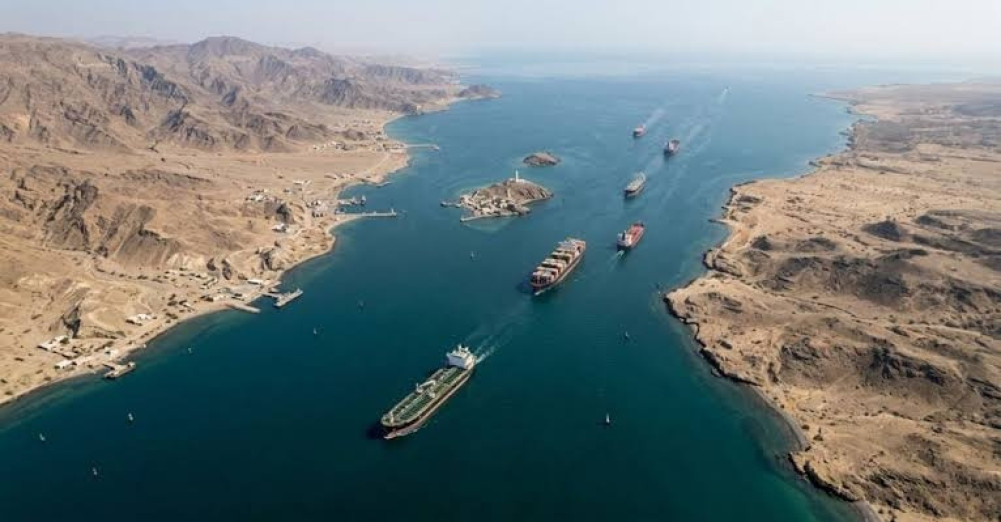
According to MarineTraffic, an organization that tracks ship movements worldwide, two oil tankers that had departed from Saudi Arabia changed their course after the Houthi announcement.
We use Google Cloud Translation Services. Google requires we provide the following disclaimer relating to use of this service:
This service may contain translations powered by Google. Google disclaims all warranties related to the translations, expressed or implied, including any warranties of accuracy, reliability, and any implied warranties of merchantability, fitness for a particular purpose, and noninfringement.
As the war intensifies, on Tuesday, Yemen’s Shia rebel group, the Houthis, which is close to Iran, declared a blockade in the Bab al-Mandeb Strait, considered strategically very important.
A Houthi spokesperson issued a video statement saying that this move was taken in retaliation for the airstrike carried out by Saudi Arabia at the main airport in Yemen’s capital, Sana’a.
According to Marine Traffic, an organization that tracks the movement of ships worldwide, after the Houthi announcement, two oil tankers departing from Saudi Arabia changed their routes.
Marine Traffic stated that this has created risks in the Red Sea. The Bab al-Mandeb Strait connects the Red Sea to the Gulf of Aden and the Indian Ocean. Commercially, it is the world’s fourth largest maritime route.
The Houthis allege that earlier this month, Saudi Arabia attacked the airport while Iranian officials were present. The Houthi rebels have described the Saudi kingdom as a criminal regime. Saudi Arabia has strongly condemned the blockade.
Saudi Arabia, the world’s largest oil-producing country, has been using this route to export millions of barrels of crude oil daily. After disruptions in the Hormuz Strait due to the US-Iran war, Saudi Arabia has been sending its oil to the outside world via Bab al-Mandeb.
With the ongoing war in Iran already destabilizing the global energy market, this blockade by the Houthi group is certain to further increase energy prices.
Amid rising tensions in the strait, Saudi Arabia, Iraq, and the United Arab Emirates (UAE) have begun working on alternatives to transport oil by road instead of by sea.
For this, these countries are discussing building new oil pipelines or expanding the capacity of existing ones. However, experts say it could take years for such massive pipeline projects to be completed and become operational.