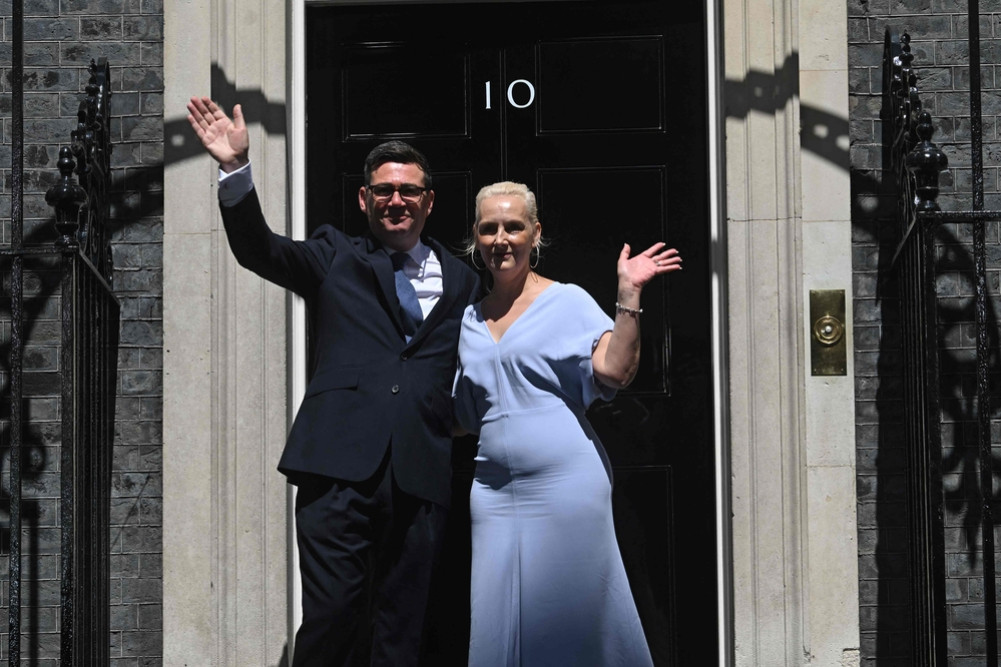
The UK government said, 'We want to give people a breathing space.'
We use Google Cloud Translation Services. Google requires we provide the following disclaimer relating to use of this service:
This service may contain translations powered by Google. Google disclaims all warranties related to the translations, expressed or implied, including any warranties of accuracy, reliability, and any implied warranties of merchantability, fitness for a particular purpose, and noninfringement.
Britain's newly appointed Prime Minister Andy Burnham has decided to remove the value-added tax (VAT) on electricity used for household purposes. The decision, made on Tuesday, will come into effect from October 1.
Britons currently pay 5 percent VAT on electricity used at home. The government expects the decision to save about 45 pounds per household this year.
Burnham formed his cabinet after being sworn in as Prime Minister on Monday. He said his goal was to control rising inflation in the UK. 'We want to give people a breathing space,' Burnham said in a statement. 'We are cutting taxes on electricity bills. It will put some money in people's pockets and hope will return.'
The government has also decided to cancel former Prime Minister Keir Starmer's digital ID card scheme. The money saved will cover the cost of tax cuts. The previous government had planned to spend 1.8 billion pounds of taxpayers' money on digital ID cards.
Burnham said he also wanted to relieve pressure on small businesses hit by tax increases. Meanwhile, Burnham also pledged to follow the strict fiscal discipline of Starmer's time to balance the government's daily spending and taxes.
UK government debt fell more than expected in June, according to official figures on Tuesday. As a result, new Chancellor John Healy is under less pressure. According to the Office for National Statistics (ONS), net public sector debt was 16 billion pounds in June, a third lower than a year ago.
Burnham, who was elected Labour Party leader after Starmer resigned, was appointed Prime Minister on Monday. Burnham, 56, became an MP in a by-election just days before Starmer resigned.
He was sworn in as an MP just hours before Starmer's resignation. He previously served as Mayor of Greater Manchester from 2017 to 2026. He was also Health Minister in Gordon Brown's government from 2009 to 2010.
Burnham describes himself as a social democrat. He seeks to promote both private business and public investment. He aims to strengthen public services such as public hospitals, transport and housing. He has also called his ideology "Manchesterism".
In his first speech as prime minister, he promised to completely end rough sleeping in England. The government has also announced that it will provide 1,200 homes and necessary support for at least 3,000 people in England over a five-year period. The government has announced that it will spend an additional 340 million
Burnham has said that all regions of the UK want to take public control of water and energy. He has said that this could be modeled on Greater Manchester's bus network. In Manchester, local authorities control fares, timetables and routes, while private operators bid to operate services on a franchise basis.
He has also put forward a plan to build bigger houses and rent them out cheaply. However, British media have reported that the government may find it difficult to implement such a plan due to the challenge of reducing debt.
He has said that he will stick to his promise not to increase income tax, VAT or National Insurance contributions. However, he has not ruled out the possibility of increasing taxes on the wealthy.
Burnham has been in favor of a more comprehensive social care system. Previously, the Starmer government
Immigration was reduced by tightening visa rules. Burnham also said that immigration should be reduced further. However, he has not set any specific target for this. He has supported Home Secretary Shabana Mahmood's proposal to increase the waiting period for foreign nationals living in the UK to apply for permanent residence.
On foreign policy, he has expressed his desire to return the UK to the European Union. But he has made it clear that he is not thinking of reviving the issue or holding a referendum right now.
He also has the challenge of repairing Britain's relations with the US, which deteriorated during Starmer's tenure. Earlier, US President Donald Trump was angry that Starmer did not provide enough support in the Iran war. Trump said that he had a telephone conversation with Burnham when he became British Prime Minister.
He said that he would meet Burnham in the near future. “We discussed a variety of topics, including trade, military alliances, and demining the Strait of Hormuz,” Trump wrote on Twitter. Burnham’s office said the UK was committed to its security agreement with the US, and that it would support the safe opening of the Strait of Hormuz. Iran has blocked the waterway since the US-Israeli war began, which has led to a global fuel crisis.