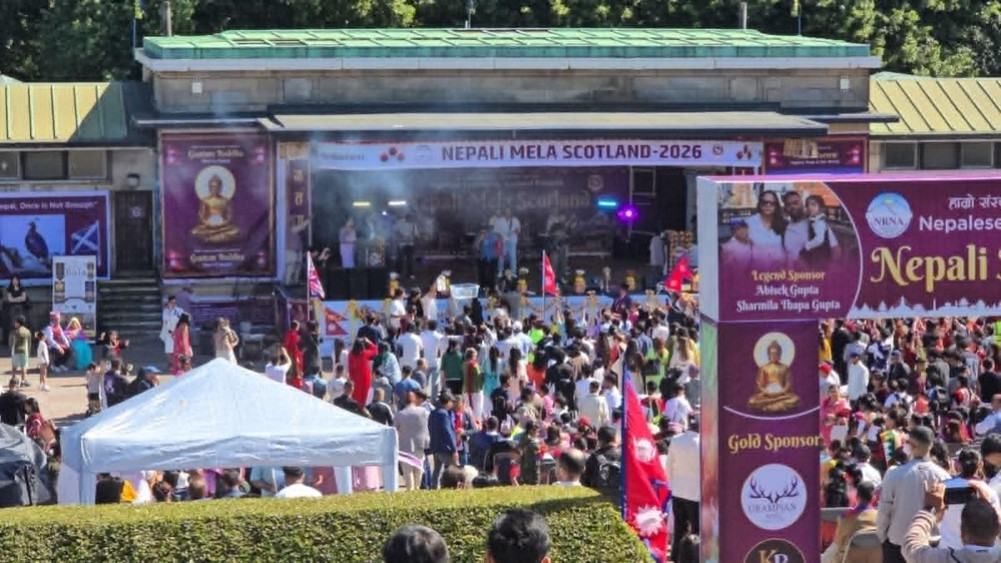
Participants dressed in traditional Nepali attire, along with cultural performances including Deuda, Jhyaure, Sakela, and Lakhenacha, attracted the attention of the audience.
We use Google Cloud Translation Services. Google requires we provide the following disclaimer relating to use of this service:
This service may contain translations powered by Google. Google disclaims all warranties related to the translations, expressed or implied, including any warranties of accuracy, reliability, and any implied warranties of merchantability, fitness for a particular purpose, and noninfringement.
The second Nepali Mela has concluded at the Ross Bandstand complex in Princes Street Gardens, in the heart of Edinburgh, the capital of Scotland, United Kingdom. The fair was held on Monday amidst a program full of Nepali art, culture and tradition. The fair, organized in the lap of the world-famous Edinburgh Castle, gave the area a glimpse of mini Nepal throughout the day.
The venue was decorated with the national flags of Nepal and Scotland, while banners with pictures of Mount Everest and Gautam Buddha reflected the identity of Nepal. Participants dressed in traditional Nepali costumes, cultural performances including Deuda, Jhyaure, Sakela, Lakhenacha, etc. attracted the attention of the audience.
Sagar Bhandari, a social worker and member of the main organizing committee of the fair, born in Aapchaur, Musikot Municipality-5, Gulmi, has been making Scotland his workplace for the past 20 years. He said that the organizing team has been working day and night to make the second Nepali Mela grand and successful. He said that he felt special pride when he participated in the fair in his original Newari attire.
'Such programs organized abroad make an important contribution to preserving our language, culture and identity. Such programs are also effective in connecting the new generation growing up in Scotland with their original culture,' said Bhandari.
The organizers have stated that about three thousand Nepalis participated in the fair, which was jointly organized by the Nepali Embassy in London and NRNA Scotland in collaboration with more than a dozen Nepali organizations in Scotland. A significant number of Scottish and other foreign citizens were also present at the fair. 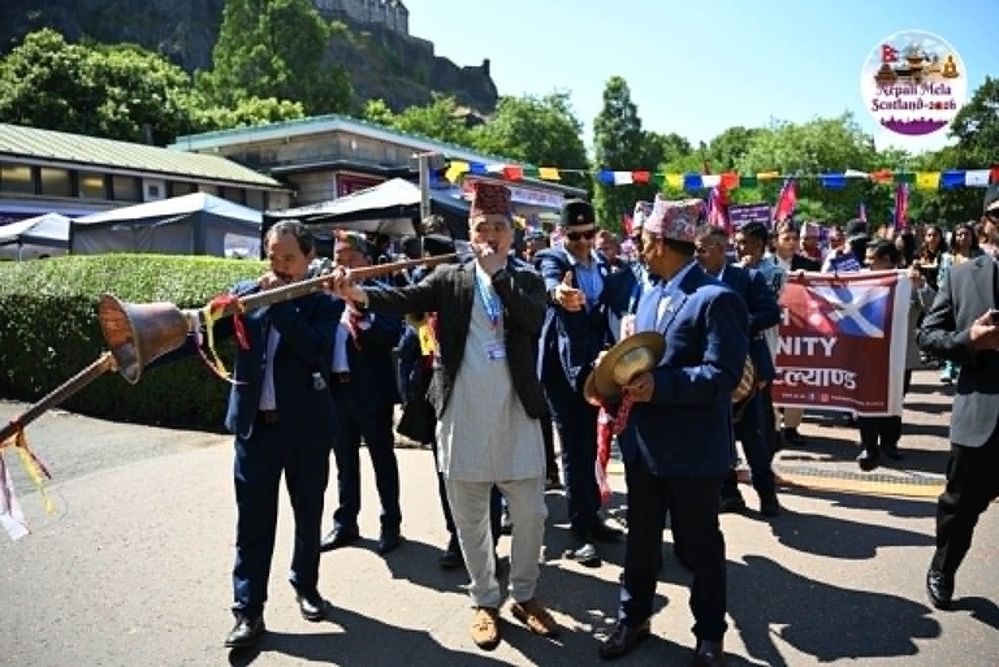
According to Bhandari, the Nepali fair has provided an opportunity to introduce Nepal's art, culture, music, food and hospitality to the Scottish community. 'Such programs further strengthen the cultural relations between Nepal and Scotland and also send a positive message in promoting Nepal's tourism,' he said.
NRNA Scotland President Sher Bahadur KC said that the aim of this year's fair is to promote tourism in Nepal, promote Nepali art, culture and tradition, and connect the new generation growing up in Scotland with Nepali identity.
The program was inaugurated after the national anthems of Nepal and Scotland. This was followed by a cultural parade with Scottish pipers and Nepali Naumati instruments. Various Nepali organizations and communities participating in the parade gave performances reflecting their original culture.
After the parade, cultural performances including Bhajan-Kirtan, Lok Dohori, Jhyaure, Sakela, Lakhenacht and Deuda were presented with the participation of local artists and communities. Artists from Nepal, Prakash Dutraj, Indra GC, Manju BK, Shobha Tripathi and Ramesh Raj Bhattarai, also gave musical performances.