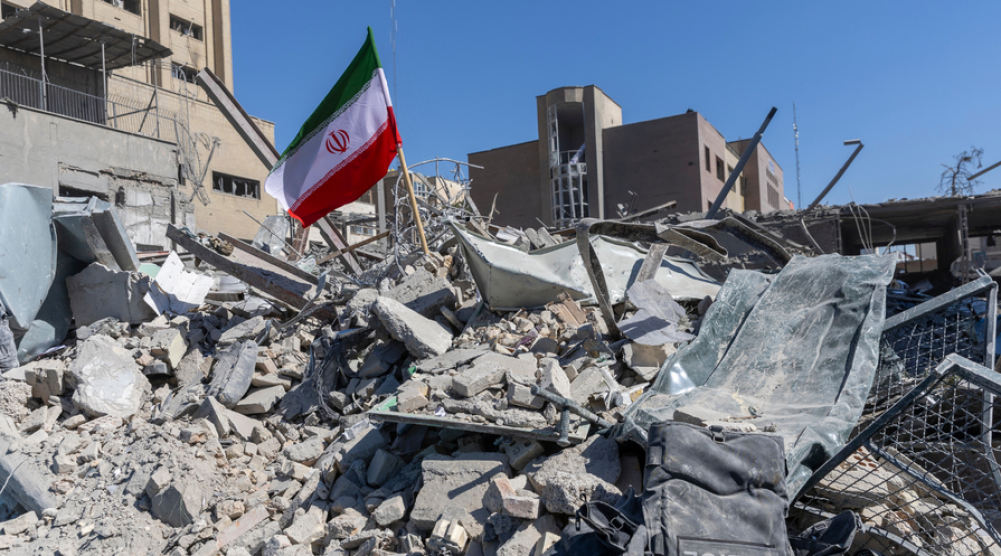
At least 38 people have died in Iran in the last six days due to US strikes, according to Iran's Health Ministry.
We use Google Cloud Translation Services. Google requires we provide the following disclaimer relating to use of this service:
This service may contain translations powered by Google. Google disclaims all warranties related to the translations, expressed or implied, including any warranties of accuracy, reliability, and any implied warranties of merchantability, fitness for a particular purpose, and noninfringement.
The US has stepped up attacks on Iranian public assets. From Thursday night to Friday morning, the US military destroyed more bridges, a power plant and a tower at the Chabahar port in Iran, Iranian media reported.
Earlier, US President Donald Trump had warned of targeting infrastructure there in an attempt to pressure Iran to loosen its control over the strategic waterway of Hormuz.
“The coming week will be very bad for them. If they don’t come to the negotiating table, we will destroy all their power plants and bridges,” Trump said on Fox News on Tuesday night.
At least three bridges were attacked in Hormuz province on Thursday night, Iran’s Mehr news agency reported.
Similarly, at least seven people were killed in the incident, local media reported. It was also reported that the Kohorestan bridge connecting Hormuz and Fars provinces was attacked.
Mehr also reported that two people were injured in the attack on a railway junction in the city of Bandar Abbas, the capital of Hormuz province.
Iran’s Energy Ministry acknowledged for the first time on Friday that its electrical infrastructure had been damaged by US airstrikes. The ministry also appealed to citizens in the country’s southern provinces to reduce their electricity consumption.
A statement issued by the ministry said, “Those regions are currently facing a double whammy of extreme heat and attacks on electrical infrastructure.” However, the ministry did not provide details on which power plants, transmission lines or other equipment were attacked.
Similarly, a tower was destroyed in a US attack on Iran’s strategic Chabahar port in the Gulf of Oman.
The port is a major trade route connecting it to landlocked neighboring Afghanistan. The port is also used by Iran’s Revolutionary Guard Corps for military security.
At least 38 people have been killed in Iran in the last six days due to US attacks. Similarly, more than 400 people were injured, IRNA news agency reported, citing Iranian Health Ministry spokesman Hossein Kermanpour.
The US attack on public property could cause a serious crisis in the transportation of food, consumer goods and military equipment needed by Iran's 90 million people.
US President Donald Trump, in an address to the nation, claimed that the war against Iran was moving in the right direction. 'We are achieving great success in Iran. You will see the results of this effort very soon,' Trump said.
Iranian Foreign Minister Abbas Araghchi has responded that the US is committing a war crime by attacking public property.
In response to the US attack, Iran has continuously fired missiles at US allies in the Middle East. Iran has also fired missiles at Qatar, which is playing a mediator role in this war.
When the air defense system was used to neutralize Iranian missiles in the sky Loud explosions were heard.
According to the Qatari Interior Ministry, a girl was injured when debris from the destroyed missiles fell.
Along with Pakistan, Qatar is a key mediator in efforts to end the Iran-Iraq war. Iran has also targeted other neighboring countries, Bahrain, Kuwait and Jordan, since early Friday. According to Kuwaiti officials, Iran has launched a major attack on a major electricity and water treatment plant there.
The plant has been extensively damaged. About 90 percent of Kuwait's drinking water supply comes from this plant. The Kuwaiti government said it was collecting detailed information about the damage and working to restore the closed plant. Similarly, the Jordanian army said it had successfully neutralized three Iranian missiles that entered its airspace on Friday morning.
The US news agency (Associated Press) AP reported that a temporary ceasefire agreement between the two sides reached last month has been completely broken. The US and Iran have been engaged in a two-pronged attack on the Strait of Hormuz for the past few days.
Iran blocked the Strait of Hormuz, considered the world's most important oil transportation route, after the US and Israel jointly launched a war against Iran on February 28. This move by Iran has significantly increased the price of crude oil in the world market and given Iran strong 'bargaining' power in negotiations.
The interim agreement signed on June 17 stated that the waterway would be opened within 30 days. However, both sides did not comply with the agreement. Recently, Iran has blocked the Strait of Hormuz. Similarly, the US has also deployed troops to this waterway and blockaded Iranian ships.
London-based military analyst Alex Alfiraz Sears told Al Jazeera that the attacks outside the traditional military arena signaled a major shift in US strategy. 'US President Trump looks frustrated and desperate. It seems that he is preparing to land troops. The current attack can be seen as the initial stage of that,' he said.
The US has attacked not only bridges, roads and railway infrastructure, but also water infrastructure, food storage facilities and electricity infrastructure in recent days. Simon Mabon, a professor of international relations at Lancaster University in the UK, said that these series of attacks can be interpreted as a prelude to a military incursion. He said that the US may have done this in an attempt to pressure Iran and bring it to the negotiating table. He said that it is unlikely that Trump will take such a step, as the plan to deploy ground troops in Iran would prove disastrous.
'A ground military operation would be disastrous. That is why it will not happen,' he said, 'It may have been done to pressure Iran to come to the negotiating table. However, attacking civilian infrastructure will only strengthen anti-American sentiment in Iran.'