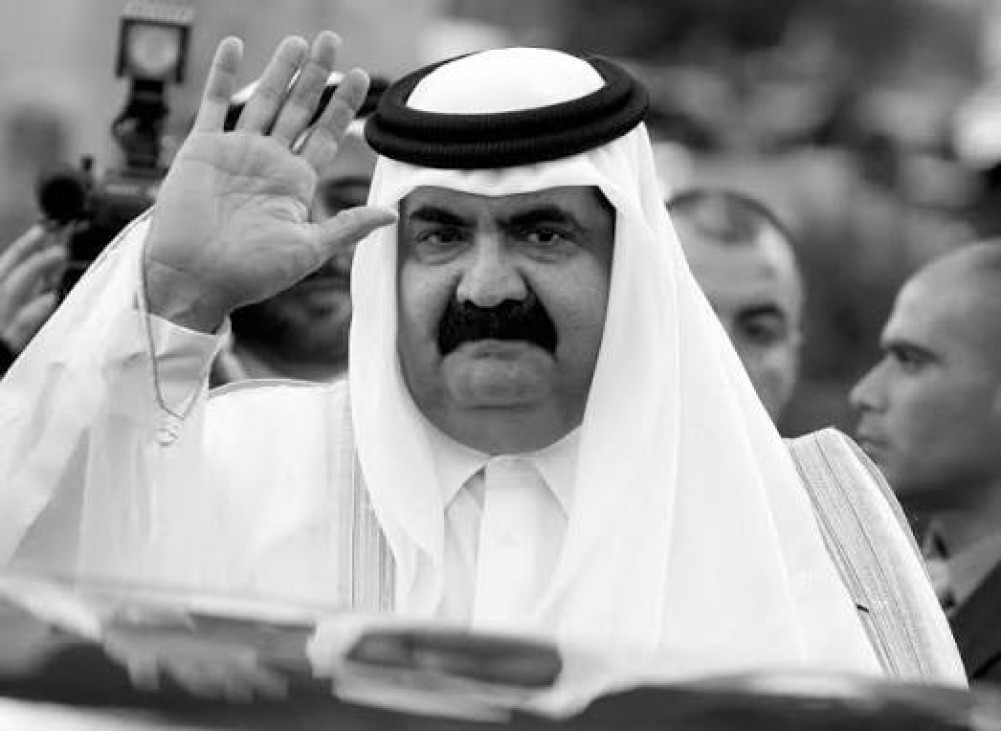
Based on Vision 2030, announced by Hamad in 2008, Qatar has transformed from an economy dependent on oil exports to one of the world's most prosperous economies and an investment hub.
We use Google Cloud Translation Services. Google requires we provide the following disclaimer relating to use of this service:
This service may contain translations powered by Google. Google disclaims all warranties related to the translations, expressed or implied, including any warranties of accuracy, reliability, and any implied warranties of merchantability, fitness for a particular purpose, and noninfringement.
Qatar's Emir Sheikh Hamad bin Khalifa Al Thani, who modernized Qatar and made it one of the world's richest and most influential nations, died on Sunday at the age of 74.
Hamad was known in Qatar as the 'Father Emir' (Father Emir). During his tenure, the small Arab country of Qatar became a global economic and diplomatic powerhouse. He assumed power in 1995 and voluntarily handed over power to his 33-year-old son Sheikh Tamim bin Hamad Al Thani in 2013. It is rare for a ruler to voluntarily relinquish power in the Arab world.
Hamad graduated from the Royal Military Academy in Britain in 1971. Before becoming emir, he held senior positions in Qatar, including army chief and defense minister.
He was also chairman of Qatar's Planning Commission in 1989. This helped him understand Qatar's problems and prospects. Hamad seized power in 1995 after overthrowing his father, Khalifa bin Hamad Al Thani, in a bloodless coup.
During his 18-year reign, Qatar's liquefied natural gas (LNG) production reached an annual average of 77 million tons. Production from the North Field made the country the world's largest exporter of liquefied natural gas (LNG) by 2006.
This made Qatar one of the richest countries in the world in terms of per capita income. Qatar's gross domestic product (GDP) increased more than 24-fold during his reign.
When he took power in 1995, Qatar's gross domestic product (GDP) was only $8 billion. However, by 2013, it had reached $199 billion. During this period, Qatar's economic growth rate was among the highest in the world, according to the International Monetary Fund.
According to the World Bank and the International Monetary Fund, during Hamad's reign, Qatar became one of the countries with the highest per capita GDP in the world.
During his tenure, Qatar's per capita income (in purchasing power parity terms) exceeded $90,000. At the same time, government spending on housing, education, and health was significantly increased, and the unemployment rate fell to a very low level.
Qatar's economic transformation during Hamad's reign was not limited to increasing oil and gas production or the income from it. The funds received from exports were also efficiently managed. According to experts, the increase in income was possible not only due to the increase in the price of energy resources, but also due to the expansion of government investment and the creation of jobs related to energy and infrastructure projects. Along with the investment in the energy sector, Qatar also took the lead in building a knowledge-based economy.
Under Hamad's presidency, Qatar established the Supreme Commission for Economic Affairs and Investment in 2011. The commission aimed to increase Qatar's financial reserves by diversifying domestic and foreign investment. Four years later, the Qatar Investment Authority (QIA) was formed.
It was established to manage profits from oil and gas exports. Within a short time of its establishment, the authority became one of the world's largest sovereign wealth funds. It invested in world-renowned companies. Qatar's investment policy has expanded to almost every continent.
Qatar's investments have spread from the world's largest football clubs to major financial institutions. The authority now has assets of more than $500 billion, according to the Sovereign Wealth Fund Institute. Qatar has been using its wealth for public welfare. According to the World Bank and the IMF, Qatar became one of the countries with the highest per capita income during Sheikh Hamad's reign.
During Hamad's tenure, large sums of money were spent on housing, education and health for the people. One of the early development decisions taken after he took power was the establishment of the Qatar Foundation for Education, Science and Community Development in August 1995.
It was developed as a major institution investing in education, scientific research, and innovation. Later, Qatar attracted international universities such as Georgetown University, Texas A&M University, and Carnegie Mellon University. This was considered part of a long-term strategy to prepare the country for the post-oil and gas era.
The policy of economic liberalization and strengthening its position as a regional financial and trade center established the capital, Doha, as an important center for international economic and investment conferences.
During Hamad's reign, gas revenues were not limited to operating the Qatari budget, but were also invested in large-scale infrastructure projects. Hamad International Airport, Hamad Port, Lusail City, modern road infrastructure, and other developments were developed during his tenure.
These infrastructures established Doha from an ordinary Gulf city to a global center. In 2008, Hamad announced the 'Qatar National Vision 2030'. This strategic plan aims to build a knowledge-based economy and continue to prosper for future generations. Economic policies have been formulated in line with the goal of using its natural resources as a basis for sustainable development.
On that basis, large multinational companies and large amounts of foreign investment are entering Qatar today. Vision 2030, which remains a guiding document for economic policy to this day, reflects Hamad's policy direction of transforming wealth obtained from natural resources into the basis of sustainable development. The same policy is being continued by Hamad's son and successor, Emir Sheikh Tamim bin Hamad Al Thani.
The identity of a mediator in geopolitical conflicts
According to those who know Hamad closely, even before assuming power, he clearly understood that Qatar did not have the traditional requirements of power, such as a military or a large geography. Therefore, he adopted a strategy of investing in soft power.
During his tenure, Qatar established its image as a country that could play a role in reducing geopolitical tensions while Iran, Saudi Arabia, and the UAE were competing for regional dominance in West Asia and the Arab region.
Qatar mediated in the conflict in Sudan's Darfur region, the conflict between various factions in Lebanon, and the conflict between the Palestinian groups 'Hamas' and 'Fatah'. Recently, following his policy, it is playing an important role in resolving the war between Iran and the United States.
Similarly, Hamad was aware of the important role of the media in the expansion of benign forces. During his tenure, the Al Jazeera network was established in 1996. It played an important role in showing the political and social activities of the Arab region to the rest of the world through their perspective.
Its on-the-spot reporting on the 2001 Afghanistan War and the 2003 Iraq War made this media outlet popular worldwide.
After the establishment of the largest US military base, Al Udeid Base in Qatar in 2002, many countries became suspicious of Qatar's role in regional politics.
On the one hand, Al Jazeera was broadcasting commentaries and interviews criticizing American interventionist policies. On the other hand, US military aircraft were flying bombs from Al Udeid base in Iraq and Afghanistan. Regional powers such as Saudi Arabia, Egypt and the UAE also accused Qatar of adopting double standards.
Al Jazeera was temporarily banned in Egypt after it prioritized the coverage of the Arab uprisings in 2011. Despite pressure from neighboring countries, Qatar openly supported the Arab uprisings.
Qatar supported NATO's military campaign during the Libyan conflict. Similarly, in Syria, after President Bashar al-Assad's extreme repression of the protesters, Qatar broke off diplomatic relations with Damascus. This led to accusations that Qatar was acting in the interests of the United States.
On the other hand, at the same time, Qatar was also providing asylum to the political leadership of Hamas and allowing the Taliban to open an office. Similarly, it maintained cautious relations with Iran.
Qatar's ability to maintain neutral relations by winning the trust of many parties has given it the opportunity to mediate in ending many conflicts. For example, the Taliban office opened in Qatar created an environment for talks between Washington and the Afghan group. As a result, the withdrawal of NATO and US troops from Afghanistan was finally possible in 2021 after a long war.
It also played a constructive role in creating an environment for talks between the two Palestinian factions, Hamas and Fatah. Not only this, it presented a rare diplomatic model by resolving disputes between Yemen, Somalia, Eritrea and Djibouti.
Qatar had proposed to host the 2022 FIFA World Cup during his tenure in 2010 and this proposal was also passed. It was a rare event in itself for a small country with a population of only 3.4 million to host the World Cup, which was not hosted by the world's largest populations such as China and India.
Qatar's infrastructure and construction sector has seen a huge boom since it won the right to host the World Cup.
The Qatari government spent more than $200 billion on infrastructure development, including roads, stadiums, railways, a new international airport and a port, for the World Cup.
Although there have been allegations of labor exploitation of Nepalese and other foreign workers during the construction of that infrastructure, hosting the World Cup has boosted Qatar's international image.