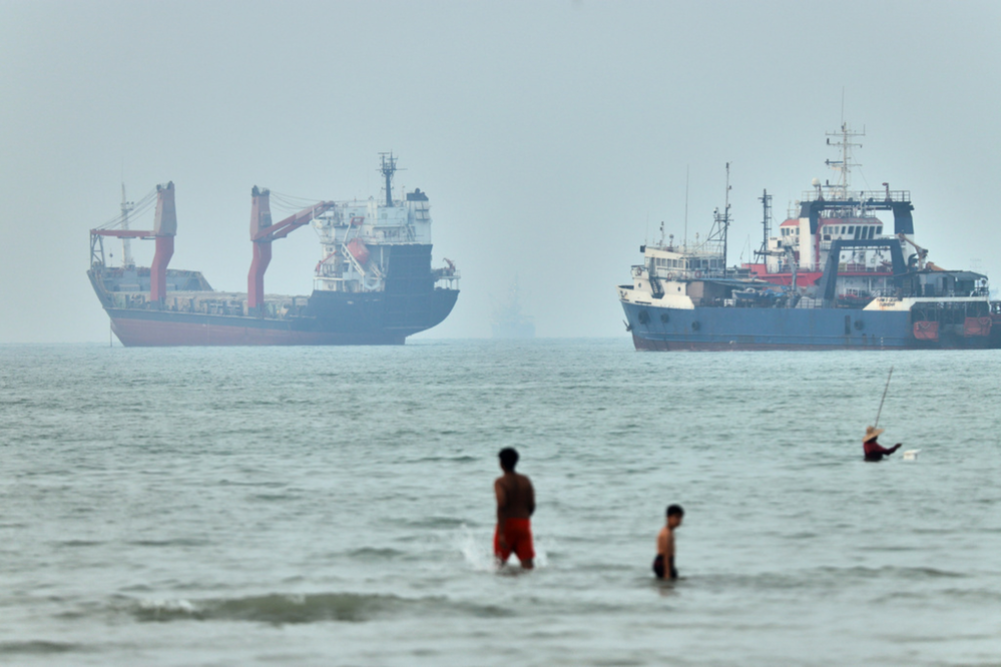
It was only a few hours after U.S. President Donald Trump indicated that Iran's attack on a commercial ship in the Strait of Hormuz had ended the effect of the ceasefire that the U.S. military launched an attack.
We use Google Cloud Translation Services. Google requires we provide the following disclaimer relating to use of this service:
This service may contain translations powered by Google. Google disclaims all warranties related to the translations, expressed or implied, including any warranties of accuracy, reliability, and any implied warranties of merchantability, fitness for a particular purpose, and noninfringement.
The United States carried out new airstrikes on various Iranian military targets on Thursday morning. In response, Iran targeted Bahrain, Kuwait, and Qatar, further escalating tensions in the Persian Gulf region. The incident has also put the temporary ceasefire, established to end the war, at risk.
Just hours after U.S. President Donald Trump indicated that Iran’s attack on commercial ships in the Strait of Hormuz had rendered the ceasefire ineffective, the U.S. military launched its assault. Previously, after Iran targeted commercial vessels near the coast of Oman, the U.S. attacked Iranian military bases and ports on Wednesday.
Thursday’s attack is reported to have been even more extensive. In Bahrain, where the headquarters of the U.S. Navy’s Fifth Fleet is located, air raid sirens sounded at least twice. Details of the damage in Bahrain, Kuwait, and Qatar have not been immediately released. The Kuwaiti military has stated that it is intercepting drones and missiles, while Iran’s Revolutionary Guard has claimed responsibility for attacks in Bahrain and Kuwait.
The U.S. Central Command (CENTCOM) has stated that around 90 military targets across Iran were attacked. According to CENTCOM, the operation was conducted with the aim of weakening Iran’s ability to threaten the free movement of ships in the Strait of Hormuz.
According to Iranian state media, explosions have occurred in areas including Bushehr, Chabahar, Konarak, Bandar Abbas, and Sirik. Local officials have reported that one firefighter was killed in the attack on Iranshahr Airport.
For the first time since April, Iranian infrastructure has also been targeted in a U.S. attack. State media have reported an attack on a railway bridge in Golestan Province. The Revolutionary Guard has stated that two bridges on the route to Mashhad were also attacked, where preparations are underway for the funeral of the late Ayatollah Ali Khamenei. It is not yet clear whether these two incidents are related.
After returning from the NATO summit, President Trump released videos of the explosions in Iran on social media, stating that the latest attack was retaliation for Iran’s assault on commercial ships. He also warned that if there were further attacks on ships, even harsher military action would follow.
Trump has previously reiterated warnings that Iran’s electrical infrastructure, desalination plants, and the oil production center on Kharg Island could also be targeted.
Meanwhile, Iran has claimed that the temporary ceasefire agreement grants it the right to manage traffic in the Strait of Hormuz. Speaker of Parliament Mohammad Bagher Ghalibaf has warned that there would be a response if the U.S. launched attacks.
After Trump declared the ceasefire agreement ineffective, fears have grown that the war could fully reignite. However, he has stated that talks will continue. Following his statement, international crude oil prices have risen.
Although preparations were underway to begin talks for a permanent peace agreement after Khamenei’s funeral, the latest military actions have cast uncertainty over the future of negotiations. The proposed talks were expected to focus on fully reopening the Strait of Hormuz and discussing Iran’s nuclear program.