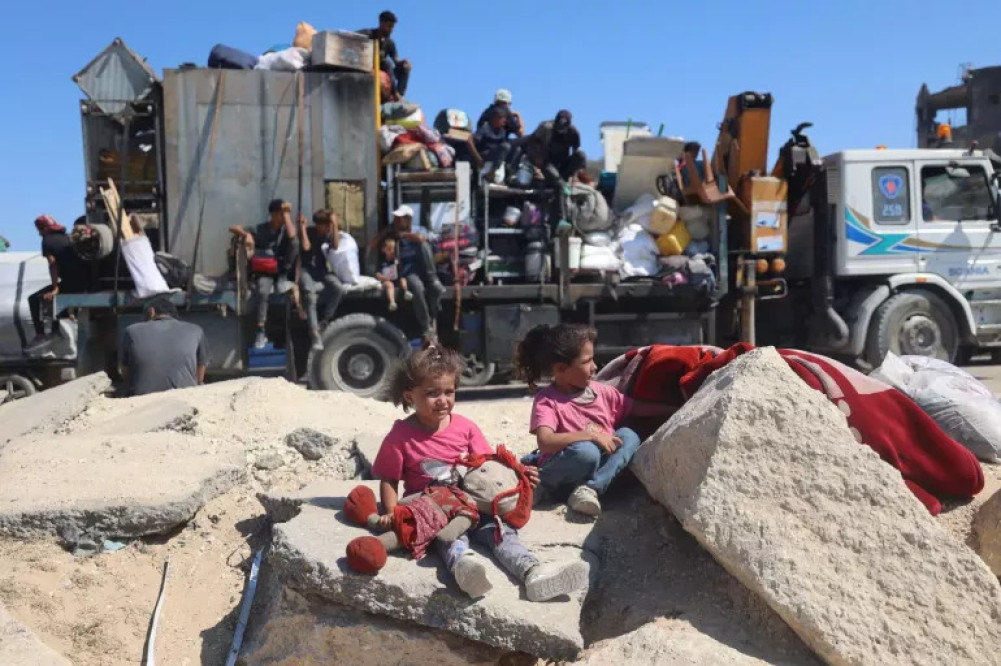
The fate of more than two million Palestinians in Gaza remains uncertain, with large numbers forced to live among the rubble.
We use Google Cloud Translation Services. Google requires we provide the following disclaimer relating to use of this service:
This service may contain translations powered by Google. Google disclaims all warranties related to the translations, expressed or implied, including any warranties of accuracy, reliability, and any implied warranties of merchantability, fitness for a particular purpose, and noninfringement.
Hamas launched a deadly attack on Israel on October 7, 2023, killing nearly 1,200 civilians. The next day, Israeli Prime Minister Benjamin Netanyahu declared war on Hamas. This began a new series of wars in the Hamas-controlled Palestinian territory of Gaza. On Thursday, the war in Gaza
began 1,000 days . And the civilian population has paid the price. During this period, both sides have repeatedly called for a ceasefire, but it has had no effect. The fate of more than two million Palestinians in Gaza remains uncertain. A large number of people are forced to live among the rubble. The number of displaced people is also large. The last time talks between Hamas and Israel were held on October 10, 2025, was under the mediation of Egypt and the United States.
At that time, it was agreed that Hamas would lay down its arms and Israel would withdraw its troops from the territory it occupied. Similarly, it was agreed to release Palestinians held captive by Israel and Israelis held captive by Hamas. The two sides also agreed to increase humanitarian aid to the Gaza Strip.
Similarly, it was agreed to develop a plan for the reconstruction of Gaza. However, other conditions were not met except for the prisoner exchange and the formation of a board for the reconstruction of Gaza under the leadership of US President Donald Trump.
The Israeli army, which has already taken control of about half of the territory in Gaza, is continuously expanding it. Its goal is to occupy about 70 percent of the territory.
Only a few people can enter or leave Gaza. 'There is a lot of work to be done to return Gaza to normal.' But we are not there yet,” said Nicolas von Arkus, regional director of the International Committee of the Red Cross, this week.
Israeli attacks have decreased since the ceasefire went into effect. But they have not stopped. The attacks continue almost daily. According to the Gaza Health Ministry, 1,053 Palestinians have been killed since the ceasefire began as of Tuesday.
More than 350 women and children are on the list. Just a few days ago, a schoolgirl and a mother were killed in an attack with her 1-year-old daughter.
“Where is the ceasefire they keep saying? They should be ashamed,” said Wisal Abu Khater, a Palestinian woman. She said Arab countries were busy watching the World Cup instead of helping the people of Gaza.
The ministry said more than 3,400 people have been injured since the ceasefire. The ministry is controlled by Hamas and its records are generally considered reliable by UN agencies and independent experts.
The ministry does not release separate figures for civilians and fighters. But it said a large number of the dead were women and children.
The Israeli military has said it is targeting Hamas and other militants. On October 7, 2023, Hamas-led attacks in southern Israel killed 1,200 people, taking some 251 hostages. Both sides have since released prisoners.
The bodies of the dead have also been handed over. Some hostages have released accounts of their abuses. According to the Gaza Health Ministry, a total of 73,066 Palestinians have died in Israeli retaliation since 2023 as of Tuesday.
Nickolay Mladenov, the top diplomat overseeing the ceasefire, said that the implementation of the ceasefire agreements has stalled due to complex issues such as the disarmament of Hamas.
US President Donald Trump formed the ‘Board of Peace’ in Gaza under his leadership on January 17, 2026. The board aims to build a modern city in Gaza with billions of dollars in investment. But its implementation has become uncertain due to ongoing tensions between Israel and Hamas. The board has not made any programs public recently.
The ceasefire agreement included the formation of a new administration in Gaza after the disarmament of Hamas and the deployment of international security forces to assist in security and reconstruction.
Hamas has not completely rejected disarmament. However, it has indicated that it wants to keep some weapons with it.
Israel itself is in trouble due to the ongoing wars in Gaza and then in West Asia. In recent days, Lebanon's Iran-backed armed group Hezbollah, Yemen's Iran-backed Houthi rebels and Iran itself have also targeted Israel.
Iran's armed proxy groups have been expressing solidarity with the Palestinians. Netanyahu launched a joint attack on Iran with the United States on February 28. Lebanon's Hezbollah then attacked Israel. This has reignited the conflict in Lebanon. Now the Israeli army has captured large areas of Lebanon. However, neither front is completely calm.
The increasing death toll of Israeli soldiers, the ongoing attacks on the Israeli border with Lebanon, and the international outcry over the attack on Gaza have tarnished Netanyahu's image. Israel is holding parliamentary elections at the end of October this year.
According to surveys, 60 percent of the public does not want to see Netanyahu as prime minister again. The October 7 attack was due to the weaknesses of the Netanyahu government, the government has not even formed a commission to investigate security weaknesses, and the people are angry at the services and facilities and exemptions being enjoyed by Netanyahu's extreme right-wing power partners.
Palestinians in Gaza say their patience has reached its limit. Some of them are living under tents without even basic facilities. Others are taking shelter in the rubble of buildings destroyed by bombs. In addition, they are experiencing the sound of Israeli drones and the terror of attacks every day.
Humanitarian aid supplies such as medicine and fuel were expected to increase dramatically after the war. But aid groups and other stakeholders say that is not the case. All of Gaza's border crossings are still tightly controlled by Israel. In some cases, they are completely closed. The United Nations said last month that 17 hospitals were still not operational.
Israel's cumbersome approval and customs procedures have made it difficult to get essential supplies into Gaza, said Tom Fletcher, the UN's humanitarian chief.
Gaza was declared a famine in August last year, but food security experts say the situation has improved since the ceasefire.
Similarly, UN Secretary-General Antonio Guterres on Tuesday appealed to the international community to provide $100 million to cover the funding gap of the UN agency for Palestinian refugees (UNRWA).
He said the budget shortfall was putting the lives of millions of people at risk. UNRWA was established in 1949 by the UN General Assembly with the aim of providing humanitarian assistance to Palestinians who were forced to flee their homes when Israel was established in 1948. The organization has been providing education, health and social assistance in Gaza, the West Bank, East Jerusalem, Lebanon, Jordan and Syria. It has provided shelter to about 2.6 million Palestinian refugees. The last time the UN General Assembly decided to renew the agency was just six months ago, with the support of a majority of member states. But due to budget constraints, this body is forced to cut back on its services.