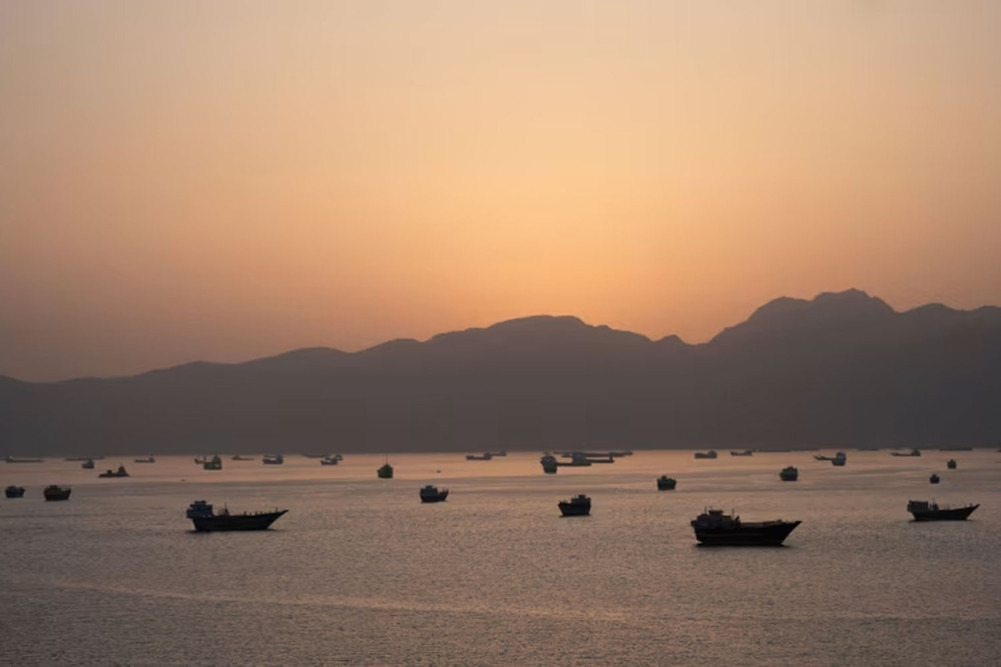
Iranian Foreign Minister Abbas Araghchi said, ”The Strait of Hormuz will remain under full Iranian surveillance and management for the next 30 days. Once all obstacles are removed, the waterway will be operated at full capacity.”
We use Google Cloud Translation Services. Google requires we provide the following disclaimer relating to use of this service:
This service may contain translations powered by Google. Google disclaims all warranties related to the translations, expressed or implied, including any warranties of accuracy, reliability, and any implied warranties of merchantability, fitness for a particular purpose, and noninfringement.
Iranian Foreign Minister Abbas Araghchi has said that Iran will maintain full control over the Strait of Hormuz for the next 30 days. He said this during a visit to Iraq.
‘I have informed my counterpart about the latest results of the war imposed on Iran. I have also informed him about the latest understanding between Iran and the United States,’ Araghchi said after meeting with Iraqi Foreign Minister Fuad Hussein, ‘The Strait of Hormuz will remain under Iran’s full supervision and management for the next 30 days. After removing all obstacles, this waterway will be operated at full capacity.’
Earlier, in the 14-point agreement between Iran and the United States, it was mentioned that the US would lift the blockade imposed on the Iranian ports of Hormuz within 30 days and that Iran would ensure movement in a warlike manner.
Iran-US has been engaged in continuous attacks and counterattacks since Friday. Due to this, the issue of implementing the agreement has become complicated. After the agreement, ships were allowed to leave through the southern corridor under Omani waters in coordination with the International Maritime Organization (IMO) under the United Nations, but Iran has recently blocked it.
On Thursday, Iran had instructed ships leaving through the Strait of Hormuz to use only the northern corridor of Iranian waters. Iran has been collecting fees from ships moving through this corridor.
Some ships moving through Omani waters returned to the southern corridor that day after Iran's warning. On Friday, Iran attacked the Singapore-flagged ship Ever Lovely, which was moving through the southern corridor. The IMO then suspended coordination to bring the ships out. On Saturday, Iran also attacked the Panamanian-flagged MT Kiku.
After the warning attack The number of ships leaving Hormuz has gradually decreased. On Wednesday, 70 ships had passed through Hormuz. Only 54 ships left after Iran's warning on Thursday. International media reported that the number had dropped to 40 on Saturday.
In response to the attack on the Singaporean ship, the US military attacked Iranian maritime areas and missile centers on Friday and Saturday. In response, Iran also retaliated by attacking US military targets in Kuwait and Bahrain.
US President Donald Trump has warned that Iran's increasing attacks will not do him any good. 'If America is forced to start a war again, Iran will no longer exist,' Trump wrote on his social media.