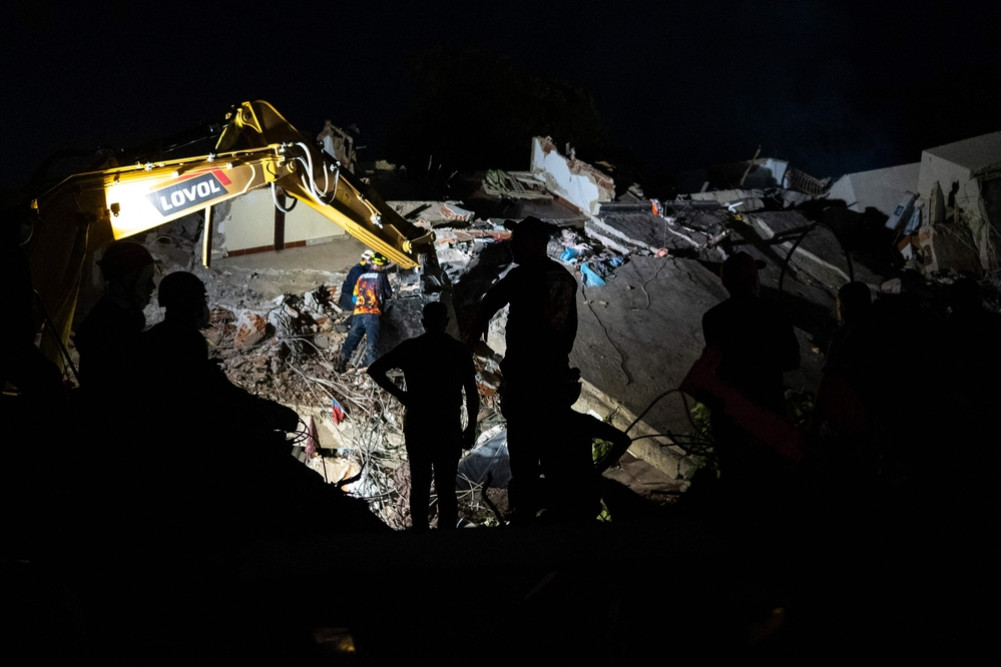
In some places, locals are struggling alone to search for their relatives and loved ones as government rescue workers have been unable to reach them.
We use Google Cloud Translation Services. Google requires we provide the following disclaimer relating to use of this service:
This service may contain translations powered by Google. Google disclaims all warranties related to the translations, expressed or implied, including any warranties of accuracy, reliability, and any implied warranties of merchantability, fitness for a particular purpose, and noninfringement.
Two devastating earthquakes measuring 7.2 and 7.5 on Wednesday evening in Venezuela have killed 920 people. More than 3,300 are injured. More than 51,000 people are missing.
Rescue and relief agencies say the best chance of survival is in the first 48 to 72 hours after the quake.
Water and food are crucial to maintaining that hope for the long term. Rescue workers are searching for survivors in the rubble of collapsed homes and buildings.
In the worst-hit state of La Guaira, authorities have decided to allow only those with permits to enter the area from Friday night after traffic jams hampered search efforts. But details about who will be allowed in have not been made public.
In some places, locals are searching alone for their relatives and loved ones as government rescuers have not arrived. They have complained about a shortage of rescue workers in the hardest-hit areas.
“The rescue of each person now is a miracle,” said Jorge Rodriguez, the president of Venezuela’s National Assembly. “We will not hide anything about this tragedy.” Even after a long time since the earthquake, families still hold out hope that their loved ones will be found.
In a building in La Guira, residents were using hammers and power tools to cut away large chunks of concrete.
Watching the scene from a distance, Nazareth Jimenez was crying, her head on her loved one’s shoulder. She was in a state of intense anxiety and fear as she waited for her siblings, nieces, nephews and friends to emerge alive.
“Oh my God, how are we going to get them out of there?” Jimenez sighed. She said large machinery was needed to remove the collapsed structures.
“We are appealing to the government and countries around the world for help. There are still people alive inside.”
Government security personnel are distributing food and water to people in La Guira. Acting President Delcy Rodriguez said rescue workers and government officials were working to rescue people alive.
She welcomed the arrival of international rescuers and humanitarian aid. Local residents, however, complained that the aid they needed was not being delivered as quickly as needed.
The death toll is expected to rise. People have reported thousands of people missing in independent digital databases.
The figure may also include people who are uncontacted due to lack of mobile phone signal. Some details may be duplicated.
The International Organization for Migration (IOM) said up to 6.76 million people may have been affected by the earthquake. About 2 million people in the capital, Caracas, were affected.
Omar Reyes said about 20 members of his family had died. “I am alone in this life now,” Reyes said as he walked through the rubble where his two sons were buried.
“People are still too scared to go inside their homes,” said Lois Pace, regional director for the Americas at the International Committee of the Red Cross. Many are still spending the night on the streets.
The chaos, crowds and loud traffic on the streets of the town of Maiquetia were at times hampering the search.
Mexican soldiers and volunteers repeatedly urged locals to remain calm, saying people might be screaming under the rubble. Despite the pleas, the motorcyclists did not turn off their engines. Some even honked their horns.
Some people were scrambling to get basic supplies like toilet paper and food from shops in the town of Maiquetia la Mar, about 10 minutes from the country's main airport, Simón Bolívar International Airport.
Some people surrounded a pickup truck that was distributing bread and water. A soldier then stopped them and secured the vehicle. A makeshift camp was set up in a tent in the parking lot of a drugstore.
A few kilometers away, 28-year-old Yuleidi Cadenas stood on the street across from a collapsed government housing complex. She was hoping her son, mother and brother would be pulled out alive. She ran barefoot after seeing a building collapse on Wednesday.
She discovered that the 12-story apartment tower where her mother lived had also been completely destroyed. “I climbed over the rubble. I asked for people to call out,” Cadenas said. “But no one answered: not my brother, not my son, not my mother,” Cadenas said.
Venezuelan officials said on Friday that 861 volunteers from Mexico, the United States, El Salvador, Switzerland, Colombia and other countries had arrived in the country and that more were on the way.
Venezuela's acting President Delcy Rodriguez said she spoke with US President Donald Trump and Secretary of State Marco Rubio on Friday and they reiterated their commitment to sending rescue teams and aid equipment.