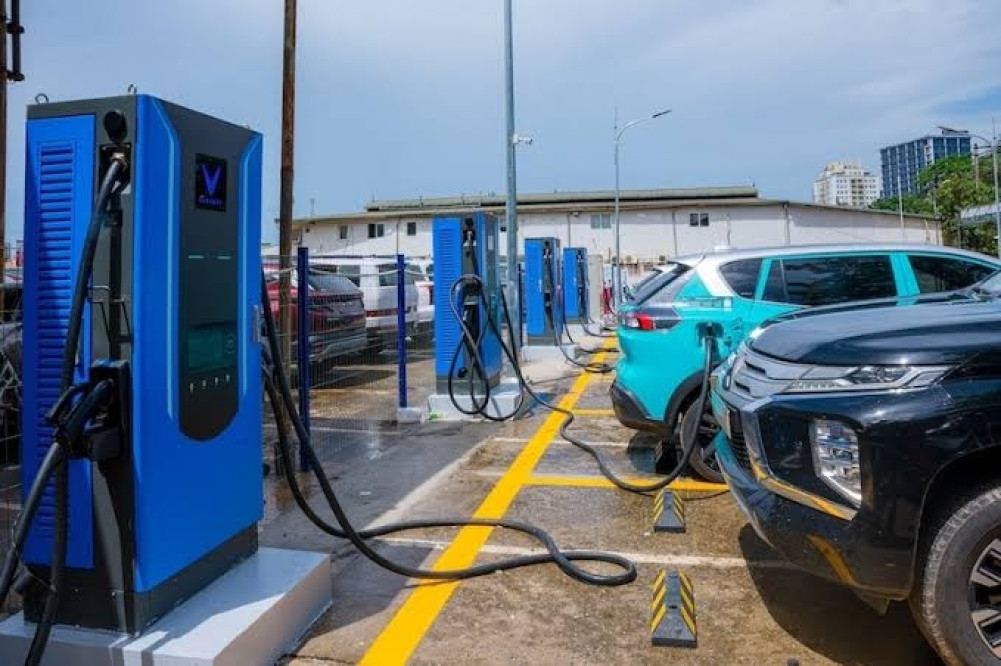
Drivers in developing countries are now looking for alternatives to traditional petrol pumps. Imports of Chinese EVs have surged in Southeast Asian countries such as Thailand, Laos and the Philippines.
We use Google Cloud Translation Services. Google requires we provide the following disclaimer relating to use of this service:
This service may contain translations powered by Google. Google disclaims all warranties related to the translations, expressed or implied, including any warranties of accuracy, reliability, and any implied warranties of merchantability, fitness for a particular purpose, and noninfringement.
The global electric vehicle (EV) market has expanded since the Iran war. However, while EVs have gained traction, charging infrastructure has been relatively slow to develop. The Iran war blocked the Strait of Hormuz, which cut off about 20 percent of the world's crude oil and liquefied natural gas (LNG). The impact was felt first in Asia and then in Africa. As a result, people's interest in EVs has increased. According to Chinese officials, China's global EV exports in April were worth $9.4 billion. This is a new record. Demand for Chinese vehicles has increased sharply, especially in Australia, Brazil, Southeast Asia and East Africa. According to the Chinese Association of Automobile Manufacturers, China exported about 435,000 passenger EVs and plug-in hybrid vehicles in May alone. Which is more than double the same period last year . However, the expansion of charging networks has been slow in line with EV imports . In Africa, government agencies and state-run institutions are playing a leading role in building charging infrastructure .
Analysts say this model could also be effective for Asian countries in the transition from fuel to green energy .
‘Paul Gong, head of China automotive industry research at UBS Bank, said that adequate charging infrastructure needs to be prioritized by governments in relevant countries . ‘Only government support for infrastructure development can accelerate the use of EVs,’ he said .
Now, drivers in developing countries are looking for alternatives to traditional petrol pumps . Imports of Chinese EVs have increased rapidly in Southeast Asian countries such as Thailand, Laos and the Philippines .
Laos has banned the import of fuel-powered vehicles for the rest of 2026 to reduce fuel import costs and promote EVs. According to data from the Chinese Ministry of Commerce, about 44,000 Chinese EVs were exported to the African continent in 2025. This figure is a 130 percent increase year-on-year.
Due to limited public transport, long journeys and heavy reliance on private vehicles, fluctuations in fuel prices have a direct impact on the general public. According to a study conducted by Stellenbosch University in South Africa in 2024, about 20 percent of total household spending in the country is spent on transportation.
Mark Wakefield of consultancy firm AlixPartners said that global interest in EVs has increased with rising fuel prices. According to the International Energy Agency (IEA), 25 percent of all new cars sold worldwide last year were electric.
The latest report by the IEA estimates that global electric car sales will reach 23 million by 2026. Chinese auto giants Geely and BYD are exporting a large number of electric cars to foreign markets.
According to the International Energy Agency (IEA), about 60 percent of the total electric cars sold worldwide are supplied by Chinese automakers. Chinese companies have established a dominant presence in the European, African and Latin American markets.
Vietnamese automaker Vinfast has also seen a significant improvement in sales. The company's revenue in the January-March quarter of this year increased by 42 percent compared to the same period last year due to increased demand in Southeast Asia.
Nguyen Thien Bao from Hanoi, the capital of Vietnam, takes to the busy streets of the city every morning on his Vinfast electric motorcycle and transports passengers and goods. The EV bike has reduced his expenses significantly as fuel prices have risen.
‘Previously, a large part of my income was spent on fuel,’ Bao said, ‘now I can save some money.’
Chitsanupong Nuamnorm from Thailand, who bought a Chinese brand ‘MG4 EV’ just a day before the Iran-Iraq war (on February 27), has saved money on fuel, but due to the hassle of charging, he uses his old petrol car (Mazda 2) to pick up passengers one day a week.
According to the Electric Vehicle Association of Thailand, there are only 4,600 public charging stations for more than 424,000 battery EVs and plug-in hybrid vehicles. That’s one charging station for every 92 vehicles.
Yuthana Samranwong, a 54-year-old driver from Phitsanulok province in northern Thailand, said he had to wait in long lines to get a turn at a public charging port. He said it was difficult. “It’s a bit of a headache,” says Samranwong.
The charging network in Bangkok has led some drivers to consider switching back to fuel-powered vehicles.’
Some countries are improving this. The Malaysian government has provided various incentives, including tax breaks, to charging point operators who make certain investments.
A large number of infrastructure projects were built there in 2025. The number of ‘public fast chargers’ increased by more than 70 percent compared to 2024.
The state-owned electricity company (PLN) has 4,500 public charging points ready in Indonesia, according to the IEA.
Ethiopia, which has imposed a complete ban on the import of fuel-powered vehicles, had only a dozen charging stations by mid-2025. The government estimates that more than 1,170 stations will be needed to meet rising demand.
The state-run electricity authority in the capital, Addis Ababa, is currently building 40 stations.
“Low prices in developing markets can boost EV adoption,” says Chris Liu of technology research and consultancy group Omdia.
But its sustainability depends entirely on infrastructure, regular electricity supply and its usability. Therefore, the government must focus on building these infrastructures.
State-owned electricity providers in developing countries are taking the lead in addressing the shortage of charging stations. There are currently about 2,000 public EV charging stations across the African continent, with South Africa accounting for the largest share.
Kenya's state-owned energy company, Kenya Power, has announced plans to build 44 charging stations within the next year.