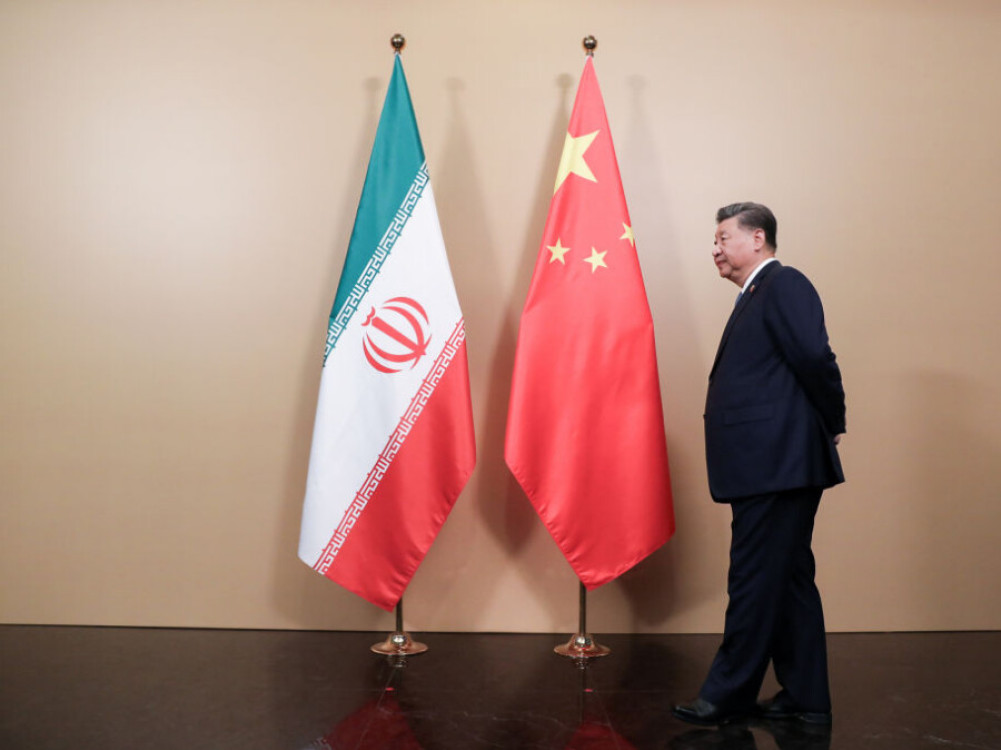
China maintained a careful diplomatic balance during this conflict.
We use Google Cloud Translation Services. Google requires we provide the following disclaimer relating to use of this service:
This service may contain translations powered by Google. Google disclaims all warranties related to the translations, expressed or implied, including any warranties of accuracy, reliability, and any implied warranties of merchantability, fitness for a particular purpose, and noninfringement.
Agency: When the US and Israel attacked Iran at the end of February, China was worried that the Iranian regime, with which it has good relations, would collapse. Because, in January, the US attacked Venezuela and kidnapped its President Nicolas Maduro . Maduro was considered close to China.
But the US's goal of changing the Iranian regime in Venezuela was not achieved. On the 110th day after the war began, the US and Iran signed an interim agreement last Wednesday. With this, the US has decided to end the attack on Iran, remove the blockade on Iranian ports, immediately lift the sanctions on Iran, and permanently end it after phased negotiations.
Some have considered this war as a defeat for the US because the war was ended by making an agreement with the same regime with which the US and Israel had fought the war, and the war was ended by making an agreement with the same regime with which the US and Israel had fought the war. At the same time, Beijing seems to have increased its diplomatic influence. When the US was caught up in the war, Beijing welcomed a large number of foreign leaders to the country. He called for world peace in those meetings. Trump himself went to Beijing and praised China's efforts to end the war.
China, the world's second-largest economy, also made good use of the energy crisis created by the Iran conflict. Along with using its strategic oil reserves, it also promoted green technology and electric vehicles during this period.
China's Foreign Ministry welcomed the announcement of the US-Iran deal. A Chinese Foreign Ministry spokesman said China is always ready to play an active role in restoring peace and stability in West Asia.
China's continuous efforts to end the war, including the four-point peace proposal proposed by Chinese President Xi Jinping last April, have been successful, said spokesman Lin Jian.
It's not just the Chinese side. The US side has also appreciated China's role . "I want to thank China and President Xi. He has remained neutral, completely neutral, and I appreciate that," Trump said at a G-7 press conference in France on Wednesday. Trump recalled that China did not use its navy to defy US sanctions on Iranian ports and sought a negotiated solution as much as possible.
China has maintained a cautious diplomatic balance during the conflict. It has condemned US and Israeli attacks on Iran and continued to buy Iranian oil in defiance of US sanctions. But it has exercised great restraint in criticising the US. It has also kept open communication channels with stakeholders on both sides.
As the conflict has escalated, several foreign leaders have visited Beijing. These include Trump himself last month, Iranian Foreign Minister Abbas Araghchi a few days earlier, and leaders of Pakistan, the main mediator in the conflict.
In the early stages of the talks, Iran had sought to include China in the peace deal. It wanted to sign the deal with China as a witness. But China has shown little interest in playing such a formal and potentially cumbersome role.
On Wednesday, China's top diplomat Wang Yi spoke to Aragchi by phone and called for proper management of navigation in the Strait of Hormuz.
"The dawn of peace has dawned. The key now is for all parties to truly implement their commitments and eliminate interference from all sides," Wang said.
It has long opposed the US-dominated world order. Experts in China have begun to predict that the US will also lose its influence in the world order after the peace deal with Iran.
Some experts have linked the current conflict to the 'Suez Canal' incident.
When Britain lost control of the Suez Canal in the 1950s, it was interpreted as its international decline. In a short time, Britain's reputation as a great power, which it had long enjoyed, shifted to the US.
Sun Degang, director of the Center for Middle Eastern Studies at Fudan University in Shanghai, asked in an opinion piece published in China’s state-run Global Times on Tuesday, “Is the same scene that loomed over the British Empire during the Suez Crisis now being repeated for the United States in the Strait of Hormuz?”
“Since the end of the Cold War, the United States has been the world’s sole superpower,” Sun wrote. “However, this time, US military power has not proven to be as formidable as Washington imagined. It has also seen a lack of allies to support its war. This shows that there are growing signs of division in the global alliance system led by the US.”
It is a question that is also being debated in Western countries. However, analysts in China have argued that Beijing has benefited from the war that Washington has started.
Political analyst Hu Xijin wrote on the social media platform Weibo earlier this week, “Although this is not China’s involvement, The war has also affected the world's view of China. It has exposed China's strategic plan to deal with the energy crisis and China's attraction to the path of peaceful development it has been taking.'
According to Hu, the war has also reduced America's resilience in the Taiwan issue. Hu claims that the inability to fight Iran alone has exposed America's weakness. He says that it will be difficult for the United States to convince European countries that are observing this situation to directly confront China in the future.
China has long presented itself as the carrier of a multipolar world. Throughout the war, China has focused on carefully managing its interests rather than explicitly taking sides.
Despite its strategic verbal support for its long-time ally Iran, China has exercised great restraint in criticizing the United States. Similarly, it has also held repeated phone conversations with Gulf countries that have been targeted by Iran's attacks.
The United States had previously accused China of providing weapons to Iran. However, pressure to negotiate with the United States has not been Analysts believe that China has also done the work of giving.
Chinese officials and analysts have been saying that Beijing does not aspire to become a superpower in the style of America. Therefore, in their interpretation, the “Suez moment” does not mean surpassing the United States and reaching the top of the world order. But it does mean moving the monopolistic world order to a multipolar state.
“The United States is still the most powerful external player in the Middle East. What has changed is that it now has to pay a much greater political, military, economic and reputational price than before to maintain its dominance,” Sun Chenghao, a fellow at the Center for International Security and Strategy at Tsinghua University in Beijing, told CNN.
He said that the conflict has further enhanced the relevance of China’s worldview, which emphasizes sovereignty, non-interference, political solutions and development-oriented security. “But criticizing American actions alone does not build credibility . It depends on whether China can provide practical diplomatic solutions, safeguard energy stability, and help create an environment to reduce tensions,’ Sun said.