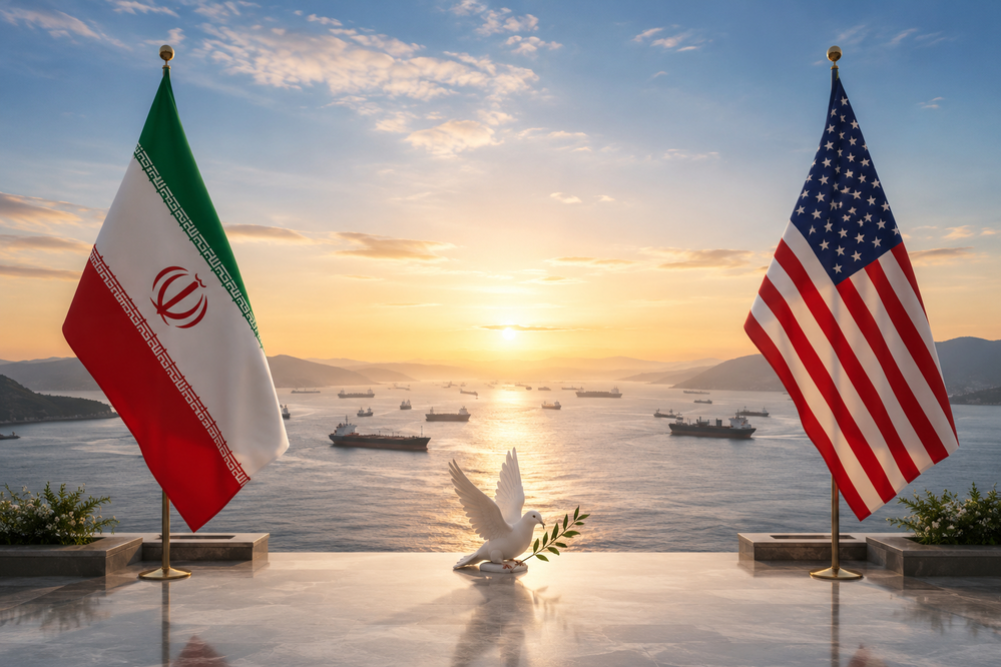
Trump signed the agreement at a dinner held at the Palace of Versailles in France during the G7 summit.
We use Google Cloud Translation Services. Google requires we provide the following disclaimer relating to use of this service:
This service may contain translations powered by Google. Google disclaims all warranties related to the translations, expressed or implied, including any warranties of accuracy, reliability, and any implied warranties of merchantability, fitness for a particular purpose, and noninfringement.
US President Donald Trump and Iranian President Masoud Peshmerga signed the peace deal separately on Wednesday. Both sides had previously said they would sign it in Geneva, Switzerland. Trump, however, digitally signed the deal during a dinner at the Palace of Versailles in France during the G7 summit. Peshmerga then signed it in Tehran. The deal, called the Islamabad Agreement between the United States and the Islamic Republic of Iran, calls for Tehran to reduce its stockpile of highly enriched uranium in exchange for the lifting of US sanctions on Iran. The deal allows Iran to sell its oil freely immediately, according to details released by both countries. If all the terms of the current deal are met, comprehensive talks within the next 60 days could lead to a final deal that would lift all sanctions on Iran. The deal appears to have benefited Iran. The formal ceremony scheduled for Friday in Geneva has been postponed. Versailles is the palace where many historic agreements have been signed over the centuries to end wars or territorial disputes. In a video posted online by a White House aide, Trump can be seen sitting next to French President Emmanuel Macron and signing a copy of the agreement. Trump then handed the document and pen to US Secretary of State Marco Rubio. The room erupted in applause. As he left the dinner, Trump confirmed that the deal had been signed. Iran's state news agency IRNA reported that President Masoud Pejeskian signed the agreement on behalf of Iran. IRNA also released a copy of the agreement signed by Pejeskian and Trump.
The US side has not yet released the official text of the agreement. But US officials have shared the details of the agreement with the media on condition of anonymity.
The text released by Iranian state media largely matches the details given by the Americans. This 14-point agreement has opened the door to an end to the war and future talks.
It includes an end to hostilities between the two countries, Iran's commitment not to develop nuclear weapons, and the reopening of the Strait of Hormuz.
The Prime Minister of the mediating country, Pakistan, Shahbaz Sharif, has claimed that the Strait of Hormuz has been opened with the agreement.
According to the agreement, Iran will not take any payment for using the waterway for two months. But the possibility of charging fees in the future cannot be ruled out. The US will temporarily suspend some sanctions imposed on Iran.
The agreement states that the war will end on all fronts, including Lebanon. Meanwhile, Israel claims that it will not withdraw its troops from the Lebanese territory it occupies.
The war in Iran began after the US and Israel attacked on February 28. Trump said that the US's goals were to prevent Iran from developing nuclear weapons, change its regime, and stop Iran's support for Hezbollah and other allied armed rebels.
The agreement has failed to achieve all of these. Trump has praised it as "very strong."
What is in the agreement?
The agreement has 14 points. It mentions the immediate and free sale of Iran's oil and the eventual lifting of all sanctions. This is a big relief for Iran, which is already economically weak.
Iran has received more concessions through this deal than the agreement it reached with world powers in 2015 to end its nuclear weapons program.
Trump called the agreement reached under President Barack Obama the worst deal ever. He announced his withdrawal from the deal during his first term and imposed sanctions on Iran.
Iran has been claiming that its nuclear program is peaceful. However, according to the International Atomic Energy Agency (IAEA), Iran has the highest level of enriched uranium among countries that do not have nuclear weapons. Iran's enriched uranium is 60 percent pure.
However, under the Obama-era agreement, Iran was willing to limit the purity of its uranium to 3.67 percent. Under the current agreement, Iran will reduce the quality of its enriched uranium and the IAEA will monitor it. However, details have not been released and the next round of talks within 60 days will decide this.
The US has also agreed to release $24 billion worth of Iranian assets frozen abroad. Similarly, it has also agreed to provide $300 billion for Iran's reconstruction.
US Vice President JD Vance has claimed that the Gulf countries will provide the money to Iran. However, for that, Iran must ensure that it complies with the terms of the talks.
14 points of the agreement:
American media outlet CNN has reported that it has received a draft of the agreement. Earlier,
Iranian media outlets had made the agreement public. This agreement is as follows:
Summary of the 14 points of the agreement
1. End of military operations: An immediate and permanent end to military operations on all fronts, including Lebanon.
2. Sovereignty: Commitment to respect each other's sovereignty and territorial integrity and non-interference in internal affairs. 3. Deadline for final agreement: Negotiations to reach a comprehensive agreement within a maximum of 60 days. The deadline can be extended by mutual consent. 4. Movement of ships: Immediately after the agreement, the US will begin to lift the blockade on Iranian ports. The blockade will be fully lifted within 30 days. During this period, Iran will ensure the movement of ships in a state of war. The US will withdraw its forces from the vicinity of Iran 30 days after the final agreement.
5. Strait of Hormuz: Ensuring the safe movement of commercial ships from the Persian Gulf to the Sea of Oman for 60 days without fees. Technical and military obstacles to be removed within 30 days. Iran will negotiate with Oman and other littoral states to determine the future administrative operation of the Strait of Hormuz in accordance with international law.
6. Reconstruction plan: Develop a specific plan of at least $300 billion for Iran's reconstruction and economic development.
7. Complete end of sanctions: The United States will gradually lift all sanctions against Iran, including in accordance with UN resolutions.
8. Nuclear weapons prohibition: Iran will renew its commitment not to acquire or develop nuclear weapons. Management of uranium stockpiles will be monitored by the International Energy Agency.
9. Status quo: Iran will maintain its nuclear program as it is until a final agreement is reached. The United States will not impose any new sanctions. No additional troops will be deployed to the West Asia region.
10. Export and Banking Exemptions: Lift U.S. sanctions on Iranian crude oil, petroleum products, and related banking/insurance services.
11. Release of frozen assets: Release of all frozen Iranian funds and assets upon implementation of this Memorandum of Understanding. The procedures for its use will be determined in future negotiations.
12. Monitoring Mechanism: Establish an executive mechanism to ensure implementation of the Memorandum of Understanding and compliance with future agreements.
13. Continuation of Negotiations: Implementation of points 1, 4, 5, 10, and 11 will begin upon signing this Memorandum of Understanding. The United States and Iran will begin negotiations on a final agreement, focusing solely on the remaining points, with the condition that they be continuously implemented.
14. International Recognition: Have the final agreement ratified by the United Nations Security Council.