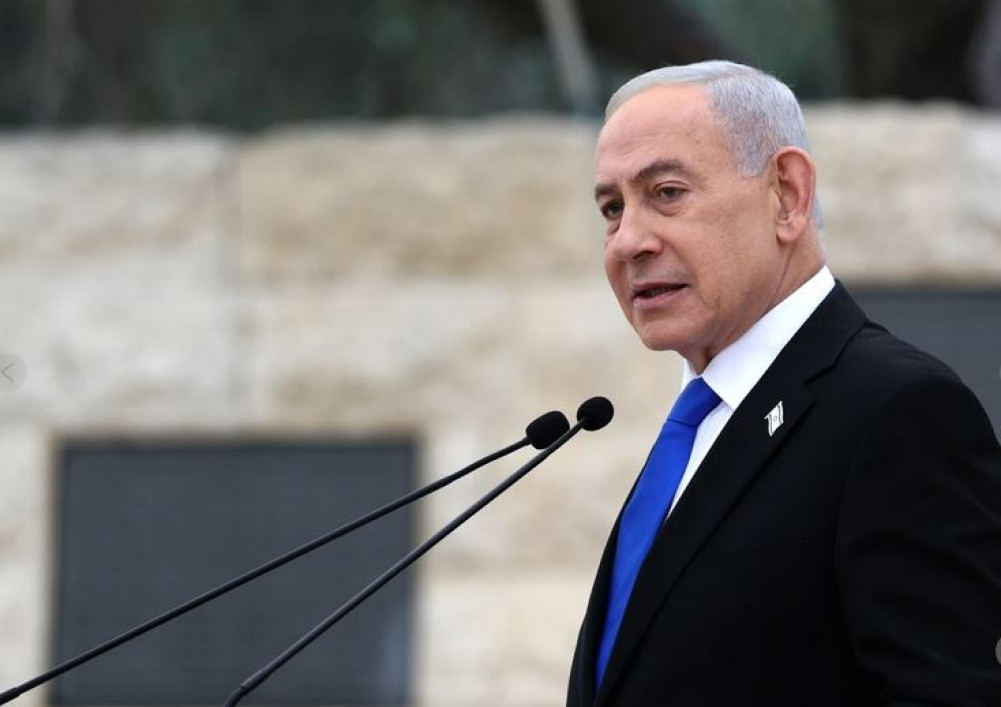
Trump has been increasingly critical of Netanyahu since the Iran deal. He has also urged Netanyahu to be responsible, warning that Israel would cease to exist without America's support.
We use Google Cloud Translation Services. Google requires we provide the following disclaimer relating to use of this service:
This service may contain translations powered by Google. Google disclaims all warranties related to the translations, expressed or implied, including any warranties of accuracy, reliability, and any implied warranties of merchantability, fitness for a particular purpose, and noninfringement.
When launching the war against Iran, Israeli Prime Minister Benjamin Netanyahu's clear goal was to overthrow the regime there. Netanyahu's plan was to destroy Iran's enriched uranium stockpile and end its nuclear weapons ambitions, destroy its ballistic missile production facilities, weaken Iran economically and end its support for rebel fighters such as Hezbollah, Hamas, and the Houthis, and sign a peace deal with the new regime after winning the war.
If these plans had succeeded, Israel would have become the most powerful country in West Asia, shifting the regional balance of power. Iran and Israel have had hostile relations since the 1979 Islamic Revolution. Before the revolution, Iran was one of the few Muslim-majority countries to recognize Israel as a state. The last Shah of Iran, Mohammad Reza Pahlavi, was considered a ally of the United States and Israel. However, diplomatic relations between the two countries ended and became bitter after the revolution.
This hostility reached its peak with the US-Israeli attack on Iran on February 28. The first target of the attack was Iran's Supreme Leader Ali Khamenei. Israel had been spying on him for a long time. Both US President Donald Trump and Netanyahu were very happy, considering it a great success. Trump immediately claimed that the Iranian regime would surrender within three weeks.
During the war, many senior officials in power in Iran were killed. However, the Islamic regime in Iran did not change. Nor did it surrender. Instead, senior military officers of the Islamic Revolutionary Guard Corps (IRGC) took control of the regime by making Khamenei's own son, Mojtaba Khamenei, the Supreme Leader. These officials are among those who have a tougher policy towards Israel and the US. The results began to be seen within a few days. Iran intensified its counterattack against the US and Israel. It also attacked US military bases in the Gulf. Blocking the Strait of Hormuz caused a global fuel crisis.
In fact, Iran was already going through an economic crisis before the war. Demonstrations were taking place across the country against unemployment and economic recession. A large number of protesters were killed due to the brutal repression of the regime. Netanyahu's initial assessment was that the attack would further intensify the movement and the fall of the Iranian regime by exploiting the growing public anger. However, that proved to be wrong. On the contrary, as soon as the war began, the anti-government movement collapsed and the Islamic regime's grip became stronger.
On April 7, the day after Trump threatened to end Iranian civilization, thousands of Iranians formed a human chain on the 1,700-year-old historic Dejful Bridge in Tehran, wearing national flags. This was a bitter blow to Trump, who was becoming defensive due to the price increases and protests in the United States due to the war. And, a meaningful message to the rest of the world.
Meanwhile, Trump signed a ceasefire with Iran on April 8 and began peace talks mediated by Pakistan. That too without consulting his beloved Netanyahu. Then the distance between Trump and Netanyahu grew. Both began to go their separate ways. Trump wanted to end the war quickly, while Netanyahu wanted to prolong it until his goal was achieved. Israel continued its attack on Lebanon. And, more people were killed in Lebanon than in Iran. Netanyahu also intensified the attack on the Palestinian territory of Gaza.
However, none of Iran's Islamic regime, Hezbollah, and Hamas surrendered. During this period, there were two ceasefires brokered by Trump between Israel and Lebanon. Despite Trump's insistence, Netanyahu never adhered to them. Trump has recently started publicly criticizing him for playing a role in disrupting the atmosphere for negotiations. Trump has also repeatedly threatened not to attack Iran and Lebanon.
After a long series of negotiations and ceasefire violations, Trump announced on Sunday, on the occasion of his 80th birthday, that an agreement had been reached to end the war with Iran. Iran only confirmed it on Monday. According to the agreement, the two sides will sign an agreement in Geneva, Switzerland on Friday. Israel has no role in the US-Iran talks and agreement. However, Netanyahu has not been able to openly oppose this agreement.
According to the agreement, the agreement will be in two phases. In the first phase, the two sides have agreed to end the war and open the Strait of Hormuz, and to sign a comprehensive peace agreement in the second phase within 60 days. Iran will commit to using its nuclear program only for peaceful purposes. With the agreement, the world community has welcomed the agreement, expecting that the obstruction seen in the Strait of Hormuz, through which about 20 percent of the world's crude oil and natural gas flows, will be removed and global price increases will be controlled.
The draft of the agreement has not been made public. However, judging by the initial details and the statements of both sides, the agreement does not include issues such as controlling Iran's ballistic missile stockpile, stopping Iran's financial support to regional rebel groups. Instead, the US appears to have agreed to release $24 billion in assets frozen abroad and lift international economic sanctions on Iran in return for Iran's commitment to end its nuclear weapons program.
Some analysts also fear that this will improve Iran's economy, increase support for the rebel and militant groups it supports, and create a different kind of tension in West Asia. This has also shocked Israel. Israel, which has fought alongside the US against Iran, will not be a signatory to the agreement. But the agreement includes an end to the war on all fronts, including Lebanon. Meanwhile, Israeli Prime Minister Netanyahu has said that Israeli troops will not withdraw from Lebanon.
'We have created a deep security zone around Israel in Gaza, Lebanon and Syria,' Netanyahu said at a press conference on Monday. 'I want to make it clear that we will stay in those areas for our own security.' He has not commented on the agreement, fearing that opposing the Iran-US deal would be seen as anti-Trump and fearing criticism at home if he supports it. Both Netanyahu's ruling coalition and the liberal opposition appear to be unhappy with this.
'The Iran deal is bad for Israel and the rest of the free world,' right-wing Israeli Finance Minister Bezalel Smotrich wrote on social media on Monday. The ruling coalition has criticized Netanyahu for not being able to openly oppose the deal. The opposition claims that Netanyahu has failed diplomatically. Its impact may be seen in Israel's parliamentary elections due in late October.
Trump has been increasingly critical of Netanyahu since the Iran deal. Trump has warned that Israel would not exist without America's support and has even urged Netanyahu to take responsibility. 'If it weren't for America, Israel wouldn't exist. If it weren't for me, Israel wouldn't exist. Because no other president has done as much for Israel as I have. Now Netanyahu must be more responsible and respect Lebanon,’ Trump said at the G-7 summit in France starting Tuesday. ‘Israel has been fighting Hezbollah for a long time and many people have been killed in Lebanon. It is not necessary to raid an apartment every time to find someone. There are many people there and not all of them are Hezbollah.’
Israel has also opposed US efforts to improve relations with Iran in the past. Netanyahu strongly opposed the agreement that the US government led by Barack Obama brought in 2015 with the aim of limiting Iran’s nuclear program to peaceful purposes. Despite Obama’s disagreement, he went to the US Congress to oppose the agreement. This increased his popularity in the country and helped him stay in power. However, the US made the agreement anyway, even though it left Israel aside. At the same time, relations with the US Democratic Party cooled.
The Democratic Party has been opposing Netanyahu’s aggressive policies in Gaza and Lebanon. After Trump was elected US President, Netanyahu became closer to him. At the same time, relations with Trump's party, the Republicans, also became cordial. However, recently, the Republican Party's opinion of Netanyahu has also changed. Republican lawmakers have started to argue that Netanyahu is pushing America towards ruin by dragging Trump into an unnecessary war.
In the understanding of many Israelis, the current Iran-US peace agreement is worse than the 2015 agreement. This also indicates that Netanyahu's support base has become weaker. However, Netanyahu and his supporters have been trying to justify the war by claiming that Iran's infrastructure has been destroyed and its military capability has been greatly weakened. On Monday, he also claimed that he had succeeded in Iran by showing this. "We have pushed Iran's nuclear program for years. This means that millions of Israeli citizens have been saved from the threat of mass death," Netanyahu said at a press conference on Monday.
Although exact numbers are not available, it is estimated that a large number of Israeli civilians were killed in Iran's counterattack. In the last days of the war, Iran has sent a message that its military capabilities are not weak by launching sophisticated missiles and drones at Israel. The Iranian leadership is also confident that it will have the upper hand after the peace agreement. The war has also proven false the propaganda that Israel has the best defense system in the world. "The risk of facing the US military used to scare the Iranians the most. But now they have the confidence that they can fight anyone," said Shira Efron, an analyst at the American think tank Rand Corporation.
Yaakov Katz, co-founder and analyst of the Middle East-America Dialogue, said that Netanyahu did not understand Trump. "Netanyahu failed to understand that Trump can be with him just as he can be against him," Katz told the American media outlet The New York Times. "The US can withdraw from the war." However, Israel will have to face more challenges in this region than ever before.’
Meanwhile, Israel’s international image has also deteriorated. When Hamas launched a series of attacks on Israel on October 7, countries around the world, especially European countries, showed great goodwill. However, after Israel’s increasingly inhumane behavior in Gaza and Lebanon, those countries are condemning Netanyahu. Israeli opposition leader Yair Lapid has accused Netanyahu, who has extreme right-wing views, of ruining the country by pushing it into war.
‘No one has failed diplomatically on the Iranian front like Netanyahu. We now understand the fact that Netanyahu cannot do anything,’ he said. ‘Because of Netanyahu, the US president has openly told the Israeli Prime Minister for the first time that I am your boss and you must do what I say.’
The leaders of his right-wing party Likud had been promoting the idea that Netanyahu’s policies and political skills had protected Israel from regional threats. However, despite attacking Iran and killing many senior officials, including its supreme leader, destroying much of its infrastructure, and weakening it economically, Netanyahu was unable to force it to surrender or change its Islamic regime. The real test of his popularity in Israel will be the upcoming elections. However, the events seem to have put him in a major crisis. (With the help of the agency)