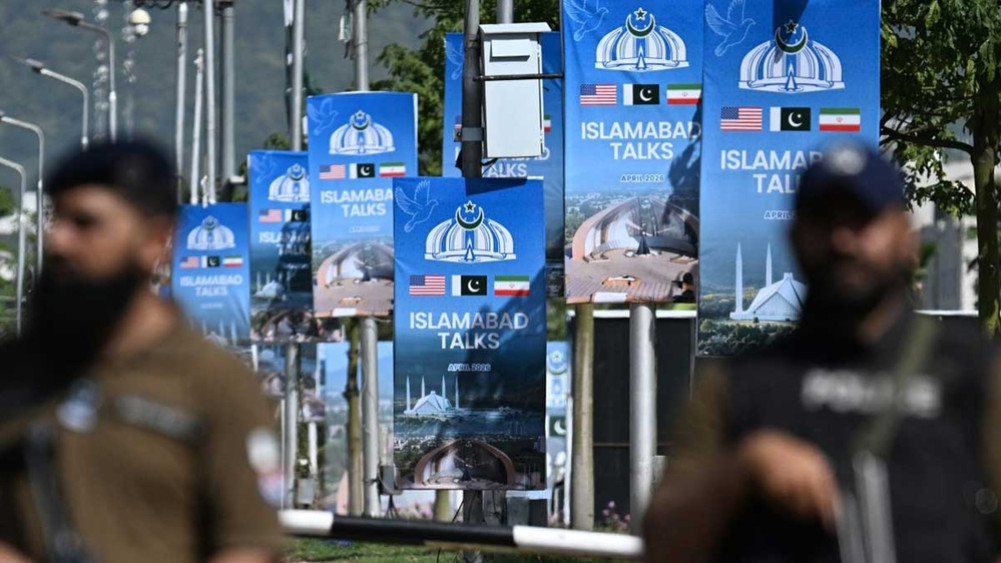
Pakistan, which was classified as economically weak by the International Monetary Fund in early 2026, has suddenly become the world's geopolitical crisis solver, restoring American trust that had been lost for 15 years.
We use Google Cloud Translation Services. Google requires we provide the following disclaimer relating to use of this service:
This service may contain translations powered by Google. Google disclaims all warranties related to the translations, expressed or implied, including any warranties of accuracy, reliability, and any implied warranties of merchantability, fitness for a particular purpose, and noninfringement.
Pakistan's image on the international stage has been tarnished in recent times due to an unstable political environment, economic crisis and the struggle to control armed groups.
During the military tension with India last year, the Western media portrayed Pakistan as a 'factor of instability'. Pakistan's relations with not only India but also with its neighbor Afghanistan have been bitter.
The border military tension that began on February 21 has not yet fully ended. Despite all these internal and external challenges, Pakistan has surprised diplomatic circles by successfully mediating the US-Iran conflict. The US-Iran agreement to end the war is scheduled to be signed in Geneva next Friday and a comprehensive peace agreement will be signed within 60 days.
The agreement could provide great relief to the global economy, which has been battered by inflation and the economic crisis. That is why the world community is praising Pakistan's diplomatic activism. Pakistani Army Chief Field Marshal Ashim Munir had been creating the atmosphere for this agreement from behind the scenes since the beginning of the war. The war that began on February 28 was temporarily stopped on April 8 at his initiative. Pakistan's diplomatic activism was not limited to this; on April 11 and 12, representatives of Iran and the United States sat at the table for direct talks under Pakistan's own management in Islamabad. Although the talks did not reach an immediate conclusion, this was the first historical turning point in which the two countries formally held direct talks since the 1979 Islamic Revolution. Despite the failure of this initial effort, Pakistan continued the dialogue by involving regional powers such as Qatar, Turkey, and Egypt. When the atmosphere for talks began to deteriorate, Field Marshal Munir took all-out initiatives to bring both sides to an agreement.
Pakistan shares its western border with Iran. The two countries have historical and cultural ties. Similarly, Pakistan has a long-standing strategic and military partnership with the United States. The roots of the current diplomatic success are linked to the Cold War history and the special political chemistry that has developed since then.
In 1953, the Iranian army, under the plan of the American intelligence agency CIA and the British MI-6, overthrew the government of the elected Prime Minister Mohammad Mosaddeq and handed over power to the then King Mohammad Reza Shah Pahlavi. Mosaddeq, who was very popular among Iranians, nationalized the oil fields, making the Shah a reliable partner for the Western powers who were angry.
The Shah reduced the national company set up by the Mosaddeq government to paper and gave foreign companies control of Iran's oil fields. The Iranians had not forgotten the dismissal and imprisonment of Mossadegh. In the wake of that public outrage, the Islamic Revolution in Iran took place in 1979. After the Shah was overthrown, Iran's relations with the United States turned hostile. On the other hand, Pakistan became closer to the United States during the Cold War. The Soviet-Afghan War brought them closer. Iran was always wary of the madrasas and jihadist movements established in the border areas with the financial support of the United States and Saudi Arabia. Because the United States and Saudi Arabia were supporting Sunni Islamic militants, while Iran is a Shia Muslim majority country. It feared that its newly successful movement would be jeopardized by the activities carried out in the neighborhood with American-Saudi involvement. For that reason, it considered it appropriate to distance itself from Pakistan. After the September 11 attacks in 2001, Pakistan and the United States fought together against the Taliban in Afghanistan. However, the US military's failure to give Pakistan any advance warning when Osama bin Laden was killed in Abbottabad in 2011 created deep distrust between Islamabad and Washington.
What was Pakistan watching while bin Laden was hiding in the city where his military base was located? This question still arises in American circles.
In 2017, President Trump cut military aid to Pakistan. After that, Pakistan's elected Prime Minister Imran Khan's inclination towards China increased. In 2022, Imran Khan was ousted after a clash with the army and Shahbaz Sharif became the prime minister.
After the 2024 elections, the Sharif government tried to get relations with the US back on track. The Pakistani army is playing an important role in this. As a result, Field Marshal Ashim Munir is known as the most powerful man in the country.
Last year, a four-day fighting between India and Pakistan ended in a ceasefire. Trump wanted to take credit for mediating this war. Pakistan announced a ceasefire under his mediation. India, however, claimed that there was no third party in the mediation. To appease Trump, Pakistan recommended him for the Nobel Peace Prize. Despite not receiving the award, Trump became friendly towards Pakistan and General Munir, which deepened the relationship between the two countries. On the other hand, the lack of regional partners with Iran became a great opportunity for Pakistan. Oman, which was mediating the talks before the war, was attacked by Iran after the war broke out. As a result, Oman distanced itself from further talks. As most Gulf countries have US military bases, Iran could not trust them. Moreover, Iran has regional competition with the influential Gulf countries Saudi Arabia and the UAE as well as historical bitterness. Syria and Iraq are not in a position to mediate due to long-standing conflicts and instability. Turkey is a NATO member, so Iran cannot fully trust it. India had an opportunity to mediate. However, it missed the opportunity by remaining silent when the US-Israeli attacked Iran. Pakistan has achieved success in both strategic and economic terms through this mediation. Pakistan, which was classified as an economically weak country by the International Monetary Fund in early 2026, has suddenly become the world's geopolitical crisis solver, which has restored American trust lost for 15 years. In the future, access to important minerals and American investment may flow into Pakistan through the military-backed investment council. In addition, the opening of the Strait of Hormuz is also important for Pakistan's economy. However, this success is not without risks. Proximity to Iran may cast doubt on the strategic military understanding with Saudi Arabia.
Similarly, with Israeli Defense Minister Israel Katz taking a stand against withdrawing troops from Lebanon, there is a risk that this peace effort could collapse at any time. Pakistan's history is a witness that international prestige alone cannot avert internal crises. In 1971, Pakistan mediated US Secretary of State Henry Kissinger's visit to China, which changed world politics. However, due to internal discontent, East Pakistan seceded that same year and became Bangladesh.
(With the help of the agency)