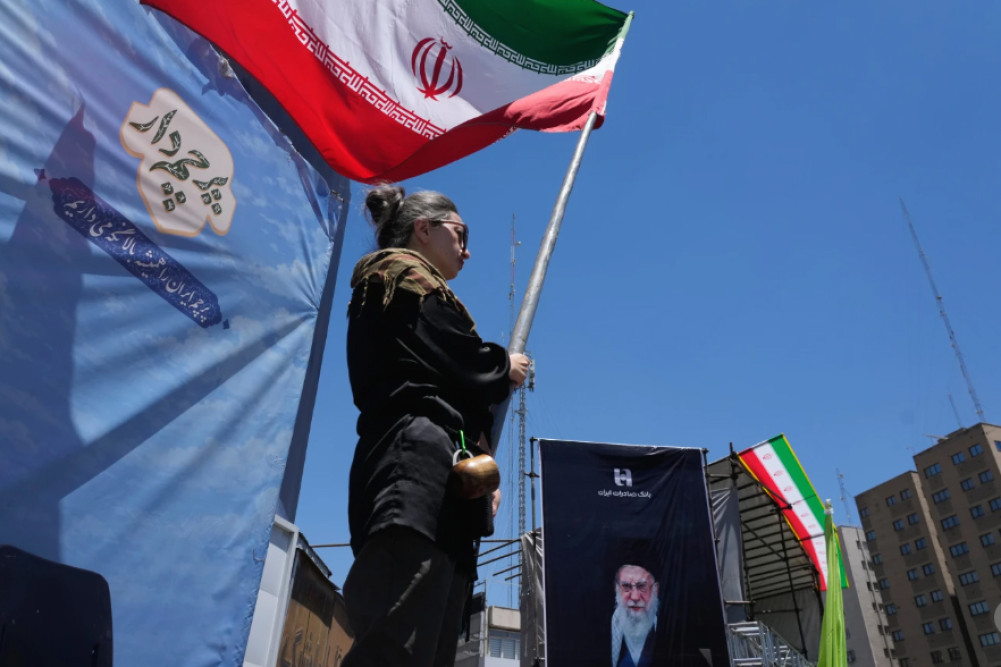
Trump, correcting his previous statement, claimed that Hormuz would open after a formal agreement on Friday, as landmines laid in the sea must be removed.
We use Google Cloud Translation Services. Google requires we provide the following disclaimer relating to use of this service:
This service may contain translations powered by Google. Google disclaims all warranties related to the translations, expressed or implied, including any warranties of accuracy, reliability, and any implied warranties of merchantability, fitness for a particular purpose, and noninfringement.
Iran and the US are set to sign a peace deal on Friday. Both sides have confirmed the signing of the peace deal in Geneva, Switzerland. Iran and the US agreed on Sunday to end the war. However, the details of the agreement to be signed in Geneva have not been officially made public.
Iranian state media Mehr News Agency has claimed to have received a draft of a 14-point agreement to be signed between the two sides on Friday. However, some points of the agreement made public by the agency and the claims of US officials are at odds. Both sides have said that the war will end on all fronts immediately after the agreement and that a final agreement will be reached within 60 days, covering important issues.
US President Donald Trump had claimed on Sunday that the Strait of Hormuz had been opened free of charge immediately after the agreement. He also said that the US military had been ordered to lift the blockade imposed on Iranian ports. However, the British media outlet BBC reported that the blockade in Hormuz remained in place on Monday.
Trump, correcting his earlier statement on Monday, claimed that the Strait of Hormuz would open after a formal agreement on Friday to remove landmines laid in the sea. “This great agreement will bring peace and security to the entire region. Many presidents have tried to make peace with Iran, but all failed before me. For the first time, the leadership of this region has a president who can help them achieve true peace. The agreement on Friday will open the Strait of Hormuz because the explosives there must be removed. Oil will once again flow through this area to the world,” he wrote on social media.
A draft of the agreement obtained by Mehr News Agency contradicts Trump’s claim. The agency said that an agreement had been reached to completely lift the US blockade and Iran’s blockade of the Strait of Hormuz within 30 days. Mehr said that the agreement included an immediate and permanent cessation of hostilities on all fronts, including Lebanon, a comprehensive agreement on nuclear negotiations and sanctions against Iran within 60 days.
According to international news organizations, the agreement also includes a commitment by Iran not to develop nuclear weapons. For that, both countries are ready to conclude nuclear talks within 60 days. The Trump administration has long demanded that Iran's nuclear activities be completely stopped. Iran has been claiming that its nuclear program is limited to peaceful purposes. Both countries have also agreed to create a special mechanism to monitor whether the terms of the agreement are being properly implemented.
According to Mehr, the draft states that sanctions on Iran's oil sales, petrochemical production and various products will be lifted during the 60-day negotiations. Similarly, the draft also states that Iran's assets worth 24 billion dollars frozen by the US will be released within 60 days.
The draft also states that half the amount (12 billion) will be released immediately after the peace agreement, according to the Iranian news agency. According to Mehr, the US and its allies will present a plan worth at least 300 billion US dollars for the reconstruction of Iran. It also states that the final agreement will be officially approved through a UN Security Council resolution. There has been no public response from the US on these issues.
Another Iranian news agency, Tasnim, quoted an informed source as saying that some changes were made to the draft at the last moment of the talks. It claims that Iran will take over the administrative operation of the Strait of Hormuz. While Trump has been claiming that free movement in Hormuz will be ensured.
Leaders of various countries have welcomed the US-Iran agreement to end the war. They have praised the efforts made by countries including Pakistan to mediate the talks. Pakistani Prime Minister Shahbaz Sharif and Army Chief Asim Munir have been active for a long time to bring these peace talks to a conclusion.
UN Secretary-General Antonio Guterres has congratulated the US and Iran. “This is a very important step towards a peaceful resolution of the conflict,” said Secretary-General Guterres, “and I express my sincere gratitude to Pakistan, Qatar, Egypt, Saudi Arabia, Turkey, and other countries for their constructive and supportive role in creating an environment for negotiations that led to a peace agreement.”
Australian Prime Minister Anthony Albanese and Foreign Minister Penny Wong also issued a joint statement praising Pakistan, Qatar, Saudi Arabia, Turkey, and other countries for their mediation efforts. Turkish President Recep Tayyip Erdogan described the agreement as an important achievement for establishing regional peace and stability. Qatar’s Foreign Ministry issued a statement thanking Pakistan and all regional and international parties that contributed to the agreement.
French President Emmanuel Macron issued a statement saying the agreement was the result of collective diplomatic efforts by many partner countries. Japanese Prime Minister Sane Takaichi also praised the countries that played the role of mediator. German Chancellor Friedrich Merz, British Prime Minister Keir Starmer, New Zealand Foreign Minister Winston Peters, and others welcomed the agreement, saying it was an important step towards maintaining peace and stability in the West Asia region.
Israel, which launched a joint attack on Iran with the United States on February 28, is not a party to the agreement. Recently, Israel has intensified its attacks in Lebanon. Iran, which has demanded an end to the war on all fronts, including Lebanon, has condemned it.
Israel attacked the Lebanese capital Beirut on Sunday. After that, Trump wrote on social media, ''It should not have been attacked on this special day when we are so close to a peace agreement with Iran.'' Israeli Defense Minister Israel Katz
issued a statement on Monday saying that its troops would not withdraw from the territory they had occupied
in Lebanon.
Crude oil prices fall
Crude oil prices have fallen sharply in the global market since the US and Iran reached an agreement to end the war. On Monday, the price of global benchmark Brent crude fell by 3.9 percent to around $84 per barrel. Similarly, the price of US crude also fell by 4.8 percent to $81 per barrel.
Experts say that it will take some time for crude oil prices to fall to the pre-war price of $70 per barrel. They say that many challenges remain to restore crude oil supplies to their previous level.
The Strait of Hormuz must be cleared of explosives, the passage of ships must be fully opened, oil production in West Asia must be resumed,
emergency petroleum reserves must be replenished
and energy infrastructure damaged by the war must be repaired.
That is why analysts expect crude oil prices to remain high for some time. They predict that it will take weeks for most of the oil fields in West Asia to reopen and increase production, as the war has shut down most of them.
“Until ships start moving in and out regularly and safely, the market will remain skeptical that the Strait of Hormuz is truly open,” Bob McNally, president of Rapidan Energy, told ABC’s “This Week” program on Sunday. “If the supply disruptions continue and emergency reserves are depleted, there is a risk that oil prices will skyrocket further.”
Joe McMonigal, president of the Global Center for Energy Analysis, a Saudi Arabian think tank, also said that market skepticism will only subside once the waterway is open and ships start moving. “If the waterway is open, that is a good thing, but until I see ships freely passing through it without any obstacles, I will not be completely confident in it,” he said.
(with the help of an agency)