On May 10, Modi announced a 'national mission' to adopt natural farming and reduce the use of chemical fertilizers by 50%.
We use Google Cloud Translation Services. Google requires we provide the following disclaimer relating to use of this service:
This service may contain translations powered by Google. Google disclaims all warranties related to the translations, expressed or implied, including any warranties of accuracy, reliability, and any implied warranties of merchantability, fitness for a particular purpose, and noninfringement.
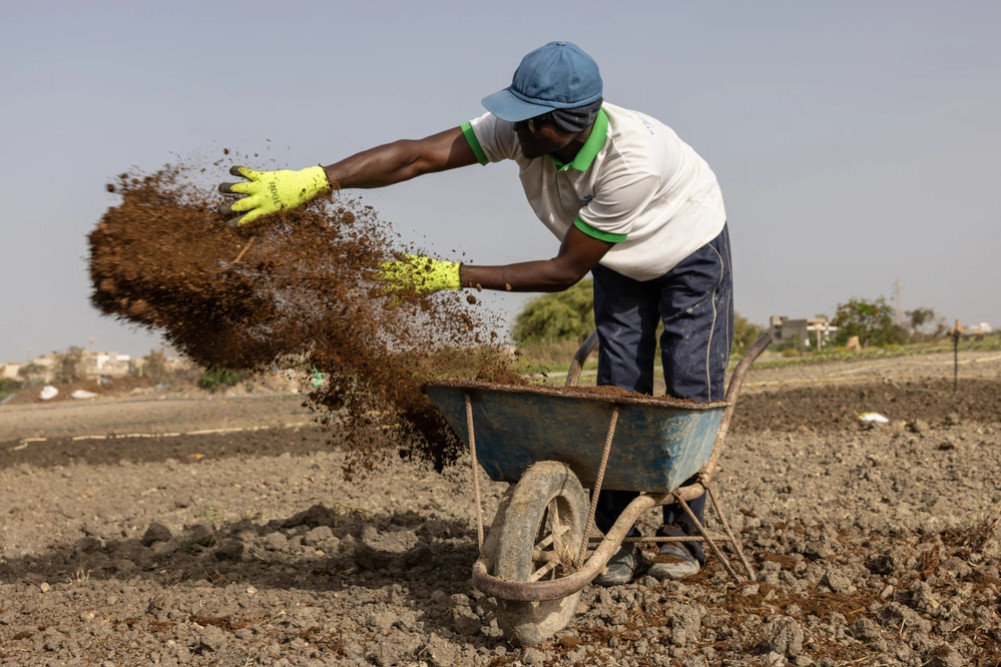
When Senegalese farmer Abu So first saw footage of the US missile strike on Iran on social media, he knew it would soon affect the West African nation’s agricultural sector. The price of fertilizer in Senegal has risen by 40 percent since the war began on February 28. For the past eight years, So has been promoting organic compost and other natural fertilizers instead of chemical fertilizers. He encourages Senegalese farmers to buy manure from local herders and advises them on how to make good compost. “We cannot wait for a ceasefire,” So said. “It is risky to rely on chemical fertilizers.” Iran’s blockade of the Strait of Hormuz has affected the global supply of natural gas needed to make chemical fertilizers. The Gulf region produces 30 percent of the world’s chemical fertilizers, according to the International Food Policy Research Institute. Globally, prices have risen by nearly 50 percent since the war began, according to the World Bank’s Fertilizer Price Index. 'Time is very short,' said Maximo Torero, chief economist at the UN's Food and Agriculture Organization, as concerns about food security grow. Experts say using organic fertilizers instead of chemical fertilizers could have major environmental benefits. The production and use of chemical fertilizers emit greenhouse gases, a major contributor to climate change. In contrast, organic fertilizers can store carbon in the soil. They cause less pollution.
'It's good for the planet because it frees food production from fossil fuels,' said Susan Chomba, a member of the International Panel of Experts on Sustainable Food Systems.
Senegal imports 125,000 tons of fertilizer annually. Agriculture Minister Mouaba Diagne said the state has enough chemical fertilizer for the current season, but farmers have complained that it is becoming increasingly difficult to obtain.
In addition, some farmers use sheep manure. Farmer Aliou Fal blames US President Donald Trump for the skyrocketing price of fertilizer. “He starts wars in the world and doesn’t even think about the impact. Now farmers are suffering,” Fal said.
Every year, he uses six tons of compost. He raises sheep near the town where he lives, so organic fertilizer is abundant. In rural and remote areas, sourcing and transporting large amounts of fertilizer is a challenge. He says some people may give up farming during these difficult times.
An alternative is the ‘biofertilizer’ industry, in which bacteria and other microorganisms help plants absorb nitrogen (a nutrient essential for plant growth) from the air and soil. A growing number of companies are making large-scale compost from municipal waste in Africa.
The Senegalese government announced in April that it would subsidize and distribute 30,000 tons of organic fertilizer to help farmers. But he says it is not enough.
According to the Organization for Economic Cooperation and Development (OECD), governments around the world spend $700 billion a year on agricultural subsidies, much of it on chemical fertilizers. Chomba says this has made alternatives like organic fertilizers more expensive and less competitive.
“You’re encouraging the wrong kind of products,” she said. Brazil, a major exporter of soybeans, coffee, sugarcane and meat, imports more than 80 percent of the fertilizers it uses.
Now, with rising fertilizer prices and shortages, Brazil’s biofertilizer sector has gained momentum. “Every time there’s a war, farmers step up their use of biofertilizers,” said Luis Barbieri, founder of the Folio Institute, an organization that connects Brazilian farmers, scientists and researchers. He said fertilizer prices have risen by 50 percent since the Iran war. Although chemical fertilizers were widely used in the 1970s, Barbieri said they were less effective in Brazil’s climate. Because, there is a problem of fertilizer runoff due to high rainfall and high temperatures.
According to the Brazilian government agency 'Embrapa', the biofertilizer area in Brazil has increased by 15% from 2023 to 2024. In addition, farmers have the facility to make their own biofertilizer at a very low cost.
However, in Mexico, government subsidies are still promoting the use of chemical fertilizers. This information was given by Gerardo Noriega, a research professor at the Autonomous University of Chapingo and who is promoting the use of organic fertilizers in Mexico.
However, The current crisis may force farmers to adopt organic fertilizers faster than they thought, he has indicated. In India, too, Prime Minister Narendra Modi is promoting organic farming. On May 10, Modi announced a 'national mission' to adopt organic farming and reduce the use of chemical fertilizers by 50%.
Manohar Chari was using chemical fertilizers in the southern Indian state of Telangana. But now he They are making ‘Jivamrut’. It is made from cow dung, wheat, flour, soil and jaggery.
“We are not dependent on companies,” said Chari. He is one of the 1.7 million farmers in the states of Telangana and Andhra Pradesh who have been attracted to organic farming after the current crisis.
India imports 60% of its fertilisers from the Gulf countries. In the current crisis, the government has had to provide huge subsidies on fertilisers to ensure supply and prevent price increases. This has put a huge strain on the state exchequer. “There has definitely been a surge in interest in organic farming this year, especially after the conflict in the Middle East,” said G.V. Ramanjeneyulu, an agricultural scientist at the Centre for Sustainable Agriculture.
Organic farming requires more labour and farmers have to go through a transition period. According to Chari, the government needs to support farmers who practice organic farming instead of subsidising chemical fertilisers. “If just a small portion of that support were given to organic farmers, more people would be attracted to it,” he said.