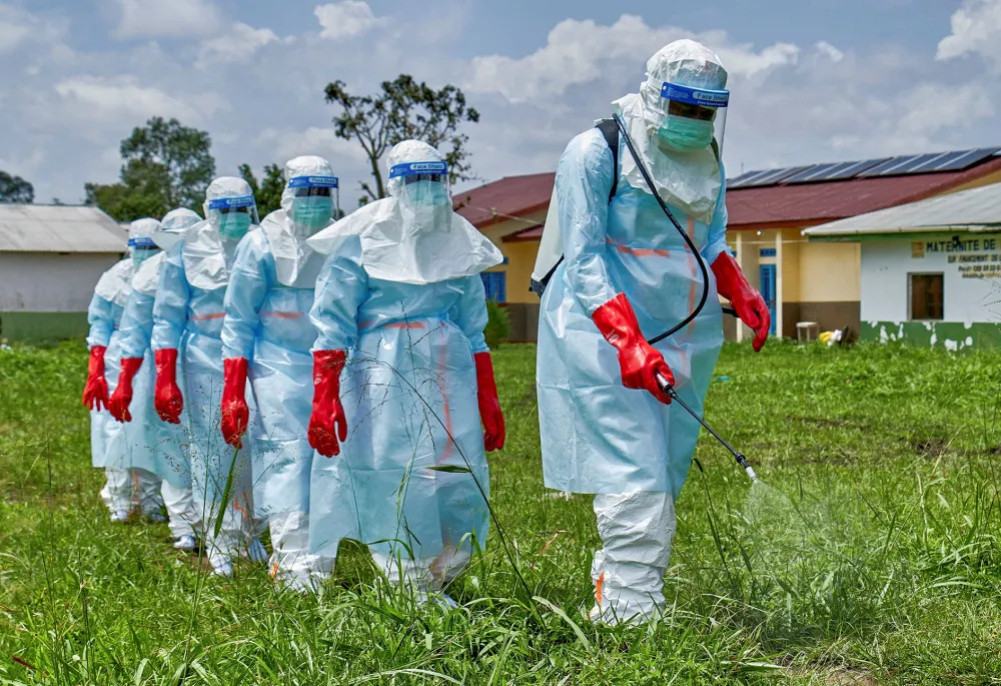
On Sunday, Tedros expressed suspicion that more than 900 patients had Ebola.
We use Google Cloud Translation Services. Google requires we provide the following disclaimer relating to use of this service:
This service may contain translations powered by Google. Google disclaims all warranties related to the translations, expressed or implied, including any warranties of accuracy, reliability, and any implied warranties of merchantability, fitness for a particular purpose, and noninfringement.
World Health Organization (WHO) Director-General Tedros Adhanom Ghebreyesus has said that 220 deaths in Africa may be due to a suspected Ebola outbreak. He said that the delay in identifying the infected is making it difficult for teams deployed to control the epidemic. 'We are rapidly scaling up operations, but at this point the epidemic is spiraling out of control,' Director-General Tedros said on Monday, 'Countries bordering Congo (DRC) must take immediate action.'
Earlier on Monday, two more Ebola cases were confirmed in Uganda. The total number of infected people there has reached seven. Earlier on Sunday, Tedros had said that more than 900 patients were suspected of having Ebola.
The latest outbreak of Ebola came from Ituri in Congo. The risk of contracting Ebola is highest when you come into contact with the blood, saliva, vomit, sweat or other body fluids of an infected or deceased person. The disease can be transmitted if these fluids come into contact with a healthy person's broken skin or organs such as the eyes, nose and mouth. This is why healthcare workers and family members caring for the patient are at the highest risk of infection.
The WHO said in a statement on Friday that the risk level in Congo was 'very high' and 'high' in the African region. The WHO said that the risk of the infection spreading globally was low.
There is no proven vaccine available to prevent infection with the currently spreading Bundibugyo strain of Ebola. The WHO declared the strain a 'public health emergency' only last week.
The University of Oxford in the UK is developing a new vaccine. But it will take about two to three months to send it for clinical trials, the BBC reported. There is currently no guarantee that this vaccine will be effective. It will be tested first on animals and then on humans.