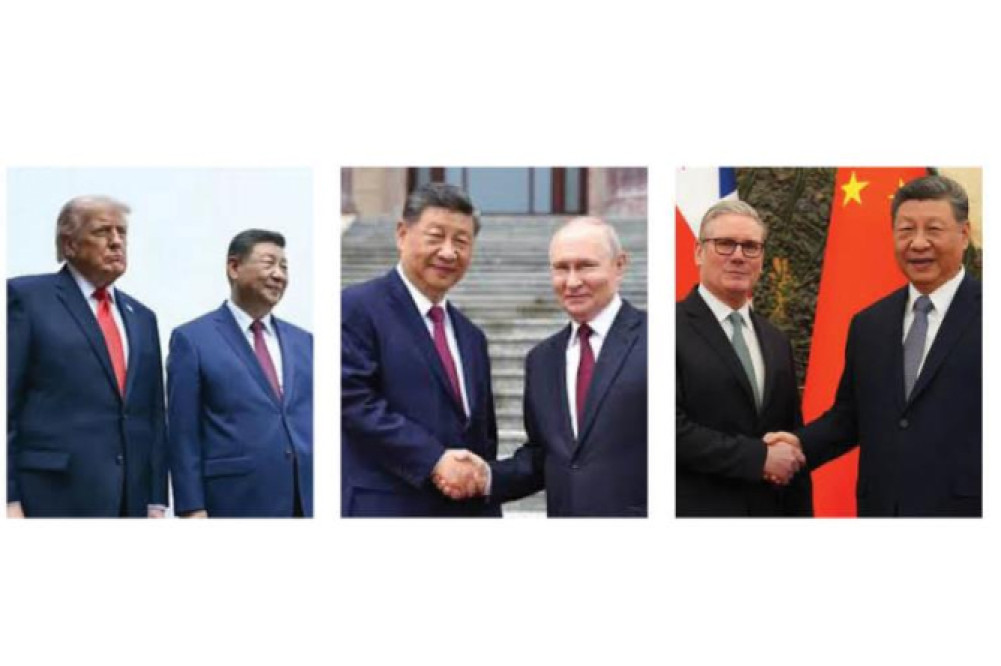
The growing presence of not only government representatives but also business leaders demonstrates the growing willingness of the rest of the world to engage in investment and trade cooperation with Beijing.
We use Google Cloud Translation Services. Google requires we provide the following disclaimer relating to use of this service:
This service may contain translations powered by Google. Google disclaims all warranties related to the translations, expressed or implied, including any warranties of accuracy, reliability, and any implied warranties of merchantability, fitness for a particular purpose, and noninfringement.
In Beijing on May 13-15, US President Donald Trump met with Chinese President Xi Jinping, accompanied by a delegation of senior members of his cabinet and CEOs of major business conglomerates. Russian President Vladimir Putin soon arrived in Beijing. On Monday, Pakistani Prime Minister Shahbaz Sharif and Army Chief Asim Munir met with Xi.
US President Trump has been praising the mediation role played by Sharif and Pakistani Army Chief Field Marshal Asim Munir in ending the Iran war. In Beijing, Chinese President Xi said that China would coordinate Sharif's mediation efforts.
Politics, technology, mutual trade and investment seem to have taken priority in recent meetings. The increasing presence of not only government representatives but also people from business families indicates the growing willingness of the rest of the world to invest and trade with Beijing.
In just 10 days in April, foreign guests including Thailand's Princess Maha Chakri Sirindhorn, Spanish Prime Minister Pedro Sanchez, Abu Dhabi Crown Prince Sheikh Khalid bin Mohammed bin Zayed Al Nahyan, Vietnamese President To Lam, and Russian Foreign Minister Sergei Lavrov visited China. "The recent wave of visits is an example of the world's great trust in China," Chinese state-run media outlet Global Times wrote at the time. Chinese local media have used terms like "meeting room" and "Beijing time" to describe these visits.
"China will definitely play an important role in the world in the future," Spanish Prime Minister Pedro Sanchez said at an event held at Tsinghua University during his visit to China last April. He said that a multipolar world is a necessity today and that it cannot be ignored. Recently, countries in the Western alliance such as Canada and Spain have been trying to deepen cooperation with China. Canadian Prime Minister Mark Carney visited Beijing last January and met with the Chinese president. This was the first visit by a Canadian chief executive since 2017. The two countries discussed renewable energy, agriculture, crime control, and other issues. In January, Korean President Lee Jae-myung, Irish Prime Minister Michael Martin, Finnish Prime Minister Petty Orpo, British Prime Minister Keir Starmer, and others met with Xi. Similarly, in February, Uruguayan President Yamamoto Orsi and German Chancellor Friedrich Merz visited Beijing.
Economist Poshraj Pandey told Kantipur that China's stable policy and growing influence in the high-tech industry have made other countries interested in economic cooperation. ‘China has 90 percent of the processed rare earth metals needed to manufacture everything from fighter jets to smartphones and computers. In Trump’s own words, the card is now with China. China played this card to thwart the tariff war launched by the US last year,’ Pandey said. ‘America has its own consumer market. Which attracts many. However, despite this, people are not taking the risk of investing there because the US market is uncertain. Small and large powers want to increase trade and investment with China to protect their economies. Where there is stability, investors are attracted.’ He added, ‘Trump has a plan to promote agriculture in the US. Keeping that in mind, China is going to ease the restrictions previously imposed on American products like beef, soybeans and corn. The US has also agreed to provide chips to China for AI. This may bring some stability to world trade.’
Especially since Donald Trump was elected president, US foreign relations and policy have been volatile. Trump’s ‘Make America Great Again’ policy, while claiming to prioritize domestic issues, has discouraged global cooperation. This has raised suspicions among its Western allies. In contrast, China has been emphasizing policy continuity, commitment to multilateralism, and global cooperation.
‘The world has recognized that China can represent new concepts and new practices and lead the world towards a transformation of peace, prosperity, and stability. Against this, the old mentality of factionalism and unilateralism has emerged,’ Li Haidong, a professor at China Foreign Affairs University, told the Chinese state-run Global Times.
It seems that countries around the world are seeking cooperation with China according to their own contexts. Neighboring countries like Vietnam want to build a strong foundation with a shared future. European countries like Spain are seeking cooperation in green energy and technological innovation. West Asian countries have sought China's mediation and support for regional peace. Russia wants a strategic partnership, while the United States has focused on trade and technology. China's recently concluded National People's Congress passed the 15th Five-Year Plan. The plan calls for China to work hand in hand with the rest of the world for development and prosperity.
Since launching the One Belt One Road (now the Belt and Road Initiative – BRI) project in 2013, China has been strengthening its global presence. By 2026, more than 150 countries had signed up to the project. However, the plan has not been implemented in many countries because agreements on investment and loans have yet to be reached. According to President Xi Jinping's ambitious goal, the 'Chinese Dream,' China wants to establish itself as the world's number one power by 2049.
'Xi has made a plan to establish China as a strong socialist country in the economic, political, and diplomatic fields by the centenary of the founding of the People's Republic of China.' This is called the 'Chinese Dream' or Chinese revival,' said diplomatic affairs expert Rupak Sapkota. 'The agreement reached during Trump's visit also includes the issue of Chinese revival along with Make America Great Again. This shows that the United States recognizes China as one of its own or equals. The United States led the unipolar world for a long time after the Cold War. But China's role in the multipolar world has now increased. That is why other countries are also attracted to build relations with China.’
He said that China’s growing diplomatic network, increasing presence in the high-tech industry and commitment to peace also played a big role in this. ‘The geopolitical conflict from Iran to Venezuela and especially the failure to achieve the goals in Iran have sent a message to the world that America is unstable.’ It seems that America is seeking China’s cooperation to end the war. On the other hand, China has not fought a major war with any country for almost 50 years. Whether from the perspective of the balance of political power or in trade relations, it is expanding relations according to the principle of coexistence,’ Sapkota said, ‘International forums are weakening.’ Most powerful countries are not running the world according to international rules. In this context, China's rise and its commitment to the rule of law have also enhanced its role in the balance of political power.'
He added, 'The Chinese, who focused on the production of garments and household goods until 2010, are now leading the way in high-tech industries including smartphones, aerospace, ships, weapons and ammunition, drones, AI, robotics, electric vehicles, and telecommunications. At a time when many economies around the world are under pressure, China has provided opportunities for cooperation in modern technology-based industries. Other economies around the world seem willing to cooperate with China due to its control over rare minerals, large supply chains, and economic growth.'
Despite all this, China's international relations are not without challenges. Cecil Tubbwick, a senior lecturer in political science and foreign relations at the University of Adelaide in Australia, wrote in The Conversation, 'China has its own complexities.' For example, Beijing has been providing large subsidies to some productive sectors to prevent industries from closing and achieve economic growth targets. The surplus produced by this is exported at cheap prices to the world, including the European Union (EU). Although this has caused problems for domestic industries there, China is not in a position to stop exports. On the other hand, despite the importance of Western markets for China's economic development, it is supporting Russia and Iran. So while the high-profile meeting in Beijing is a big celebration, the results from it are limited. (With the help of the agency)