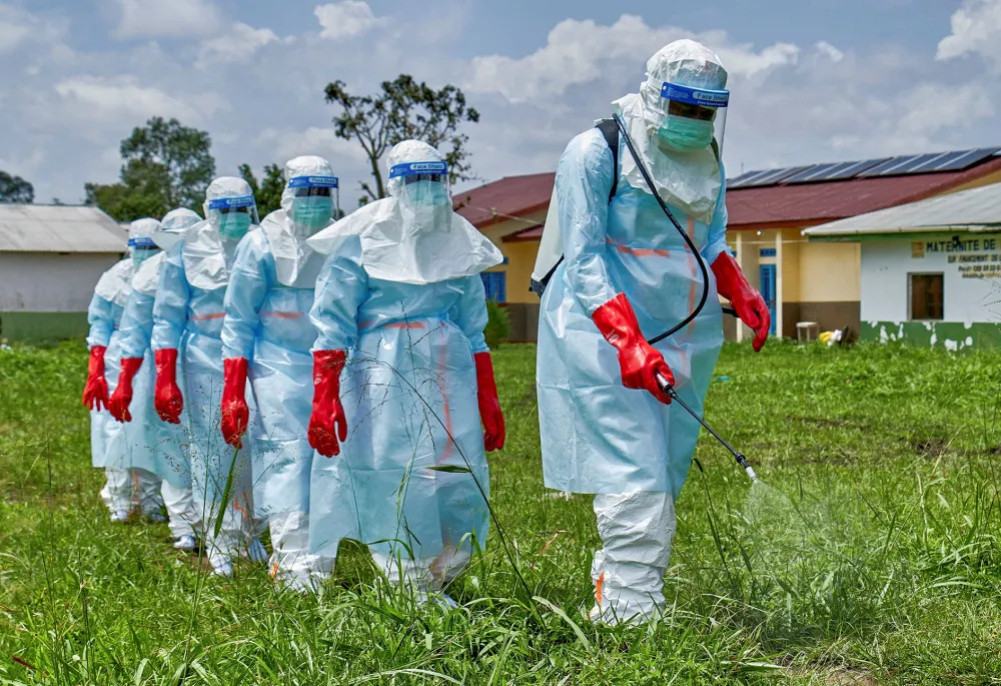
The situation in eastern Congo is very challenging due to conflict and shortages.
We use Google Cloud Translation Services. Google requires we provide the following disclaimer relating to use of this service:
This service may contain translations powered by Google. Google disclaims all warranties related to the translations, expressed or implied, including any warranties of accuracy, reliability, and any implied warranties of merchantability, fitness for a particular purpose, and noninfringement.
Helen Akilimali, a cocoa vendor in the eastern Democratic Republic of Congo, always wears a mask in public to protect herself from Ebola. But despite this, she has to meet many people in her business. Some still think Ebola is not a real disease. Helen has no way to control their behavior
‘Ebola is a real disease. People need to stop spreading false rumors,’ Akilimali told the American media outlet CNN. ‘I always cover my face with a mask. But some of my customers come without masks.’ The two provinces of Ituri and North Kivu in eastern Congo that have been hit hardest by the Ebola virus are struggling with local outbreaks and misinformation.
World Health Organization Director-General Tedros Adhanom Ghebreyesus posted on social media on Sunday that more than 900 suspected cases of Ebola have been found in Congo so far. He said that 101 people have been confirmed infected.
Earlier, the WHO had said that at least 177 deaths in Congo may be related to Ebola. The Ebola infection is believed to have started in rural areas of Ituri. However, the virus has now spread as an epidemic in large cities such as Bunia, the capital of Ituri province, and Goma, the capital of North Kivu. Five people have been infected in neighboring Uganda. Two have died.
There is no proven vaccine available to prevent the currently spreading Bundibugyo strain of Ebola.
The University of Oxford in the UK is developing a new vaccine. But it will take about two to three months to send it to clinical trials, the BBC said. There is currently no guarantee that the vaccine will be effective. It will first be tested on animals and then on humans.
There is a high risk of infection from contact with blood, saliva, vomit, sweat or other body fluids from an infected or deceased person with Ebola. If these fluids come into contact with broken skin or parts of the eyes, nose and mouth of a healthy person, the disease can be transmitted. Therefore, the risk of infection is highest among doctors and family members caring for the patient.
In a statement issued on Friday, the WHO said that the risk level in Congo is 'very high' and 'high' in the African region. The WHO said that the risk of this infection spreading globally is low.
The situation in eastern Congo is very challenging due to conflict and shortages. Armed groups have existed here for a long time. Youths disgruntled by the Ebola outbreak have been wreaking havoc with vandalism and arson. The government banned public gatherings and gatherings on Friday, but not everyone has followed suit.
An Ebola treatment hospital in Ituri province was attacked by a group of angry youths on Sunday. The hospital's director, Dr. Richard Lokudu, said the youths were demanding the return of the bodies of two of their relatives. Medical workers had to rush to evacuate patients after shots were fired inside the hospital. The extent of the damage caused by the clashes has not been made public. Two health centres were set on fire last week.
Experts say the health service has been devastated by violence by armed rebel groups, mass displacement, local government failure and a lack of international aid. The organization Physicians for Human Rights has expressed concern about the current situation, calling it a “series of devastating crises.”
“At first, we thought it was not a disease, but a joke. But when we saw people dying, it started to feel real,” said Ili Ilung, a local in Bunia town. “Those spreading misinformation about this disease probably haven’t seen anyone in their family infected or dying yet.” Ilung said he had kept his family at home to protect them. He also urged people to be vigilant about Ebola and not spread unnecessary confusion.
In Uganda, President Yoweri Museveni has urged the general public to stop shaking hands. The WHO had declared the situation in Uganda stable. Maseveni has urged the public to be vigilant to prevent the spread of the infection.
The Africa Centers for Disease Control and Prevention (Africa CDC) said authorities were ready to arrange for the treatment. The organization coordinates health concerns for all African Union countries. Similarly, the vaccine development program has also prioritized. “It takes months to develop a vaccine,” Africa CDC Director-General Dr. Jean Kaseya told reporters. “No one can predict that in a few months. If they do, that’s not true. It takes some time.”
Violence and lack of resources
Dozens of rebel and combatant groups have existed in eastern Congo for years. Some of these groups also have foreign ties.
Armed groups affiliated with the radical Islamic State group are also active here. Rwandan-backed M-23 rebels have taken control of parts of the region. The Congolese government remains in control of the northeastern Ituri province, the epicenter of the Ebola outbreak, but its presence is weak.
As a result, the rebels have been carrying out repeated attacks. The Ugandan rebel group Allied Democratic Forces, which is affiliated with the Islamic State, is one of the main rebel groups there. It has been targeting public infrastructure and civilians.
A report published by Doctors Without Borders (MSF) before the Ebola outbreak noted that the security situation in Ituri was poor. The report noted that insecurity had forced doctors and nurses to flee the region.
The report also noted that the pressure on health facilities had created a “catastrophic situation” in some areas. The Ebola outbreak has added to the already dire situation. The UN humanitarian office says nearly one million people have been displaced by the conflict.
“The Ebola outbreak is spreading in communities already facing insecurity, displacement and weak health systems,” said Gabriela Arenas, regional coordinator for the International Federation of Red Cross and Red Crescent Societies. There are concerns that the disease could spread to large displacement camps near the city of Bunia, where the first Ebola cases were reported.
Ebola has also spread to North Kivu and South Kivu, two eastern provinces controlled by the M-23 rebels. The United States and other wealthy nations cut aid to Congo last year, health experts say. The move has been devastating for eastern Congo.
Thomas McHale, public health director at Physicians for Human Rights, said, “This cut has weakened the ability to detect and respond to infectious disease outbreaks.” Congo has faced more than a dozen Ebola outbreaks in the past. Aid groups working in eastern Congo have said there is a shortage of essential protective equipment. They say there is a shortage of face shields and protective suits to protect health workers from infection, testing kits, and body bags and other materials needed to safely bury the dead.
“We have appealed to various partners, but we have not really received any support so far,” said Julien Lusenge, president of the aid group Women’s Solidarity for Inclusive Peace and Development, which runs a small hospital near Bunia. “We only have hand sanitizer and a few masks for the nurses.”
Colin Thomas-Jensen, impact director at the Aurora Humanitarian Initiative, said the attacks on hospitals and health facilities were fueled by deep distrust and anger among the Congolese people towards government institutions. “They have been suffering from violence for decades from foreign-backed rebel groups. The government and international peacekeepers have not been able to protect the people from that.
This has angered them,” he said. Another reason for the anger is the strict protocols surrounding the burial of suspected Ebola victims. The authorities are taking charge of the management of the bodies themselves to prevent the further spread of the disease. Whereas, in normal circumstances, it is customary for family members, relatives and friends to gather for the funeral.