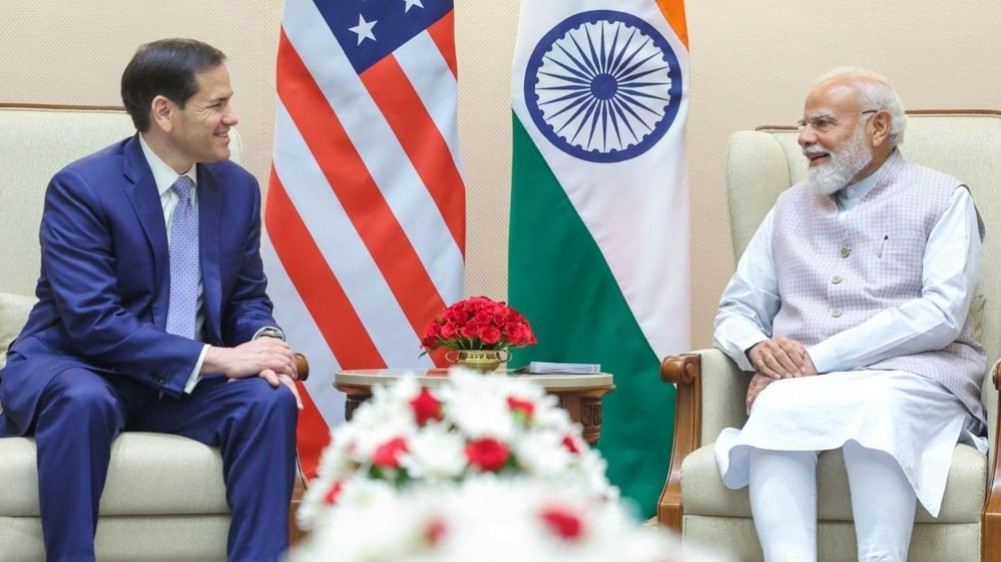
The ongoing war in West Asia was also discussed during the Modi-Rubio meeting, according to a statement issued by the US State Department.
We use Google Cloud Translation Services. Google requires we provide the following disclaimer relating to use of this service:
This service may contain translations powered by Google. Google disclaims all warranties related to the translations, expressed or implied, including any warranties of accuracy, reliability, and any implied warranties of merchantability, fitness for a particular purpose, and noninfringement.
Indian Prime Minister Narendra Modi held talks with visiting US Secretary of State Marco Rubio on Saturday in New Delhi on trade, security and technology. This is Rubio's first visit to India since becoming the Secretary of State. After the meeting, Modi wrote on social media that the India-US Comprehensive Strategic Partnership and regional and global peace and security were discussed. The meeting was attended by Indian External Affairs Minister S Jaishankar, National Security Advisor Ajit Doval, US Ambassador to India Sergio Gore and US Assistant Secretary of State Alison Hooker. Speaking after the meeting, Gore said that India and the US prioritize a free and open Indo-Pacific. The meeting comes at a time when India and the US are seeking to enhance cooperation in security, technology, trade, supply chain and fuel.
Gore wrote in X, ‘We had constructive discussions on deepening the US-India partnership . We discussed a free and open Indo-Pacific and the security, trade and technology sectors that strengthen both countries . India is an important partner of the US .’ Gore also said that Rubio had extended an invitation to Modi to visit the White House in the near future on behalf of US President Donald Trump . The ongoing war between the US, Israel and Iran was also discussed during the Modi-Rubio meeting, according to a statement issued by the US State Department. ‘The US will not leave the global energy market under the control of Iran and there is potential to diversify India’s energy supply in US energy products,’ the statement said, quoting Rubio.
Modi had said that India would support the peace efforts . Similarly, he stressed the need to end the conflict through dialogue and diplomacy . Rubio has arrived in India a week after the China-US summit. Rubio, who began his visit from Kolkata on Saturday, will stay in India for four days.
On Saturday, he visited the headquarters of the late Mother Teresa's Missionaries of Charity in Kolkata. He will participate in the foreign ministerial meeting of the Quad countries of Australia, India, Japan and the US on May 26. The Strait of Hormuz has been blocked since the start of the war in Iran. India imports about 80 percent of its crude oil and a large amount of natural gas from abroad. Before the war, about 55 percent of crude oil used to come to India from West Asia.
But with the outbreak of the war, the blockade on this waterway has increased India's dependence on Russian oil. Similarly, the prices of crude oil and other consumer goods have increased in India. The impact of the Iran war is visible in daily life in India, which has a population of about 1.4 billion. The US wants to sell oil to India. 'The more they buy, the more we want to sell, and on the other hand, our production and exports are now at historic highs,' Rubio had said before his visit to India. India buying US oil will also reduce the trade imbalance between the two countries. In 2025, the US had a trade deficit of $58.2 billion with India. US President Donald Trump has repeatedly argued that this trade deficit should be reduced. But bringing oil from the US to India is not easy. The distance between the two countries is very long. 'India has prioritized energy security. Because the situation with Iran does not seem to be resolved right now,' Vineet Prakash, associate professor of American studies at Delhi's Jawaharlal Nehru University, told the BBC. 'The US has already given India a waiver to buy Russian oil.' But Delhi wants more concessions.'
Delhi-Washington relations were strained for some time after the US imposed a tariff hike on India last year. The Trump administration, which imposed a 50 percent tariff on Indian goods for nearly 10 months, reduced the tariff to 18 percent early this year after talks with Indian Prime Minister Narendra Modi.
India has also not yet accepted the US's claim of mediation in the India-Pakistan conflict. However, Pakistani President Shahbaz Sharif thanked the US for this work. Trump has repeatedly claimed that India and Pakistan reached a ceasefire under his mediation. Trump has publicly praised Pakistan Army Chief Asim Munir. India has not liked this.
Pakistan is currently trying to mediate talks between Iran and the US. The meaningful dialogue between the two countries comes at a time when India is wary of the growing US proximity to Pakistan.