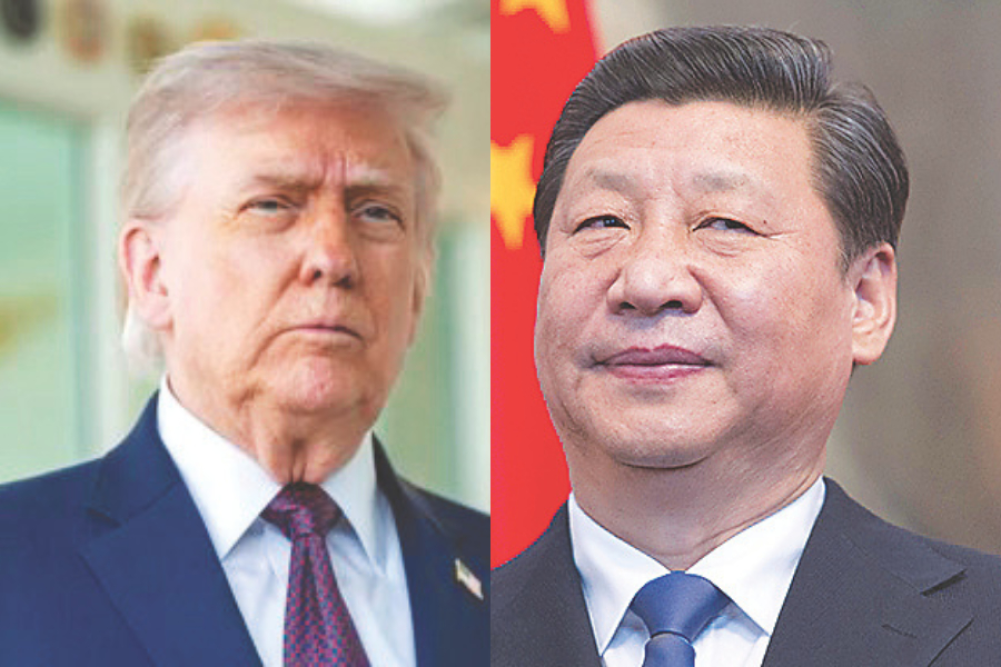
Bilateral trade and technology will be a priority during the visit.
We use Google Cloud Translation Services. Google requires we provide the following disclaimer relating to use of this service:
This service may contain translations powered by Google. Google disclaims all warranties related to the translations, expressed or implied, including any warranties of accuracy, reliability, and any implied warranties of merchantability, fitness for a particular purpose, and noninfringement.
US President Donald Trump is visiting China amid tensions in the Middle East. Trump is about to land in Beijing with a plan to pressure Iran to accept his terms by creating pressure through China.
It is estimated that these issues will be discussed when Chinese President Xi Jinping hosts Trump in Beijing. Officials from both countries also seem to be aware that the issue of mutual interests and improving bilateral relations should not be overlooked at the summit.
According to White House Deputy Press Secretary Anna Kelly, Trump will arrive in Beijing on Wednesday, meet with Xi on Thursday, and return to the US on Friday. Bilateral trade and technology will be a priority during the visit. Trump will be accompanied by CEOs of 16 major companies, including Elon Musk and Tim Cook, in Beijing to discuss them.
According to senior US officials, the issue of the Iran war will be the focus of Trump's visit. China is the largest buyer of Iranian crude oil and Iran's strategic partner. The US-Israeli war against Iran, which has been going on for about two and a half months, has been temporarily halted, but it has not ended permanently. Even during the ceasefire, the two sides are targeting each other.
Direct talks were held between the two sides in Islamabad on April 11 and 12. Even after that, indirect talks are still being attempted under the mediation of Pakistan. Meanwhile, Iran has put forward a 14-point proposal to end the war. US President Trump has said that Iran's proposal is unacceptable. The US hopes that Iran can be forced to comply with its terms by putting pressure on China. However, China, which has been pushing for an end to the war through diplomatic dialogue, has been reluctant to get directly involved. Trump's understanding of China's role is also unclear. Trump has admitted that China played a role in bringing Iran back to the talks after the failed talks in Islamabad last month. However, Trump has also been criticizing it for not playing a sufficient role in the talks.
Ahmed Abudouh, an expert at the London-based Chatham House think tank who is familiar with China's influence in the Middle East, said China is pressuring both sides for diplomatic dialogue. "They have constantly expressed dissatisfaction with Iran for closing the Strait of Hormuz and with the United States for blocking Iranian ships. They are very cautious, do not want to take risks and do not want to get directly involved in anything that they do not consider a problem," he said. Analysts say that China is helping Pakistan's mediation to end the war between the United States and Iran, although it is not directly visible.
A few days ago, US Secretary of State Marco Rubio and Treasury Secretary Scott Besant urged China to put pressure on Iran to reopen the Strait of Hormuz. Before the war, 20 percent of the world's crude oil was supplied through Hormuz. The disruption of supplies due to the war has caused a global energy crisis. The White House is not sure that Trump's visit will change China's stance on the Iran war. Instead, the Trump administration has prioritized Chinese cooperation to curb fentanyl exports, improving economic relations, and other issues. The Trump administration is also wary of any Iran war that might overshadow these priorities.
“We don’t want a war to derail our broader relationship or the agreements that could come from the agreement with Beijing,” US Trade Representative Jameson Grier told Bloomberg TV last week.
The US administration has also imposed sanctions on China ahead of Trump’s visit. The US State Department has imposed sanctions on four companies for providing satellite imagery to Iran, three of which are Chinese. Earlier, the US Treasury Department had imposed sanctions on Chinese oil refineries and oil tankers for buying oil from Tehran. The sanctions cut off the companies from the US financial system and punish anyone who does business with them. “Iran is the world’s largest state sponsor of terrorism, and China buys 90 percent of its energy. "They are funding the largest state sponsor of terrorism," US economist Scott Bessant told Fox News last week. Beijing has called the sanctions "illegal unilateral pressure."
Ahead of Trump's arrival, Chinese Foreign Minister Wang Yi welcomed his Iranian counterpart Abbas Araghchi to Beijing last week. Yi said Iran's right to pursue a nuclear program for energy purposes must be ensured. Xi has also criticized the US for the war. He said that internationally established rules should not be undermined or selectively applied. "The world cannot be allowed to return to the rule of law," he said.
Trump on Monday dismissed the differences with China over Iran. "Xi wants to see the Strait of Hormuz reopened," Trump said. According to analysts, like Trump, Xi is in favor of not letting differences over Iran disrupt the dimensions of relations with the US. A deterioration in relations with the US could pose many challenges to the Chinese economy. “A win for Xi is to maintain stability without bowing to the US,” said Craig Singleton, senior director of the China program at the Foundation for Defense of Democracies. “He wants this summit to recognize China’s great power status. He also wants the US to see Beijing through its own eyes.”
China has long accused the US government of supporting Iran’s ballistic missile program. Last month, Trump threatened to impose 50 percent tariffs on China after reports emerged that Beijing was preparing to supply Iran with a new air defense system. But he later backed down from his threat. Trump claimed to have received a written assurance from Xi that he would not provide weapons to Iran to back up his decision.
Later, Trump revealed that the US Navy had turned back a ship carrying Chinese gifts to Iran from the Gulf of Oman. The ship was heading to the Iranian port of Bandar Abbas. However, Trump did not elaborate. “There were some moments like that. “When the dispute seemed to be getting worse,” said Patricia Kim, co-director of the China Project at the Brookings Institution, “but I think both sides seem very careful not to destabilize the broader relationship.”
Trump and U.S. officials have said that the Iran conflict and the blockade of the Strait of Hormuz have hurt China and the Asia-Pacific more than the United States. “China is an export-oriented economy. That means they want other countries to buy from them,” U.S. Secretary of State Marco Rubio told reporters last week. “It’s in China’s best interest to let Iran continue to operate through the waterway. If you can’t ship goods, no one can buy from you.”
China has shown little interest in getting involved in the ongoing conflict. “It will be difficult to engage the Chinese,” said Kurt Campbell, a former deputy secretary of state in the Biden administration and president of The Asia Group. “They want to be cautious because, like others, they see the political risks.” Xi and Trump met in South Korea last October, at the height of the trade war. At the time, the US had imposed 145 percent tariffs on Chinese goods. In response, China tightened controls on rare earth exports. The meeting in Korea brought a pause to the trade war.